

Emotionally Healthy in a Relationship: 9 Proven Signs
By Love and Balance Team| Updated September 21, 2026 | 12-minute read
Quick answer: Being emotionally healthy in a relationship means you can notice and manage your own feelings, say what’s true without attacking, respond to your partner’s feelings with care, keep a firm sense of who you are, and repair things after a fight. It’s a set of learnable skills, not a personality type.
It’s 11:40 p.m. Someone left a wet towel on the bed, and somehow, you’re now arguing about whether either of you ever listens. Ten minutes later, nobody remembers the towel. You both just feel unheard.
Every couple has a night like that. What separates the pairs who bounce back from the ones who slowly drift is rarely how much they love each other. It’s how each person handles feelings, their own and their partner’s, when things get uncomfortable. That’s what being emotionally healthy in a relationship comes down to.
Below you’ll find nine signs backed by real research, including the Harvard Study of Adult Development and John Gottman’s decades of couples’ studies. You’ll also get a side-by-side comparison, the red flags that shouldn’t be brushed off as “bad communication,” and six habits to try this week.
What does “emotionally healthy in a relationship” really mean?
First, what it isn’t. It isn’t fighting. It isn’t staying calm around the clock, needing nothing from your partner, or reaching some finish line called “healed.” Someone who insists they never get angry, jealous or hurt usually isn’t emotionally healthy. They’re just quiet about it.
A working definition: you can recognise your own emotions without dumping them on your partner, ask for what you need honestly and kindly, notice what your partner is feeling, stay yourself while staying close, and repair the connection when it frays.
Psychologists file most of this under emotional intelligence, and the link to happier couples is well documented. A 2022 meta-analysis in Personality and Individual Differences pooled 90 effect sizes from 78 samples and found a moderate positive correlation, about .37, between emotional intelligence and relationship satisfaction. Correlation isn’t proof, and .37 isn’t destiny. Still, it’s a strong hint that these skills matter. And skills can be practised.
Why emotional health matters more than chemistry
In 1938, in the middle of the Great Depression, Harvard researchers began tracking 268 Harvard sophomores. Later they added 456 men from inner-city Boston, bringing the original group to 724, and eventually their wives and children. The Harvard Study of Adult Development is still running. One of its clearest findings surprised even the researchers: how satisfied people were in their relationships at 50 predicted their health at 80 better than their cholesterol did. Director Robert Waldinger also described octogenarian couples who bickered day in and day out, and whose memories held up fine as long as each felt they could count on the other when things got hard. The early cohort was all men, so treat this as one strong piece of evidence, not the whole picture.
Widen the lens further. In 2023, then-Surgeon General Vivek Murthy issued an advisory calling loneliness and isolation a public health epidemic. It noted that lacking social connection can raise the risk of premature death about as much as smoking up to 15 cigarettes a day. Notice the word connection, not relationship. You can share a home, a bed and a mortgage and still feel alone. Emotional health is what turns living together into being connected.
9 signs you’re emotionally healthy in a relationship
None of these is a pass/fail test. Read them as a mirror, and give yourself credit for the ones you already do.
1. You can name what you feel before you act on it
“I’m fine” may be the most expensive sentence in any relationship. Emotionally healthy people can usually offer something more precise, like “I’m anxious because you haven’t texted, and I’m making up stories.” There’s brain science behind why that helps. In a 2007 UCLA imaging study, putting words to what people saw in upsetting images dampened activity in the amygdala, the brain’s alarm system, compared with other kinds of processing. Naming a feeling won’t make it vanish. It just buys you a few seconds of choice between feeling and reacting.
2. You feel safe telling the truth
Try this test. Can you say “that hurt” without being mocked, punished or told you’re crazy? In emotionally healthy relationships, honesty is almost boringly safe. You may get a disagreement, but you won’t get ridicule or three days of silence. When honesty costs you peace, you stop being honest, and that’s how partners quietly become roommates.
3. You notice and answer the small stuff
John Gottman calls them bids for connection: a sigh, a “look at this,” a comment about the weather. In his study of newlyweds, couples who were still married six years later had turned toward their partner’s bids about 86% of the time. Couples who had divorced managed roughly 33%. The gap didn’t come from grand romantic gestures or even how they fought. It came from whether someone looked up from their phone when their partner said: “Come see this.” You’ll miss some. Everyone does. The sign of health is that you usually don’t.
4. You fight the problem, not the person
Gottman’s lab identified four patterns that do the most damage: criticism, contempt, defensiveness and stonewalling. Contempt (eye-rolling, mockery, sarcasm that’s really an insult) is the one he treats as most corrosive. Healthy couples still argue, but they complain about a situation (“The dishes have piled up and I’m wiped out”) instead of issuing a verdict on character (“You’re lazy”). His research also points to roughly five positive interactions for every negative one during conflict in stable couples. Nobody needs a spreadsheet for this. The point is that warmth has to outweigh the sharp edges, even mid-argument.
5. You pause when you’re flooded, and you come back
Gottman found that once your heart rate climbs to around 100 beats a minute, your ability to take in what your partner is saying drops off sharply. He calls it flooding. You’re not being stubborn when you stop listening. You’re overloaded. The move isn’t to power through. It’s to say, “I’m flooded. I need 20 minutes, and then I want to finish this,” and spend that time on something calming: a walk, slow breathing, music. Not rehearsing your closing statement. The “then I want to finish this” part is what matters. A break with no return time is just a disappearing act.
6. You repair, quickly and imperfectly
A repair attempt is any move that lowers the temperature: a joke, a hand on the shoulder, “Can we start over?”, “That came out harsher than I meant.” Gottman describes repair attempts as one of the biggest factors in whether a marriage thrives or struggles. Healthy couples break things too. They fix them faster. Emotionally healthy people apologise without tacking on a “but,” and they can accept a clumsy apology without demanding a perfect one.
7. You stay yourself
Closeness isn’t fusion. Emotionally healthy partners keep their own friends, opinions and interests, and they don’t treat time apart as betrayal. If you’ve stopped mentioning things you love because it’s easier, or you can’t remember what you used to enjoy, pay attention to that. We wrote a full guide on how to maintain your identity in a relationship with 11 research-backed ways to do it.
8. You say the appreciation out loud
A 2025 study in the Journal of Social and Personal Relationships tracked 175 couples over 14 weeks, trying to work out why emotionally intelligent people tend to have better relationships. The researchers tested three strategies: helping a partner see a problem differently, listening, and valuing, meaning making your partner feel important and appreciated. Only valuing fully explained the link, and it benefited both people. In other words, that thank-you for making the coffee is doing more work than it looks like. The authors also note the effect didn’t predict improvement beyond where couples already stood, so treat appreciation as a foundation, not a magic fix.
9. You can step outside the argument
In a two-year study led by Eli Finkel at Northwestern, 120 couples were asked, three times in one year, to write for a few minutes about their latest disagreement from the view of a neutral third party who wants the best for both people. The couples who did this didn’t argue less. But they were less distressed by their arguments, and the usual slow slide in marital satisfaction stopped. Being able to zoom out (“what would a fair, kind observer says about this?”) is a hallmark of emotional health, and this study suggests it’s trainable.
Emotionally healthy vs. unhealthy: the same moment, two ways
Moment | Emotionally healthy | Emotionally unhealthy |
You’re upset | “I’m hurt, and I need a minute.” | Sulking, sarcasm or silence, and expecting them to guess |
You disagree | Complain about the behaviour | Attack the person, dredge up the past |
After a fight | Repair, apologise, reconnect | Scorekeeping, days of cold shoulder |
You need something | Ask directly | Hint, test, then resent |
Their good news | Celebrate it | Feel threatened or change the subject |
Honesty | Hard things can be said safely | Everyone walks on eggshells |
A 60-second self-check
Answer yes or no. No app or scoring required.
• When I’m angry, can I usually say what I feel before I say something cutting?
• Does my partner know what I need this week because I told them?
• When they’re upset, do I get curious rather than defensive?
• Can I name one thing I appreciated about them today?
• Do I still have something in my life that’s mine?
If you answered no to two or more, pick the matching sign above and start there.
Red flags that aren’t “just communication problems”
Everything above assumes two people who are basically safe with each other. That isn’t always the case. Be honest with yourself if any of this sounds familiar:
• You’re regularly afraid of how your partner will react.
• They control your money, your phone or who you see.
• They insist you’re misremembering things you clearly remember.
You can’t fix that by turning toward more bids. It could be emotional abuse, and gaslighting in particular is hard to spot from the inside. Our guide to 15 gaslighting examples in everyday relationships can help you put words to what you’re seeing. If you’re in danger, contact your local emergency services. In the U.S., the National Domestic Violence Hotline offers support, and Find a Helpline lists verified services in many countries.
6 habits to build emotional health this week
1. Check in with yourself first. Before a tough conversation, name one emotion and one need. “I feel anxious, and I need reassurance.”
2. Agree on a time-out signal. Do it while you’re calm, not mid-fight. Pick a word or gesture, a break of at least 20 minutes, and who restarts the conversation.
3. Catch three bids a day. Put the phone down, look up, and answer with more than a grunt.
4. Say one specific thank-you. “Thanks for sorting the school forms” lands better than “thanks for everything.”
5. Write the neutral-observer version. After your next disagreement, spend seven minutes describing it as a fair third party who wants the best for you both.
6. Hold a 20-minute weekly check-in. Each person shares one appreciation, one thing that felt hard, and one request. No problem-solving marathons.
If your marriage feels close to the edge
Affiliate disclosure: this section contains an affiliate link. If you buy through it, we may earn a commission at no extra cost to you.
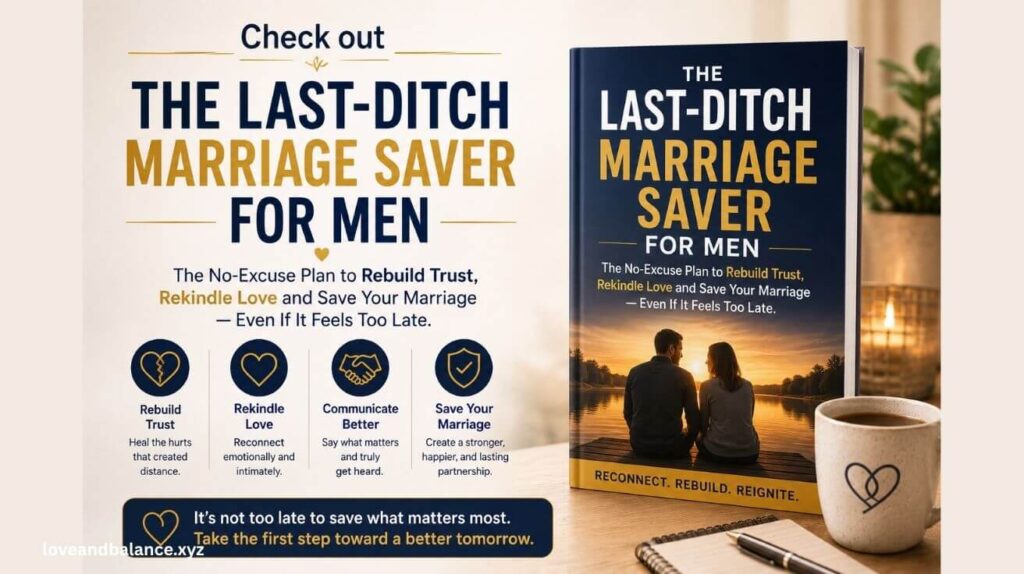
Some people land on articles like this at 2 a.m. because their marriage feels like it’s slipping and reading is easier than saying it out loud. If you’re a husband in that spot and want a structured guide you can work through privately, one option is The Last-Ditch Marriage Saver for Men, a downloadable guide covering communication, conflict, trust and reconnection. No guide can promise to save a marriage, and we can’t promise this one will fit yours. It isn’t therapy, and it isn’t right for situations involving abuse. The seller’s page currently lists a 60-day refund policy, but check the price and terms yourself before you buy. If you’re a wife or in a different kind of relationship, the habits above and a licensed couple’s therapist are a better starting point.
Take a look at the guide and its current terms: See The Last-Ditch Marriage Saver for Men (affiliate link)
Final thoughts
Emotional health in a relationship isn’t a badge you earn once. It’s closer to fitness. Ignore it, and it fades. Rebuild it with small, boring, repeatable reps: name what you feel, answer the little bids, cool off when you’re flooded, come back, apologise well, stay yourself, say thank you, and zoom out when you’re stuck. You don’t have to nail all nine this month. Pick the one that made you wince a little while reading and start there.
Emotionally Healthy in a Relationship: 9 Proven Signs
Frequently asked questions (FAQs)
What does it mean to be emotionally healthy in a relationship?
It means you can recognise and manage your own emotions, communicate needs honestly, respond to your partner’s feelings with care, keep a separate sense of self, and repair after conflict. It doesn’t mean you never argue or never feel hurt, jealous or angry.
What are the signs of an emotionally unhealthy relationship?
Common signs include constant criticism or contempt, the silent treatment, scorekeeping, fear of your partner’s reaction, controlling behaviour, and having your version of events routinely denied. One rough week isn’t a diagnosis, but a steady pattern deserves attention. If you feel unsafe, put your safety first and contact a support service.
Is it normal to argue in an emotionally healthy relationship?
Yes. What differs is how healthy couples argue: gentler starts, repair attempts, breaks when someone is overwhelmed, and enough warmth to outweigh the negativity. Gottman’s research points to roughly five positive interactions for every negative one during conflict.
Can I become more emotionally healthy if my partner won’t change?
You can change your half of the pattern: how you handle your feelings, ask for what you need and set boundaries. Because couples work as a system, that often shifts things. But you can’t do the whole job for two people, and if the relationship is unsafe, your well-being comes first. A therapist can help you tell the difference.
How long does it take to build emotional health in a relationship?
There’s no fixed timeline. Habits like a time-out signal or a weekly check-in can help within weeks, while deeper patterns such as defensiveness or avoidance usually take months of practice. In Finkel’s study, the protective effect showed up across a year of occasional practice, so think steady, not overnight.
When should we see a couple’s therapist?
Consider it when the same fight keeps looping, when contempt or shutdown has become the default, after a breach of trust such as an affair, or when one of you has stopped trying. You don’t need to be at the brink. Earlier is usually easier. If there’s abuse, seek individual support first.
Keep reading: more on healthy love
If this article got you thinking about your own relationship, these three posts are a good next step. Start with 9 signs you’re in the right relationship for the bigger picture. If anything in the red flags section felt uncomfortably familiar, read our breakdown of 15 gaslighting examples in everyday relationships. Then finish with 11 research-backed ways to maintain your identity in a relationship. Pick one and read it tonight, and share whichever helps most with someone you trust.
About the author
Written by the editorial team at Love & Balance. Our articles are researched against primary sources, peer-reviewed journals, diagnostic manuals and clinical bodies, and every claim here links to the study it came from. We are not licensed clinicians, and where clinical judgement is needed, we point readers toward it.
How this article was researched
We checked the claims above against the original publications or the organisations behind them, including the Harvard Gazette, the Gottman Institute, peer-reviewed studies in Psychological Science, Personality and Individual Differences and the Journal of Social and Personal Relationships, and the U.S. Surgeon General’s 2023 advisory. Sources are linked in the text. Last reviewed September 21, 2026.
DISCLAIMER
Educational use only. This article is for general information and isn’t medical, psychological, legal or professional relationship advice, and it doesn’t create a therapist-client relationship. Research findings describe patterns across groups of people, not guarantees for any one couple. If you’re struggling, consider talking with a licensed mental health professional. If you’re in an abusive or unsafe situation, contact your local emergency services or a helpline in your country.
Affiliate disclosure. This post contains an affiliate link to a third-party product. If you purchase through that link, we may earn a commission at no additional cost to you. We don’t own or sell the product. Its price, contents and refund terms are set by the seller and may change, so please review them on the seller’s page before buying. Results vary, and no outcome is guaranteed.