
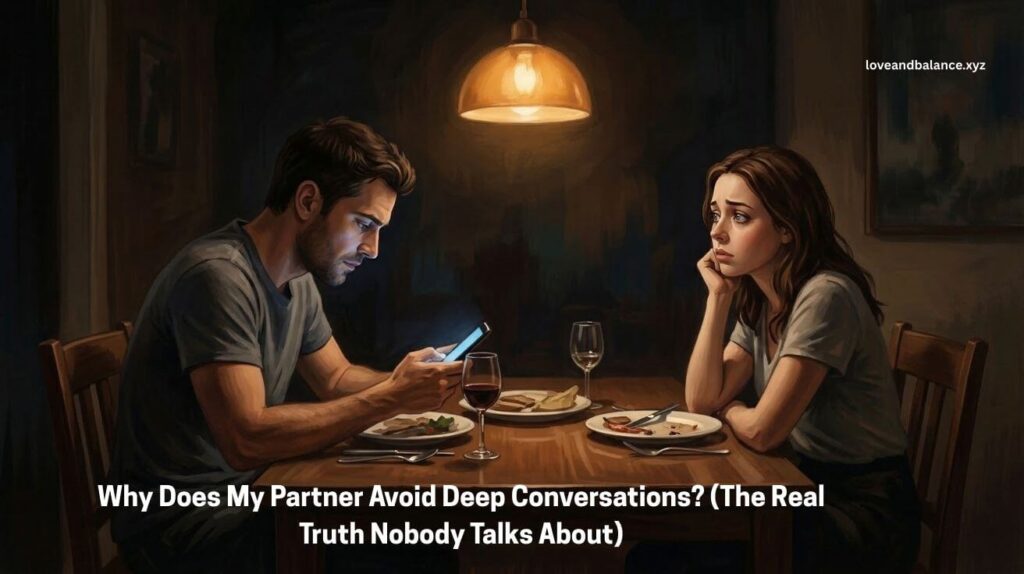
Why Does My Partner Avoid Deep Conversations? (The Real Truth Nobody Talks About)
By the Love and Balance Team | Relationship Psychology & Emotional Wellness
There’s a particular kind of loneliness that doesn’t come from being alone. It comes from sitting across from the person you love — maybe after dinner, maybe late at night — and realising that no matter how hard you try, you can’t seem to reach them. You ask something real. Something meaningful. And they look at their phone, change the subject, or give you a one-word answer that closes the door before you even get inside.
If you’ve ever sat with that hollow feeling and wondered, “Why does my partner avoid deep conversations?” — this blog is for you.
This isn’t about whether your partner loves you. In most cases, they do. But something is getting in the way. And until we understand what that something is, the distance between you two will keep growing — quietly, painfully, one avoided conversation at a time.
It’s More Common Than You Think
Let’s start with the data, because knowing you’re not alone matters.
A 2023 survey found that almost 48% of couples actively avoid difficult conversations with their partner, citing fear of a negative reaction and a desire to keep the peace. That’s nearly half of all couples — people who care about each other, choosing silence over depth because vulnerability feels too risky.
And here’s the irony: research published in the Journal of Personality and Social Psychology (Kardas et al., 2021) found that people consistently overestimate how awkward deep conversations will be. When participants actually had those meaningful exchanges, they felt far more connected and less uncomfortable than they predicted. In other words, your partner may be avoiding something that — if they just tried it — would actually bring them closer to you.
But knowing that doesn’t make it easier when you’re the one being shut out.
What “Avoiding Deep Conversations” Actually Looks Like
Before we explore why, let’s make sure we’re talking about the same thing. Avoidance of deep conversations doesn’t always look like someone storming off or refusing to talk. It’s often far subtler:
They redirect emotional questions into logistical ones (“We should just focus on fixing the problem”)
They respond to vulnerability with humour or sarcasm
They give surface-level answers and don’t ask follow-up questions
They go quiet when you bring up feelings, the future, or anything uncomfortable
They physically leave the room — bathroom, kitchen, phone — right when the conversation gets meaningful
They agree with everything just to end the discussion faster
Sound familiar? That pattern has a name, and understanding it can change everything.
The Root Cause: Attachment Theory Explains a Lot
In the 1960s and 70s, British psychologist John Bowlby developed attachment theory — the idea that the emotional bonds we form with our earliest caregivers become the template for how we connect (or disconnect) with others throughout our lives. His work, later expanded by Mary Ainsworth, gave us the attachment styles we still use today.
One style, avoidant attachment, is at the heart of why so many partners shut down emotionally.
People with avoidant attachment learned early on — often in childhood — that showing emotion didn’t get them comfort. Maybe their parents were emotionally distant, dismissive, or simply didn’t have the tools to respond to a child’s emotional needs. Over time, the child’s nervous system adapted: Don’t ask for closeness. Don’t show vulnerability. Manage everything alone.
That child grew up. And now they’re your partner.
As the team at The Secure Relationship explains, avoidant partners often retreat into silence, turn to logic too quickly, or get defensive — not because they don’t care, but because they are rejecting the shame and fear that show up when they feel overwhelmed, not their partner.
This is critical. When your partner goes cold during a deep conversation, they are not rejecting you. They are managing an internal storm you may not even be able to see.
The Science of Emotional Shutdown
A 2024 study published in Personality and Social Psychology Bulletin (Gauvin et al.) revealed something striking: individuals high in attachment avoidance were less accurate at reading their partner’s positive emotions during conversations about love and closeness.
Let that sink in. When you’re opening up to your partner — being warm, vulnerable, emotionally available — an avoidant partner may literally not be registering those signals correctly. Their nervous system is tuned to detect threat, not warmth. It’s not emotional coldness; it’s emotional mismapping, developed over years before they even met you.
The same study found that avoidant individuals “deactivate their attachment systems” under emotional pressure — essentially turning down the volume on feelings to avoid what they’ve learned is dangerous territory.
Therapy provider Rick Cox, an MBACP-accredited psychotherapist, describes this beautifully: “Love, grief, anger, or vulnerability can trigger anxiety, and the nervous system learns ways to reduce contact with those experiences”. It becomes automatic. Involuntary. And completely invisible to the person doing it.
It’s Not Always Attachment: Other Real Reasons Your Partner Shuts Down
Avoidant attachment is the most common root cause, but it’s not the only one. Here are other very real reasons your partner might be pulling back from meaningful conversations:
Fear of Your Reaction
Research consistently shows that people avoid deep conversations because they don’t know how the other person will respond. If past conversations got heated, if you’ve cried or withdrawn in frustration, or if your partner feels like they always say “the wrong thing,” — they may be avoiding depth to protect both of you from conflict.
Emotional Overwhelm (Flooding)
Relationship researcher Dr. John Gottman identified a state called “flooding”, — where the body’s stress response during conflict or emotional conversations becomes so intense that rational thinking shuts down. Heart rate spikes, the mind goes blank, and the only option feels like escape. Men experience flooding more quickly and intensely on average, which partly explains the gendered patterns many couples notice.
Past Trauma
Sometimes the silence has nothing to do with you or even the relationship. A partner who experienced emotional abuse, neglect, or trauma may have learned that expressing themselves led to punishment, manipulation, or ridicule. Deep conversations feel like landmines because in their past, they were.
Cultural and Social Conditioning
In many cultures — including large parts of South Asia, East Asia, and traditionally masculine environments globally — expressing emotional vulnerability is taught as weakness. Men, especially, may have been raised in households where “being strong” meant not showing feelings. This isn’t an excuse, but it is a context worth understanding.
They Genuinely Don’t Know How
This one surprises people. Some partners aren’t avoiding deep conversations out of fear or self-protection. They simply were never taught the emotional vocabulary to have them. If nobody modelled open, authentic conversation in their home growing up, they may literally not know what it looks or sounds like.
A Real Story: Priya and Arjun
Names changed for privacy.
Priya, 31, reached out to us after nearly two years of feeling emotionally alone in her marriage. “Arjun is wonderful,” she wrote. “He’s kind, he works hard, he’s a good father. But when I try to talk about us — really talk about how I’m feeling, what I need, where we’re going — he just… disappears. He’ll say ‘everything’s fine’ and go back to scrolling. And I sit there feeling crazy.”
What Priya described is textbook avoidant shutdown. Arjun, as she later discovered through couples counselling, had grown up with a father who responded to emotional expression with anger or silence. He’d learned that feelings were burdens — things you handled quietly, not things you shared. He loved Priya deeply. But intimacy, for him, had always felt like the edge of a cliff.
After six months of therapy, things began to shift. Not dramatically, not overnight — but Arjun started using small phrases: “I need a few minutes to think about this.” “I’m not sure how I feel yet, but I want to try.” Those four words — I want to try — changed everything for Priya.
This is the story beneath most of these relationships. Not a partner who doesn’t love you. A partner who doesn’t yet know how to let you in.
What Happens If Nothing Changes?
It’s important to name this honestly: avoiding deep conversations is not a neutral act. According to relationship counselling specialists, consistent conversational avoidance erodes the foundation of the relationship and has a significant impact on trust and intimacy over time.
Think of it like this. Every time your partner deflects a meaningful moment, a tiny thread connecting you both goes unstitched. One thread? Barely noticeable. A hundred threads? The whole fabric starts to unravel.
Couples who avoid emotional depth tend to:
Grow into polite roommates rather than intimate partners
Lose the ability to navigate conflict, because they’ve never built the muscle
Develop parallel lives rather than a shared one
Find that small resentments calcify into permanent distance
And the partner reaching for connection — usually the one reading this blog right now — slowly stops trying. Not out of anger, but out of exhaustion.
How to Actually Break Through: Approaches That Work
Here’s what the research and lived experience suggest:
1. Lower the Stakes of the Conversation
Avoidant partners shut down partly because deep conversations feel HIGH stakes — big, heavy, serious. One of the most effective strategies is to create a low-pressure emotional connection. Side-by-side activities (driving, cooking, walking) produce more openness than face-to-face “serious talks.” There’s less eye contact, less performance pressure, and the conversation can breathe.
2. Use “I” Statements, Not “You” Statements
“You never open up” activates defensiveness. “I feel really disconnected when we don’t talk about real things” opens a door. The difference is not just semantic — it’s neurological. “You” statements register as attacks; “I” statements invite rather than accuse.
3. Time It Right
Gottman’s research suggests trying to initiate emotional conversations after physiological calm — not when either person is hungry, tired, already stressed, or right after an argument. Sunday morning over coffee tends to work better than 11 pm after a long week.
4. Don’t Demand Depth Immediately
Ask lighter questions that point toward depth, rather than plunging straight into the deep end. Instead of “Tell me what you’re really feeling about our relationship,” try “What’s been on your mind lately?” or “Is there anything that’s been bothering you this week?” Small doors lead to bigger rooms.
5. Acknowledge and Appreciate When They Do Open Up
When your avoidant partner takes a risk and shares something real — even something small — make them
Why Does My Partner Avoid Deep Conversations? (The Real Truth Nobody Talks About)
Frequently Asked Questions (FAQs)
❓ Why does my partner shut down when I try to have a deep conversation?
Your partner likely shuts down due to one or more of these reasons: avoidant attachment developed in childhood, fear of emotional flooding (where the nervous system becomes overwhelmed), past trauma, or simply never having been taught how to express emotions. It is rarely about not loving you — it’s almost always about self-protection learned long before you came into the picture.
❓ Is avoiding deep conversations a sign my partner doesn’t love me?
Not necessarily. Emotional avoidance and love are two completely separate things. Many deeply loving partners struggle with vulnerability because of how they were raised or what they experienced in past relationships. However, if your partner consistently refuses to engage and shows no willingness to try, that’s worth addressing — either in couples therapy or through an honest, calm conversation about what you need.
❓ Can an emotionally avoidant partner change?
Yes — but change requires awareness and willingness. Research and clinical experience both show that avoidant partners can and do develop deeper emotional communication skills, especially with the support of therapy (individual or couples), consistent, safe experiences with their partner, and time. Change is rarely fast or linear, but it is absolutely possible.
❓ What attachment style avoids deep conversations the most?
Dismissive-avoidant attachment is most strongly associated with avoiding emotional depth. People with this style learned to suppress attachment needs and tend to value independence over closeness. They may feel genuinely uncomfortable with intimacy — not as a choice, but as an automatic nervous system response.
❓ How do I get my partner to open up without pushing them away?
Start with low-stakes, low-pressure moments (walks, car rides, casual meals)
Ask open-ended questions rather than launching into “we need to talk” conversations
Use “I feel” language instead of “you never” or “you always”
Give them time to process — some people need hours, not minutes, to formulate an emotional response
Appreciate and affirm every small moment they do open up, no matter how minor it seems
❓ Is emotional avoidance in relationships a form of emotional neglect?
It can be, depending on the pattern and degree. When one partner consistently refuses emotional engagement — leaving the other feeling unseen, unheard, and alone inside the relationship — that can absolutely constitute emotional neglect. The key distinction is intent versus impact: even if your partner doesn’t mean to neglect you, the effect on your emotional well-being is real and valid.
❓ Should I see a therapist if my partner won’t open up?
Yes — individual therapy can be enormously helpful even if your partner won’t go. A therapist can help you understand your own attachment patterns, communicate more effectively, set healthy boundaries, and decide what you can and cannot tolerate long-term. Couples therapy is ideal when both partners are open to it, but personal healing doesn’t have to wait for your partner’s readiness.
❓ What’s the difference between an introvert who needs quiet and an emotionally avoidant partner?
Great question. Introversion is about energy — introverts recharge through solitude and may need more quiet time, but they are still capable of emotional depth and vulnerability when they feel safe. Emotional avoidance is specifically about deflecting or suppressing emotional intimacy, not about energy levels. An introvert might say, “I need an hour to decompress, and then I really want to talk about this.” An emotionally avoidant partner often changes the subject, minimises feelings, or never returns to the conversation at all.
At Love and Balance, we believe every relationship deserves depth, honesty, and real connection. If this resonated with you, explore our other articles on anxious-avoidant dynamics, emotional intimacy, and healing in relationships.