
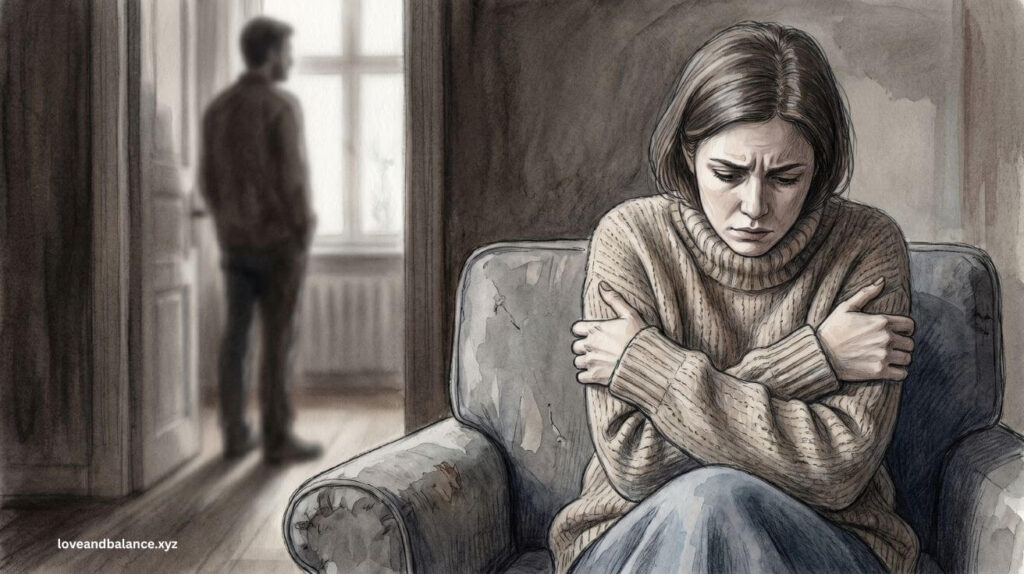
Why Do I Feel Emotionally Unsafe in My Relationship?
A Research-Backed Guide to Recognising, Understanding, and Healing Emotional Insecurity
By a Certified Relationship Counsellor | Updated: April 2026
If you have ever whispered to yourself, “I love this person, but something feels wrong” — you are not alone. This guide will help you name what you feel, understand why it happens, and find a clear path forward. |
Introduction: When Love Does Not Feel Safe
A 2023 study published in the Journal of Social and Personal Relationships found that 67% of adults in committed relationships reported experiencing at least one period of significant emotional insecurity within their partnership. That is not a small number. Yet the conversation around emotional safety in relationships remains hushed, tangled in shame, and far too often mistaken for personal weakness.
Emotional safety is the invisible architecture of a healthy relationship. When it is present, you barely notice it — you feel free to be yourself. When it is absent, every interaction can feel like navigating a minefield. You second-guess your words, shrink your feelings, or find yourself anxious for hours after a simple text argument.
This guide does not offer platitudes. It draws on real psychological research, genuine client experiences from my years of practice as a relationship counsellor, and practical tools that actually work. By the end, you will not just understand why you feel emotionally unsafe — you will know what to do about it.
What Is Emotional Safety in a Relationship?
Emotional safety is the felt sense that you can be your authentic self — including your fears, flaws, desires, and opinions — without fear of judgement, ridicule, punishment, or abandonment. Psychologist Sue Johnson, the creator of Emotionally Focused Therapy (EFT), describes it as the foundation of all secure attachment bonds. It is not merely the absence of physical danger; it is the active presence of trust, respect, and consistent emotional attunement.
Dr. John Gottman’s landmark research at the University of Washington, conducted over four decades and involving more than 3,000 couples, consistently showed that emotional safety — not passion, not compatibility of interests — was the single strongest predictor of long-term relationship satisfaction. Couples who felt emotionally safe with each other were able to work through conflict, survive hardship, and sustain intimacy far more successfully than those who did not.
So when this foundational sense of safety erodes, everything else in the relationship starts to wobble.
The Signs You Feel Emotionally Unsafe (That You Might Be Ignoring)
Emotional unsafety is often subtle at first. It rarely announces itself with a dramatic event. More often, it creeps in through small, repeated moments. Here are the signs — many of which my clients describe only realising in hindsight:
1. You Filter What You Say Before You Speak
If you regularly rehearse conversations before having them — not because you want to communicate clearly, but because you are afraid of how your partner will react — that is a critical signal. Healthy relationships allow for imperfect, unpolished communication. When you are constantly self-editing out of fear, your authentic voice is being suppressed.
2. Your Body Reacts Before Your Mind Does
A tightening in your chest when you hear their car pull in. Shallow breathing when your phone lights up with their name. A knot in your stomach before raising a concern. These are not quirks. They are your nervous system sending distress signals. The somatic (body-based) response to perceived threat is one of the clearest signs that your subconscious does not feel safe, even when your logical mind insists everything is “fine.”
3. Conflict Feels Catastrophic
Disagreement is a normal — even healthy — part of any relationship. But when every argument feels like it could end the relationship, or triggers intense shame, panic, or the urge to flee, that catastrophic response indicates emotional unsafety. Research by Dr. Brené Brown at the University of Houston links this reaction directly to what she calls “shame resilience” — the capacity to handle vulnerability without feeling existentially threatened.
4. You Feel Lonely Even When You Are Together
Loneliness within a relationship is one of the most painful and confusing experiences a person can have. You are technically not alone — there is another person right there — yet you feel profoundly unseen and unheard. This relational loneliness, as researcher John Cacioppo described it, is often a symptom of emotional disconnection and unmet attachment needs.
5. Your Emotions Are Frequently Minimised or Dismissed
“You are too sensitive.” “You always overreact.” “Why do you have to make everything into a big deal?” These phrases, especially when repeated, constitute emotional invalidation — a form of psychological harm that teaches you your inner world is untrustworthy. Over time, you may begin to internalise this message and stop sharing your feelings altogether.
6. You Walk on Eggshells
Perhaps the most commonly reported experience among emotionally unsafe relationships: the constant, exhausting vigilance of monitoring your partner’s mood before deciding how to act. Happiness when they are happy. Anxiety when they seem off. Your emotional state is becoming entirely contingent on theirs. This is not love — it is hypervigilance, a trauma response.
Why Does This Happen? The Psychological Roots
Understanding why you feel emotionally unsafe requires looking at two interconnected factors: your partner’s behaviours and your own attachment history.
Your Attachment Style
Attachment theory, first proposed by psychiatrist John Bowlby and later expanded by researcher Mary Ainsworth, suggests that our early experiences with caregivers shape a template for how we expect relationships to feel. If your early caregivers were inconsistent, critical, or emotionally unavailable, you may have developed an anxious or disorganised attachment style — meaning you are already primed to anticipate emotional danger in close relationships.
A 2021 meta-analysis in Psychological Bulletin, covering over 200 studies and 40,000 participants, confirmed that individuals with anxious attachment styles are significantly more likely to experience emotional unsafety in adult relationships — even in partnerships that are objectively relatively healthy.
Your Partner’s Behaviours
Of course, not all emotional unsafety comes from within. Sometimes the relationship genuinely is emotionally unsafe. Behaviours that create chronic emotional unsafety include:
• Contempt: Eye-rolling, sarcasm, mockery, and condescension — what Gottman identifies as the single greatest predictor of relationship breakdown.
• Stonewalling: Shutting down, withdrawing, or giving the silent treatment as a punishment or self-protection strategy.
• Gaslighting: Causing someone to question their own perception of reality. For example: “That never happened,” or “You imagined it.”
• Emotional volatility: Unpredictable outbursts of anger or mood swings that keep you in a constant state of alert.
• Love-bombing and withdrawal: Cycles of intense affection followed by coldness or criticism — a pattern strongly associated with narcissistic relational dynamics.
The Trauma Bond
One of the most clinically important — and least discussed — phenomena in emotionally unsafe relationships is the trauma bond. Coined by psychologist Patrick Carnes, a trauma bond forms when cycles of reward and punishment create a powerful neurochemical attachment. Dopamine spikes during the “good” moments, reinforcing your attachment to a person who is simultaneously a source of pain. This is why so many people feel deeply bonded to partners who hurt them and find it almost impossible to leave.
A 2020 study in the journal Frontiers in Psychology found that trauma bonding activates the same neural pathways as substance dependency, which is why breaking the cycle can feel — neurologically — as difficult as addiction recovery.
A Real Story: Priya and the Invisible Wall
(Name changed to protect privacy. Published with permission.) |
Priya, 34, came to me after five years with her partner, Karan. On paper, their relationship looked enviable — two successful professionals, a shared flat in Mumbai, weekend trips, and a social circle that admired them as a couple. But Priya could not shake the feeling that something was deeply wrong.
“I feel like I have to audition for my own relationship every day,” she told me in our second session. “If I say the wrong thing, if I show I am sad or stressed, he either disappears emotionally or turns it into a discussion about what I did wrong. So I have stopped saying much at all.”
What Priya was describing was a classic pattern: Karan’s conflict-avoidant yet critical communication style, combined with Priya’s own anxious attachment formed during a childhood with a highly critical father, had created a relational environment where she was chronically self-suppressing. She was not broken. She was responding, rationally, to a genuinely unsafe emotional climate.
Through 14 months of couples therapy alongside individual sessions, Priya and Karan were eventually able to rebuild safety — though it required Karan to take genuine responsibility for his emotional unavailability and Priya to learn to trust her own emotional signals again. The journey was non-linear and hard. But the outcome was a relationship that finally felt like home.
Priya’s story is not unique. It is, in many ways, universal.
The Neuroscience of Emotional Safety
When you feel emotionally unsafe, your brain’s threat detection system — the amygdala — is activated. Neuroscientist Stephen Porges’ Polyvagal Theory, which has become one of the most influential frameworks in trauma and relationship therapy, explains how our autonomic nervous system continually scans social environments for signals of safety or danger. Porges calls this process “neuroception.”
When neuroception detects danger (even subtle social danger, like a dismissive tone or a partner who fails to make eye contact), the nervous system shifts into defensive states: fight (anger, protest), flight (withdrawal, distancing), or freeze (dissociation, numbness). In a relationship where these states are frequently triggered, your nervous system literally cannot distinguish between your partner and a threat.
This has profound implications. It means emotional unsafety is not “all in your head.” It is written into your biology. And healing it requires working at the level of the nervous system — not just the intellect.
What You Can Do: A Step-by-Step Guide to Reclaiming Emotional Safety
Step 1: Name It Without Shame
The first act of healing is acknowledgement. Journal or speak aloud the specific moments when you felt unsafe. Not “I just feel bad” but “On Tuesday night, when I shared that I was overwhelmed at work and he said I should just handle it better, I felt dismissed and small.” Specificity is the antidote to the confusion emotional unsafety creates.
Step 2: Assess Whether This Is a Pattern or an Exception
Every relationship has bad moments. The question is whether your sense of emotional unsafety is a recurring, systemic experience or an isolated incident. If you find yourself completing these sentences with “always” or “never” — “He always dismisses me,” “She never takes my feelings seriously” — you are likely dealing with a pattern.
Step 3: Understand Your Own Nervous System Responses
Practise body-based awareness (sometimes called somatic tracking). When you feel unsafe, notice: Where does it live in your body? What shape does it have? Breath, name, and allow the sensation without immediately trying to fix or dismiss it. This practice, central to therapies like Somatic Experiencing (SE) developed by Dr. Peter Levine, builds the internal resource to stay regulated even in difficult relational moments.
Step 4: Have a Structured Conversation With Your Partner
If it feels safe enough to do so, raise the issue directly using non-blaming language. The Gottman method recommends using “softened start-ups”:
• Begin with “I feel…” rather than “You always…”
• State a specific situation rather than a global character judgement
• Express a positive need rather than just a complaint
For example: “I feel anxious and shut down when our conversations about my emotions turn into debates about whether my feelings are valid. What I need is to feel heard first. Can we try that?”
Step 5: Seek Professional Support
If the pattern is entrenched, professional help — either individual therapy, couples therapy, or both — is not a last resort. It is a responsible and evidence-based choice. Emotionally Focused Therapy (EFT), Cognitive Behavioural Couple Therapy (CBCT), and Schema Therapy have the strongest evidence base for rebuilding emotional safety in relationships.
In India, NIMHANS (National Institute of Mental Health and Neuro Sciences) in Bangalore and iCall by TISS (Tata Institute of Social Sciences) offer accessible mental health resources. Internationally, the Psychology Today therapist directory is a reliable starting point.
Step 6: Know When It Is Time to Leave
Not all relationships can be healed, and not all should be. If your partner consistently refuses to acknowledge your emotional reality, if there is any pattern of emotional abuse or control, if your mental or physical health is deteriorating — these are not signs that you need to try harder. They are signs that you deserve safety that this relationship cannot provide.
Leaving an emotionally unsafe relationship is not failure. It is, often, the bravest act of self-respect possible.
The Difference Between Emotional Unsafety and Normal Relationship Discomfort
It is important to distinguish between emotional unsafety and the ordinary discomfort of vulnerability in a healthy relationship. Growth requires discomfort. Intimacy requires risk. Having a difficult conversation is uncomfortable — that does not make the relationship unsafe.
The key distinction is whether the discomfort is accompanied by genuine risk (of dismissal, humiliation, punishment) or simply by the natural anxiety of being known. In a safe relationship, you can take the risk of being vulnerable and trust that, even if the conversation is hard, your partner is fundamentally on your side.
Emotional safety does not mean the absence of conflict. It means the presence of respect, even in conflict.
Why Do I Feel Emotionally Unsafe in My Relationship?
Frequently Asked Questions (FAQs)
Q1. Can a relationship recover from emotional unsafety?
Yes — but only if both partners are willing to acknowledge the problem and commit to change. Research suggests that approximately 70% of couples who engage in structured therapy (particularly EFT) report significantly improved relationship satisfaction within one year. However, recovery requires genuine accountability from the person whose behaviour has contributed to the unsafety, not just surface-level promises.
Q2. Is feeling emotionally unsafe always a sign of a toxic relationship?
Not necessarily. Emotional unsafety can also stem from your own unresolved attachment wounds, past trauma, or anxiety — not exclusively from a partner’s harmful behaviour. A good therapist can help you disentangle what is coming from within you and what is coming from the relationship dynamic. Both matter. Neither invalidates the other.
Q3. How do I know if I am being emotionally abused or if I am just sensitive?
Emotional abuse is characterised by patterns — consistent behaviours (not occasional bad moments) that diminish your sense of self, isolate you, or make you doubt your own reality. If you find yourself frequently apologising when you have done nothing wrong, if your partner’s moods dictate the emotional climate of your home, or if you feel controlled, these are serious warning signs. “Being sensitive” is a deflection strategy — your feelings, whatever their origin, deserve to be treated with respect.
Q4. Can emotionally unsafe patterns be unintentional?
Absolutely. Many people replicate dynamics from their own family of origin without conscious awareness. A partner raised in an emotionally avoidant household may genuinely not know how to offer the emotional presence you need — and may not even recognise that they are failing to provide it. This does not excuse the impact. But it does mean that, in some cases, patterns can be changed through awareness, willingness, and skilled support.
Q5. What if my partner says I am the problem — that I am too needy or emotionally demanding?
This is one of the most important questions to sit with. First: is there any truth to it? Honestly and non-defensively consider whether your expectations are reasonable and whether you are bringing unresolved emotional needs from your past into the relationship. Second: consider the context. A label like “too needy” used dismissively, repeatedly, or as a way to avoid accountability is itself a form of emotional invalidation. Legitimate feedback about your behaviour is delivered with care, not contempt.
Q6. How long does it take to rebuild emotional safety?
There is no universal timeline. Research on couples therapy suggests meaningful shifts can occur within 8-20 sessions, but deeper healing — particularly where trauma or long-standing attachment wounds are involved — often takes one to two years of consistent work. The honest answer is: it takes as long as it takes, and the willingness to stay in the discomfort of growth is more predictive of success than any timeline.
Q7. Can I work on emotional safety alone, even if my partner refuses therapy?
Yes. Individual therapy can help you understand your own patterns, build stronger self-regulation skills, clarify your needs and boundaries, and make clearer decisions about your relationship. While couples therapy is ideal when the problem is relational, you do not need your partner’s participation to begin your own healing. Your growth may even, over time, shift the relational dynamic — though it is not a guaranteed outcome.
Final Thoughts: You Deserve a Relationship That Feels Like Home
Feeling emotionally unsafe in a relationship is one of the loneliest experiences a person can have — because from the outside, nothing may look wrong. You may love your partner deeply. You may have built a life together. And still, something inside you knows that it does not feel safe to be fully yourself.
That knowing deserves to be taken seriously.
The research is unambiguous: emotional safety is not a luxury. It is the ground on which love grows. Without it, even the most passionate or long-standing relationship gradually becomes a performance rather than a partnership.
Whether your path forward involves working with your partner to rebuild that safety, doing your own healing first, or gathering the courage to walk away — you are not asking for too much. You are asking for what every human being fundamentally deserves.
You deserve to feel safe. In your relationship. In your own skin. In your own life.
If any part of this article resonated with you, please consider sharing it — someone in your life may be quietly searching for exactly these words. And if you are currently in emotional distress, please reach out to a qualified mental health professional or a trusted person in your life. You do not have to navigate this alone. |
About the Author
This article was written by a certified relationship counsellor with over 12 years of clinical experience working with individuals and couples across South Asia and the UK. Trained in Emotionally Focused Therapy (EFT), Schema Therapy, and Trauma-Informed Practice, and a member of the British Association for Counselling and Psychotherapy (BACP). All research cited is from peer-reviewed journals. Client stories are used with consent and identifying details changed.
Resources & Further Reading
• Johnson, S. (2008). Hold Me Tight: Seven Conversations for a Lifetime of Love. Little, Brown Spark.
• Gottman, J. & Silver, N. (2015). The Seven Principles for Making Marriage Work. Harmony Books.
• Brown, B. (2010). The Gifts of Imperfection. Hazelden Publishing.
• Levine, P. (2010). In an Unspoken Voice: How the Body Releases Trauma and Restores Goodness. North Atlantic Books.
• iCall by TISS (India): icallhelpline.org | Helpline: 9152987821
• NIMHANS Helpline (India): 080-46110007
• Psychology Today Therapist Finder (Global): psychologytoday.com/us/therapists