
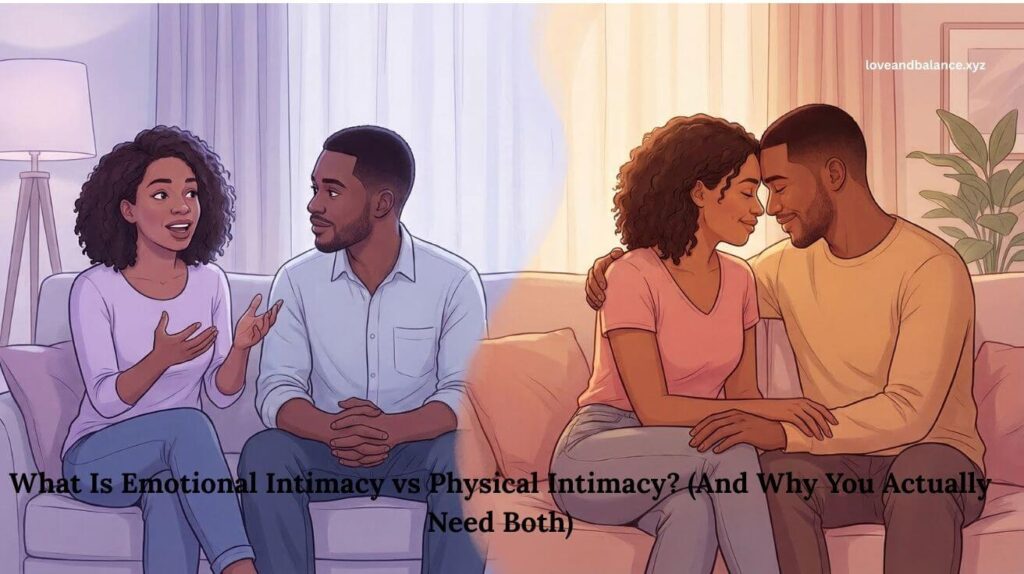
What Is Emotional Intimacy vs Physical Intimacy (And Why You Actually Need Both)
By the Love and Balance Team | Relationship Psychology | 18 March 2026
Let me ask you something personal.
Have you ever been in a relationship where everything looked right on the outside — the affection, the touch, the physical connection — but deep down, you felt completely alone?
Or maybe the opposite: you’ve had long, late-night conversations with someone, felt emotionally seen and understood, but the physical spark just wasn’t there?
Both of those experiences point to the same truth: emotional intimacy and physical intimacy are not the same thing. And confusing one for the other — or neglecting either — is one of the most common reasons relationships quietly fall apart.
In this guide, I’m going to break down exactly what each type of intimacy means, what the research says about them, how they interact, and what happens when they fall out of balance. Whether you’re in a long-term relationship, newly dating, or healing from a breakup, understanding this difference could genuinely change how you love.
What Is Emotional Intimacy, Really?
Emotional intimacy is the feeling of being truly known by another person — not just liked, not just desired, but seen.
It’s what happens when you tell your partner about your worst fear, and they don’t laugh. It’s the comfort of silence that doesn’t feel awkward. It’s the ability to say “I’m not okay” without providing a reason.
Psychologist Dr. Dan McAdams, who spent decades studying the psychology of closeness, described emotional intimacy as the experience of sharing one’s “inner life” with another — including thoughts, memories, fears, and dreams — and feeling genuinely accepted in return.
Emotional intimacy doesn’t happen overnight. It builds through:
Consistent vulnerability — sharing things that feel risky to share
Active, non-judgmental listening — not just waiting for your turn to speak
Emotional validation — acknowledging your partner’s feelings without immediately trying to fix them
Presence over performance — showing up authentically, not just putting your best foot forward
Here’s something real: I’ve heard from dozens of readers over the years who describe relationships that lasted 5, 7, even 10 years — with all the physical passion in the world — that ended because they never really talked. They never built that invisible scaffolding of trust and emotional depth that sustains a relationship long after the initial rush fades.
What Is Physical Intimacy?
Physical intimacy is any form of touch or closeness that communicates care, desire, or connection through the body. It includes sexual intimacy, yes — but it also includes holding hands, a long hug after a difficult day, a forehead kiss, sitting close together on the couch, a reassuring squeeze on the shoulder.
Touch is one of our most ancient forms of communication. Long before we had words, we used physical closeness to signal safety, trust, and belonging.
The science here is fascinating. Research published by the Oregon Health & Science University (OHSU) confirms that a healthy physical relationship is linked to lower blood pressure, better immune function, reduced anxiety and depression, and improved sleep quality. When two people are physically intimate, the body releases oxytocin — often called the “bonding hormone” — which reduces cortisol (the stress hormone) and creates feelings of warmth and trust.
Physical intimacy says, “I want to be close to you in this moment.”
But here’s the critical distinction: physical intimacy without emotional intimacy can leave both partners feeling empty. This is what people describe when they say sex felt hollow, or that they felt lonelier after being with someone than before. The body was present, but the soul wasn’t in the room.
The Science That Explains Everything
A landmark study published in PMC (PubMed Central) in 2018 found that emotional intimacy plays a particularly powerful role in maintaining sexual desire in long-term relationships. In other words, couples who feel most emotionally connected also maintain the healthiest physical relationships over time.
This wasn’t just correlation. Follow-up research cited by Healthline (2025) confirmed that higher levels of emotional intimacy were directly linked to higher levels of sexual desire among adult couples — and that the reverse was also true: physical closeness, especially orgasm, can actually increase feelings of emotional intimacy.
It works as a cycle:
Emotional safety → Physical desire → Physical connection → Oxytocin release → Greater emotional trust → More emotional openness → Deeper emotional safety
Break any link in that chain, and the whole cycle suffers.
A 2025 study published in PsychNexus involving 400 married individuals found that emotional intimacy was one of the strongest predictors of marital satisfaction, accounting for 44% of the variance in how happy couples reported feeling in their marriages. That’s a staggering number. Nearly half of what makes a marriage feel satisfying comes down to emotional closeness — not finances, not compatibility on paper, not even physical attraction alone.
Emotional vs Physical Intimacy: Key Differences
Emotional Intimacy | Physical Intimacy | |
Foundation | Vulnerability, trust, shared inner world | Touch, physical closeness, body language |
Primary need met | Feeling seen, understood, and accepted | Feeling desired, safe, and physically close |
How it grows | Through consistent conversation and openness | Through touch, affection, and physical presence |
When it’s missing | Loneliness even within a relationship | Emotional distance, feeling undesired |
What it signals | “I know and accept who you are” | “I want to be close to you” |
Threatens by | Emotional neglect, stonewalling, dismissiveness | Physical rejection, touch deprivation, avoidance |
Real Stories: When One Exists Without the Other
Story 1: “We Had Great Sex, but I Felt Invisible”
A reader of Love and Balance — let’s call her Priya — shared something that stuck with me. She had been in a two-year relationship with a man she described as “incredibly affectionate.” They were physically close, had an active, intimate life, and, to everyone around them, appeared to be the perfect couple.
But Priya said she cried alone on more nights than she could count.
“He never asked about my day in a way that meant it. He held my hand but didn’t hold my heart. I felt like he loved my body but didn’t care about my mind.”
This is the emotional intimacy deficit in its purest form. Physical closeness was abundant. Emotional safety was absent. And over time, the physical intimacy itself began to feel performative — disconnected from any real meaning.
Story 2: “We Talked For Hours, but There Was No Spark”
Then there’s the opposite experience — one many people who identify as anxiously attached will recognise. You meet someone who gets you. The conversations are electric. You share things you’ve never said out loud. You feel profoundly understood.
But the physical side is… absent. Either they’re not initiating, or when you do get physically close, there’s a detachment — like something important is missing.
This emotional-without-physical dynamic often shows up in friendships mistaken for romantic potential, in avoidant partners who are comfortable with words but not touch, or in relationships where trauma has created a barrier to physical vulnerability.
Why We Confuse Them (And Why That’s Dangerous)
One of the most damaging things modern dating culture does is treat physical intimacy as a shortcut to emotional intimacy. We’re told that if you sleep with someone quickly, you’ll “build a bond.” Sometimes that’s partially true — the oxytocin released does create a temporary sense of closeness.
But it’s a borrowed feeling. Without the emotional foundation underneath it, that closeness evaporates quickly. And often, what replaces it is confusion, anxiety, and the painful question: “Why do I feel so attached to someone who doesn’t even really know me?”
This is, in part, what drives the anxious attachment pattern — using physical intimacy as a proxy for emotional safety when emotional safety was never genuinely established.
Research from Bucknell University reinforces this: emotional accessibility was found to be more important than sexual accessibility for both men and women in long-term relationships. Interestingly, the same study found that emotional commitment tactics were rated the most effective way to express love in a committed relationship—even by men, whose desire for emotional closeness is consistently underestimated.
What Happens When the Balance Is Off
When Emotional Intimacy Is High but Physical Intimacy Is Low
Partners feel safe but not desired
Physical distance can create slow resentment
One or both partners may feel the relationship has become “more like a friendship”
Risk of emotional affairs — feeling deeply understood by someone outside the relationship
When Physical Intimacy Is High but Emotional Intimacy Is Low
Partners feel desired but not truly known
Hollow or disconnected sex over time
Loneliness within the relationship — perhaps the most painful form of loneliness
Vulnerability is avoided; real issues never surface
Higher likelihood of the relationship ending once the physical novelty fades
A 2024 research paper published on SSRN confirmed that a balance between emotional and physical closeness is essential for a thriving marital relationship, and that communication is the central mechanism through which both forms of intimacy are either maintained or eroded.
How to Build Both (Without Forcing It)
The good news: both forms of intimacy are buildable. They’re not fixed traits you either have, or you don’t. Their skills, habits, and choices are made daily.
To Deepen Emotional Intimacy:
Ask better questions. Not “how was your day?” but “what was the hardest part of today for you?”
Share something vulnerable first. Vulnerability is contagious. When you go first, you give your partner permission to follow.
Validate before you advise. When your partner shares a problem, say “that sounds really hard” before jumping to solutions.
Create rituals of connection — a nightly check-in, a Sunday morning slow hour, a no-phones dinner rule.
Stay curious about your partner. People change. The version of your partner you fell in love with is different from the one sitting across from you today. Treat them with the curiosity of someone you’re still getting to know.
To Rebuild Physical Intimacy:
Start small. If things have gone cold, a full physical reconnection can feel overwhelming. Start with touch that doesn’t lead anywhere — a long hug, holding hands during a walk.
Talk about it without blame. “I’ve been missing feeling close to you physically” lands very differently from “you never touch me.”
Address the emotional block first. In most cases, physical distance is a symptom of emotional distance. Fix the root.
Be present in your body. Many people experiencing relationship anxiety or depression become disconnected from physical sensation. Mindfulness and breathwork can help.
The Role of Attachment Styles
Your attachment style — the blueprint for intimacy you developed in childhood — profoundly shapes how you relate to both emotional and physical closeness.
Anxiously attached people often seek physical intimacy as reassurance of emotional security. They may want more touch, more sex, more closeness — but what they’re really seeking is emotional validation.
Avoidantly attached people often feel comfortable with emotional conversation up to a point, but pull back when true vulnerability is required. They may also use sex in a way that’s physically present but emotionally disconnected.
Securely attached people tend to navigate both forms of intimacy with relative ease — comfortable being emotionally open and physically close without excessive fear of abandonment or engulfment.
Understanding where you sit on this spectrum can be one of the most useful things you ever do for your relationship. It explains patterns that otherwise seem baffling, and it gives you a map for where to focus your growth.
A Final Thought
After years of writing about relationships, here is the simplest truth I can offer you:
You cannot build a lasting relationship on physical intimacy alone. And you cannot feel fully loved on emotional intimacy alone.
The couples who go the distance are the ones who tend to both kinds of closeness — who stay curious, stay present, keep touching, keep talking, keep choosing each other in the small moments that add up to a life.
Real intimacy isn’t what you feel at the beginning. It’s what you build — carefully, consistently, and with your whole self — over time.
What Is Emotional Intimacy vs Physical Intimacy? (And Why You Actually Need Both)
Frequently Asked Questions (FAQs)
Q1: Can you have emotional intimacy without physical intimacy in a romantic relationship?
Yes, and it happens more often than people admit. Some couples — especially where one or both partners have experienced trauma, chronic illness, or differences in libido — maintain deep emotional intimacy with reduced or absent physical intimacy. These relationships can be fulfilling, though both partners must genuinely be at peace with the dynamic. When one partner wants physical closeness and the other doesn’t, resentment tends to build over time if left unaddressed.
Q2: Is emotional intimacy more important than physical intimacy?
Research suggests that emotional intimacy has a slightly stronger correlation with long-term relationship satisfaction than physical intimacy alone. A 2025 study found emotional intimacy accounted for 44% of the variance in marital satisfaction. That said, physical intimacy is not optional — it’s a fundamental human need. The healthiest framing is that they are equally important and deeply interdependent.
Q3: Why do I feel emotionally distant from my partner even though we’re physically close?
This is one of the most common and painful experiences in long-term relationships. It often signals that while you are sharing space and bodies, you’re no longer sharing your inner worlds. This can happen gradually — life gets busy, conversations become logistical, vulnerability feels risky or unnecessary. The solution is almost always intentional emotional reconnection: creating space for real conversations, asking deeper questions, and being willing to be seen again.
Q4: How does emotional intimacy affect physical desire?
Significantly. A 2018 study published in PubMed Central found that emotional intimacy is a primary driver of maintained sexual desire in long-term relationships. The more emotionally connected partners feel, the more likely they are to maintain both the desire and the quality of their physical intimacy. This is particularly true for women, though research shows it matters deeply for men in committed relationships too.
Q5: Can physical intimacy create emotional intimacy?
Yes — to a degree. Physical touch, especially skin-to-skin contact and orgasm, triggers the release of oxytocin, which promotes feelings of trust, warmth, and emotional bonding. However, this effect is temporary and situational. It can facilitate emotional closeness, but it cannot substitute for it. Long-term emotional intimacy requires vulnerability, communication, and consistent presence — none of which happen automatically through sex alone.
Q6: My partner and I have emotional intimacy but no physical connection. Is our relationship in trouble?
Not necessarily — but it’s worth paying attention to. A gradual decline in physical intimacy is common in long-term relationships and doesn’t always signal a crisis. However, if one or both partners are unhappy with the level of physical closeness, it needs to be addressed directly and compassionately. In many cases, rebuilding emotional safety, reducing stress, and addressing unspoken resentments can naturally revive physical desire. A relationship therapist can be enormously helpful here.
Q7: What’s the difference between emotional intimacy and emotional dependence?
This is an important distinction. Emotional intimacy is mutual, balanced, and supportive — both partners feel free to be themselves and also feel genuinely connected. Emotional dependence (or codependency) is one-sided or imbalanced — one partner relies on the other for their entire emotional stability and sense of self. Healthy emotional intimacy enhances individual well-being; emotional dependence tends to erode it.
At Love and Balance, we write from a combination of lived experience, reader stories, and peer-reviewed research. This article references studies from PubMed Central, SSRN, PsychNexus, Bucknell University, and OHSU to ensure the information you receive is grounded in real science — not just opinion. If you found this helpful, share it with someone who needs it.