

Love or Anxiety? 7 Signs to Tell the Difference
By the Love and Balance Team.
How to finally separate real love from relationship anxiety, with real research, 7 clear signs of each, a 3-question self-check, and what to do next.
It’s 11:42 p.m. Your partner said goodnight two hours ago, and you’ve reread their last text more times than you’d like to admit. Your chest feels tight. Your stomach feels something halfway between excitement and dread. You tell yourself this is just what love feels like: the racing heart, the can’t-sleep, can’t-stop-thinking-about-them feeling.
But is it?
This is one of the most common, and most disorienting, questions in modern relationships: how do you tell the difference between falling in love and simply feeling anxious? The honest, research-backed answer is that your body often can’t tell the difference on its own. Love and anxiety run on nearly identical physical wiring. But they are not the same thing, and learning to separate them can change how you experience every relationship you’re ever in.
This isn’t a guess-and-hope guide. Below, you’ll find real psychological research, including a famous 1974 experiment on a swaying suspension bridge and brain-imaging studies on people newly in love, plus a simple self-check you can use the next time your heart is racing and you’re not sure why.
Quick answer: Love and anxiety can feel physically identical: the same racing heart, same restlessness. The real difference shows up in what triggers it, how long it lasts, and whether it calms down over time. Anxiety spikes around uncertainty and needs constant reassurance. Love, once it settles, feels steady even in the quiet moments. |
Why Your Body Genuinely Can’t Tell the Difference
Start with the physiology, because it explains almost everything else.
Biological anthropologist Helen Fisher, PhD, scanned the brains of people who had just fallen in love and found something striking: primitive reward regions lit up with dopamine- and norepinephrine-driven activity, while serotonin levels dropped. That’s the same chemical combination behind the sleeplessness, obsessive focus, and jittery energy people describe in early romance.
Here’s the twist. That exact combination, a dopamine and norepinephrine spike paired with a serotonin dip, is also what happens during fear and anxiety. Sweaty palms, a pounding pulse, a mind that won’t stop circling one topic: these aren’t uniquely “love” symptoms. They’re arousal symptoms. Your nervous system produces them any time it’s activated, whether the trigger is romance or a threat.
One of the most famous experiments in relationship psychology proved exactly that.
The Bridge Study Nobody Forgets
In 1974, psychologists Donald Dutton and Arthur Aron ran a study on two bridges in Vancouver. One was a low, sturdy wooden bridge. The other was the Capilano Suspension Bridge, a narrow, wobbly walkway hanging more than 200 feet above a rocky canyon.
An attractive research assistant approached men as they crossed each bridge, asked them to fill out a short survey, and offered her phone number in case they had questions afterwards. The men who had just crossed the terrifying suspension bridge, hearts still pounding from fear, were significantly more likely to call her than the men who crossed the stable, low bridge.
The men on the scary bridge weren’t more attracted to her. They were more aroused, period, and their brains mislabelled that fear-based arousal as attraction. Psychologists now call this the misattribution of arousal, and it’s one of the clearest demonstrations that the physical sensations of anxiety and the physical sensations of romantic interest are nearly impossible for your body to tell apart. Your nervous system reacts first; your brain writes the story about why afterwards.
That’s worth sitting with. If you’ve ever felt a rush of “chemistry” during a stressful, high-stakes moment, a fight that ended in tearful make-up sex, a will-they-won’t-they text exchange, a relationship where you never quite feel settled, some of that intensity might be adrenaline wearing love’s clothing.
So, What Actually Separates Love from Anxiety?
If the physical symptoms overlap almost completely, the real differences show up somewhere else: in what triggers the feeling, how long it lasts, and what happens when you’re not with the person.
Psychologist Dorothy Tennov spent years studying this exact grey zone in the 1970s and gave it a name: limerence, an involuntary, obsessive infatuation marked by intrusive thoughts about the other person, a desperate need for reciprocation, and mood swings that hinge entirely on their attention. Later research by psychologists Willmot and Bentley found that limerence correlates strongly with anxiety, depression, and an anxious attachment style. It can feel like the most intense love imaginable, but it behaves more like a craving than a connection.
Compare that with what Fisher’s research describes as attachment: a calmer, longer-lasting bond governed less by adrenaline and more by oxytocin and vasopressin, the hormones tied to safety, trust, and bonding rather than obsession.
In plain terms: anxiety spikes around uncertainty and rarely fully resolves. Love, once it moves past the initial infatuation stage, tends to settle into something steadier, exciting, still, but no longer frantic.
That settling isn’t instant. Many psychologists, Fisher included, note that the most intense infatuation phase, the dopamine-fuelled, can’t-eat-can’t-sleep stage, commonly eases somewhere between 18 months and 3 years. That’s an average, not a deadline, and it describes the intensity fading, not the love itself. Research from other psychologists has found long-married couples who still show brain activity associated with genuine romantic love decades in.
7 Signs It’s (Probably) Love
● The quiet moments feel good, not empty. You can sit in comfortable silence or go a day without texting and not spiral into worst-case scenarios.
● Distance doesn’t equal danger. When your partner needs space, you might feel a small twinge, but it passes; you don’t automatically assume the worst.
● You like who they are, not just how they make you feel about yourself. Their character holds up on boring, ordinary days, not just during grand gestures.
● Conflict feels solvable. Disagreements feel like problems to work through together, not proof the relationship is ending.
● Your other relationships and routines stay intact. Friends, work, sleep, and hobbies don’t quietly disappear.
● You don’t need constant proof. Reassurance feels nice, but you don’t need it hourly to feel okay.
● It stays steady over time. The early intensity mellows into something calmer without ever fully disappearing.
7 Signs It Might Be Anxiety Wearing Love’s Mask
● Obsessive thinking that won’t let up. Replaying conversations, analyzing tone, searching for hidden meaning in a two-word text.
● Reassurance that never quite lands. You ask “do you love me?” and feel better for ten minutes, then need to ask again.
● Panic, not a twinge, when your partner pulls back. A need for space on their end triggers a spiral on yours.
● Physical symptoms with no clear trigger. A racing heart or nausea before a date, even though nothing has actually gone wrong.
● You feel most “in love” during the chaos. Breakups-and-makeups or mixed signals feel more intense than calm stability, a pattern closer to limerence than secure connection.
● The doubt is loud and constant. Intrusive questions like “do I really love them?” or “is this actually right?” loop endlessly, a hallmark of what researchers call Relationship OCD (ROCD).
● The pattern repeats across relationships. If this exact feeling has shown up with more than one partner, it’s less about them and more about how your nervous system relates to closeness in general.
A Familiar Pattern: Maya’s Story
To make this concrete, here’s a composite example drawn from patterns commonly described in relationship-anxiety research and counseling literature; call her Maya, 29.
Maya had been dating Josh for eight months. Whenever he took more than two hours to reply, she assumed he was pulling away. She’d reread their entire text thread, searching for the moment things “changed.” When he reassured her, she felt relief, for about an hour. Then the loop started again.
Maya assumed this intensity meant she loved Josh more than she’d loved anyone before. In therapy, she noticed something different: the same pattern had shown up with her last two partners too, and even in a close friendship years earlier. The common factor wasn’t the people. It was Maya’s attachment system, shaped early on by an inconsistently available caregiver, which had learned to treat uncertainty as danger.
Understanding that didn’t mean she didn’t love Josh. It meant she could finally start telling the difference between her love for him and her anxiety about losing him, and work on the second part directly.
What the Research Says About Why This Happens
Anxious Attachment
Psychiatrist Amir Levine and psychologist Rachel Heller popularized adult attachment theory in their book Attached, building on the foundational research of psychologist John Bowlby. Their work describes anxious attachment as a style found in roughly one in five adults, people who crave closeness but stay hyper-alert to any sign their partner might pull away, sometimes reading neutral behaviour as rejection.
Relationship OCD (ROCD)
On the more clinical end, researchers including Guy Doron have studied a subtype of obsessive-compulsive disorder called Relationship OCD (ROCD), where intrusive doubts fixate specifically on the relationship or the partner’s flaws. Peer-reviewed research has linked ROCD symptoms to lower relationship and sexual satisfaction, and to lower mood, even after controlling for general OCD symptoms, suggesting it’s a distinct, measurable pattern, not just “overthinking.”
The Numbers
Anxiety isn’t rare, and relationship anxiety doesn’t happen in a vacuum. Generalized anxiety disorder alone affects an estimated 6.8 million U.S. adults each year, and anxiety disorders as a group are among the most common mental health conditions in the country, according to the Anxiety & Depression Association of America and the National Institute of Mental Health. If relationship-specific anxiety has been part of your story, you’re far from alone, and it isn’t a character flaw. It’s a nervous-system pattern, and patterns can shift with awareness and support.
The 3-Question Self-Check
Next time you’re not sure whether what you’re feeling is love or anxiety, ask yourself:
● Does this feeling show up even when nothing has actually gone wrong?
● Does reassurance calm it for only a few hours before it comes back?
● Have I felt this exact pattern in more than one relationship?
If you answered yes to two or three of these, what you’re experiencing is likely anxiety using the relationship as its stage, not proof that the relationship itself is wrong. If you answered mostly no, what you’re feeling is more likely rooted in genuine connection, even if it’s still intense.
When It’s Worth Getting Support
If reassurance-seeking, panic, or intrusive doubts are running your relationship rather than the other way around, that’s worth taking seriously, not as a sign, you’re “too much,” but as a sign your nervous system could use some backup. Cognitive behavioural therapy (CBT) has strong research support for anxiety disorders, and therapists who specialise in attachment or ROCD can help you build a steadier baseline, either on your own or alongside your partner.
This article is written for general, informational purposes and isn’t a substitute for professional diagnosis or treatment. If anxiety is something you’re personally navigating, in relationships or elsewhere, it’s worth reaching out to a licensed therapist or counsellor who can work with your specific situation directly.
The Bottom Line
Love and anxiety can feel almost identical in the body; that’s not a personal failing, it’s basic neuroscience. What separates them isn’t how intense the feeling is; it’s what triggers it, how long it lasts, and whether it settles once the initial rush fades. The goal was never to feel less. It’s to understand what you’re actually feeling clearly enough to choose your next step on purpose.
Love or Anxiety? 7 Signs to Tell the Difference
Frequently Asked Questions
Can anxiety really feel exactly like being in love?
Yes. Both states involve elevated dopamine and norepinephrine alongside reduced serotonin, which is why racing thoughts, a fast heartbeat, and trouble focusing on anything else show up in both. The 1974 Capilano bridge experiment by Dutton and Aron remains one of the clearest demonstrations of this overlap in psychology research.
Why do I feel more drawn to someone right after we fight or when they pull away?
This pattern often points to anxious attachment or limerence rather than settled, secure love. Uncertainty spikes adrenaline, and your brain can mistake that heightened arousal for stronger attraction, even though what you’re actually feeling is closer to fear of losing the connection.
Is relationship anxiety an official mental health condition?
Relationship anxiety on its own isn’t a standalone diagnosis, but it frequently overlaps with generalized anxiety disorder, anxious attachment, or Relationship OCD (ROCD), all recognized, studied patterns with effective treatment options, including CBT.
Can a relationship that starts anxious ever become genuinely secure?
Yes. Attachment styles aren’t fixed for life. With self-awareness, consistent communication, and sometimes therapy, people can move toward what researchers call “earned secure attachment”, a stable, trusting way of relating that develops over time, even if it didn’t start that way.
How long does the “is it love or infatuation” confusion usually last?
The most intense infatuation phase, driven largely by dopamine and norepinephrine, commonly eases somewhere between 18 months and 3 years for most people, giving way to calmer, attachment-based bonding if the relationship is healthy. If the anxious intensity never settles at all, that pattern is worth paying attention to.
Should I end the relationship if I realize what I’m feeling is anxiety, not love?
Not necessarily. Recognizing anxiety doesn’t automatically mean the relationship is wrong, it means you now have more accurate information to work with. Many people work through relationship anxiety successfully, either individually or with their partner. The self-check above is a good starting point for figuring out your next step.
Related Reads on Love & Balance
If any of this hit close to home, you’re not alone, and there’s more here to help you untangle it. Why Do I Panic When My Partner Needs Space? The Truth Nobody Tells You goes deeper into the panic-at-distance pattern covered above. If your mind won’t stop replaying every text and conversation, How to Stop Overthinking in Relationships: The Hidden Effects That Are Silently Destroying Your Love Life breaks down exactly how that habit quietly wears a relationship down, and how to interrupt it. And for a closer look at where relationship anxiety comes from and how to start healing it, read Relationship Anxiety and Mental Health: What It Really Feels Like, Why It Happens, and How to Break Free.
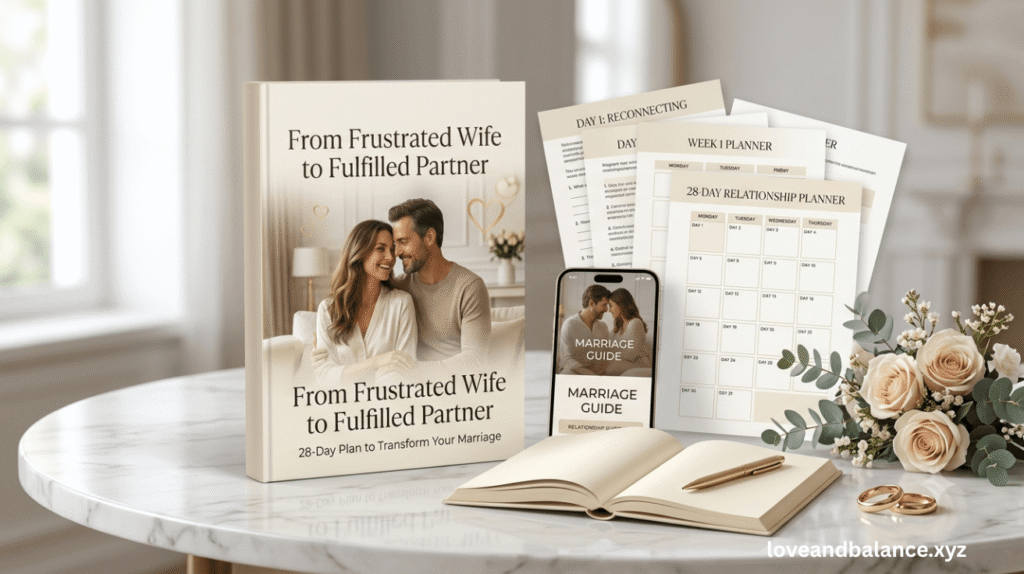
If This Is Showing Up in Your Marriage, Too
For a lot of readers, these anxious patterns don’t stay confined to dating, they follow you into marriage, especially once communication breaks down and you start feeling more like a roommate, or a parent, than a partner. If that’s closer to where you are, relationship therapist and author Rachel Morgan’s guide, From Frustrated Wife to Fulfilled Partner, walks through a structured, 28-day approach to rebuilding communication, respect, and closeness with your husband, with scripts, checklists, and connection exercises you can start using right away. It isn’t a replacement for couples therapy if that’s what you need, but it can be a practical, low-cost starting point if you’re feeling stuck and want a concrete plan to work from. You can take a closer look here.
Disclosure: This article contains an affiliate link. If you choose to purchase through it, we may earn a small commission at no extra cost to you. We only share resources we genuinely believe can help our readers, and this recommendation is separate from the research and information presented above. This article is for general informational purposes only and is not a substitute for professional medical, psychological, or therapeutic advice. If relationship anxiety is significantly affecting your daily life, please consult a licensed therapist or mental health professional.