Does Social Media Ruin Relationships? 7 Signs & Fixes
Updated 21 October 2026 | Based on published research from Pew Research Center, Baylor University, the Oxford Internet Institute and others. By Love and Balane Team
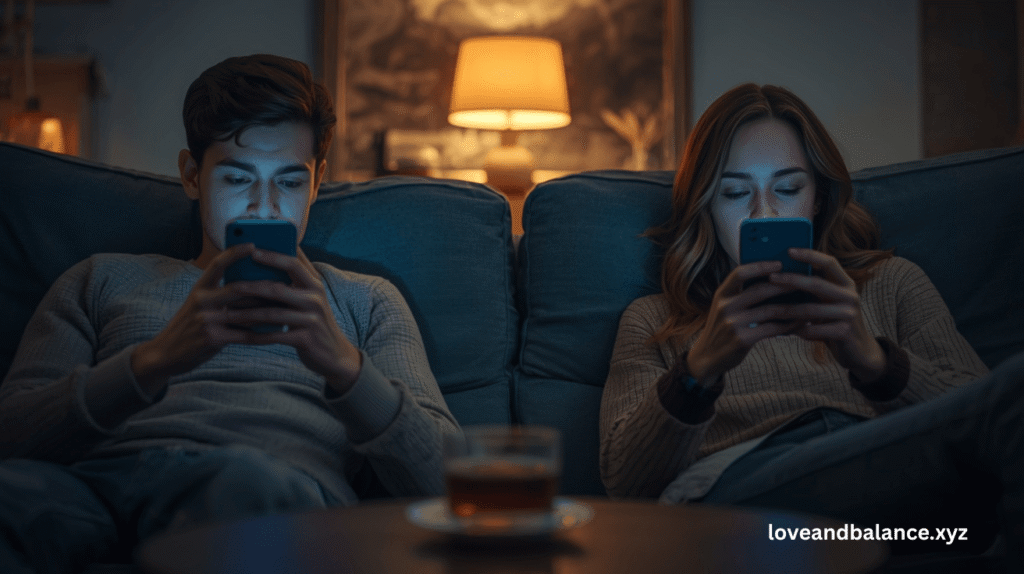
Here’s a scene that probably feels familiar. Dinner’s finished, the room is quiet, and it isn’t the comfortable kind of quiet. Two faces, two glowing screens, one thumb scrolling through a stranger’s holiday photos. Nobody is fighting. Nobody is talking either.
So, does social media ruin relationships? Not by itself, and not for everyone. But a decade of research shows it can quietly wear down trust, attention and closeness when it’s used in certain ways. The good news is that those ways are specific, and most of them are fixable.
In this guide, you’ll see what the studies actually found, seven patterns that tend to cause damage, the surprising ways social media helps couples, and a practical plan you can start tonight.
Quick answer: social media rarely ruins a relationship on its own. Trouble starts when it replaces face-to-face attention (phubbing), feeds jealousy and checking habits, or turns your love life into a comparison contest. Open, shared and moderate use looks far safer than secretive or late-night use.
What does the research actually say about social media and relationships?
Let’s start with the big picture, because headlines are louder than data. When the Pew Research Centre surveyed partnered Americans, just 27% of online couples said the internet had affected their relationship. Among those who did, roughly seven in ten called the effect positive and about one in five called it negative. That’s hardly a story of ruin.
A later Pew survey, fielded in October 2019, painted a messier picture. Among people whose partner uses social media, 23% said they had felt jealous or unsure about the relationship because of how that partner interacts with others online. For adults aged 18 to 29, the figure jumped to 34%. And 53% of social media users said they’d used these platforms to check up on someone they used to date.
Then there’s volume. A team at the Oxford Internet Institute, led by Dr Bernie Hogan, looked at more than 24,000 married people who stayed in touch through ten different communication channels. More channels didn’t mean happier marriages, and some people reported lower satisfaction. The researchers suggested there may be a tipping point where juggling so many separate conversation threads starts to work against closeness.
Researchers, including Boston University’s James Katz, went a step further. They reported that more time on social networking sites was linked with lower marital happiness in survey data of married people. They even asked the obvious question: is social media causing unhappy marriages, or is it a symptom of them? Hold on to that question. It matters more than any single statistic below.
7 ways social media can hurt a relationship
1. Phubbing: when the phone wins the conversation
“Phubbing” blends “phone” and “snubbing”. It means ignoring the person in front of you for the screen in your hand. In two surveys covering 453 US adults, Baylor University researchers James Roberts and Meredith David found that 46% of respondents said their partner had phubbed them, and about 23% said it caused conflict. The chain they traced is worth reading slowly: phubbing led to conflict, conflict lowered relationship satisfaction, lower satisfaction dragged down life satisfaction, and that was linked with higher depression.
You don’t need a study to recognise the small version. You start telling a story, your partner glances at a notification, and your enthusiasm leaks out of the room. Pew’s 2014 data suggest it’s common: 25% of partnered phone owners said their partner had been distracted by a phone while together, rising to 42% among 18- to 29-year-olds. In the Baylor work, even keeping a phone in sight counted as a snubbing behaviour. One caution: these were self-reported snapshots, so they show a link, not proof of cause.
2. The jealousy loop
Social media hands you a constant stream of “evidence” with zero context: a like on an old friend’s photo, a comment from a coworker, a follow request from someone you’ve never heard of. In a widely cited 2009 study, Amy Muise and colleagues found that more time on Facebook was linked with more jealousy. An Australian study of 342 Facebook users found that heavy, intrusive use went with lower relationship satisfaction, and jealousy was the bridge between the two.
A University of Central Florida thesis (179 participants) described a “downward spiral”: jealousy sends people to their partner’s profile, and the profile feeds more jealousy. People with anxious attachment styles were the most likely to act on those feelings in unhelpful ways. Notice what that means. Jealousy isn’t only a reaction to social media. It’s also what drags people back to it.
3. Surveillance dressed up as curiosity
Checking an ex’s profile “just once” is common enough that more than half of social media users in the Pew survey admitted to it. The real problem is the habit of checking within a current relationship. A study in the journal Communication Reports, covering 281 undergraduates in couples where both used Facebook, found that people who felt uncertain about where the relationship stood used more Facebook monitoring. Monitoring doesn’t cure uncertainty. It just gathers more ambiguous material to be uncertain about.
4. The highlight-reel comparison
Everyone else’s relationship looks fantastic from the outside: surprise flowers, anniversary carousels, matching captions. A UK poll of almost 2,000 people who had ended a serious relationship in the previous two years, reported by Mother & Baby, found that 12% realised they weren’t happy after seeing other couples’ photos and statuses online, and 54% felt social media played some role in the split. It’s a commissioned, self-reported poll, so treat it as a signal rather than a verdict.
A 2025 undergraduate honours thesis on TikTok relationship content also reported that social comparison was negatively correlated with relationship satisfaction. The pressure runs the other way too: 48% of 18- to 29-year-old social media users in Pew’s 2019 survey said social media matters for showing how much they care about a partner. When love has to be visible to count, ordinary affection starts to feel like it isn’t enough.
5. Mismatched usage
One of the most useful findings is almost boring. A peer-reviewed study found that people who believed their partner used social media excessively reported more lack of caring, loneliness and jealousy. Of those, only the feeling of not being cared for explained the intention to break up. The effect was also stronger for people who used social media less than their partner did.
Read that again. If you’re the lighter user, a partner’s screen time lands as rejection. If you’re the heavier user, it barely registers. Two people can sit in the same room and live in two different relationships.
6. Late nights and the bedroom scroll
A small pilot study from Nakuru County in Kenya (22 respondents, so take it lightly) reported that marital wellbeing was undermined by late-night social media use and by using it in front of a partner, while moderate use, good motives and using it to resolve disputes seemed to help. The sample is tiny, but the pattern matches what many couples describe. The last half hour of the day, once reserved for talking, becomes two separate feeds.
7. Blurry boundaries and drifting attention
A 2025 study on social media addiction, infidelity-related behaviours and relationship satisfaction found the expected pattern: heavier addiction went with lower satisfaction and more behaviours such as online flirting. The authors also flagged self-selection, meaning people who are already unhappy may turn to social media more, which creates a cycle. Either way, the practical takeaway is the same. When messages become something you hide rather than share, the issue has stopped being about the app.
The other side: how social media can help couples
If this were all doom, we’d have deleted our accounts years ago. The same research shows the opposite pattern too. In Pew’s 2014 data, 41% of 18- to 29-year-olds said technology helped them feel closer to a partner, and 23% of them had used it to settle an argument they struggled to resolve face to face, compared with 9% of couples overall.
In the Communication Reports study, satisfied partners used Facebook for positivity and reassurance, the digital version of “thinking of you”. A study of 58 couples found that a woman showing her partner in her profile picture was linked with higher relationship satisfaction for both of them. And a 2025 master’s thesis from Slovenia, with 260 participants, found no significant link at all between time spent on social media and relationship satisfaction.
So the honest summary is that social media is an amplifier. In a secure, communicative relationship, it amplifies sweetness, shared jokes and logistics. In an anxious or distant one, it amplifies doubt.
Is it the app, or something deeper?
Remember the cause-or-symptom question? Most of this research is correlational, which leaves three explanations on the table. Social media may damage relationships. Unhappy people may escape into social media. Or something else, like stress, anxious attachment or a family crisis, may be driving both. For different couples on different days, all three can be true.
That’s useful, because it changes what you do. If you only blame the app, deleting it feels like progress while the real issue sits there untouched. If you ask what the scrolling is doing for each of you (escaping, soothing, checking, avoiding), you get closer to the need underneath.
A 2-minute social media health check for couples
Answer these honestly and separately before you compare notes:
• Do we both look up from our phones when the other person starts talking?
• Could I show my partner what I just sent or read without feeling tense?
• Do we argue about likes, follows or replies more than once a month?
• Do I check my partner’s activity when I’m feeling insecure?
• Does scrolling at night replace talking at night?
• Does either of us feel we need to prove our relationship online?
• Is one of us online a lot more than the other?
• Do we feel closer, neutral or lonelier after time online?
If you spot three or more problem areas, that’s not a verdict. It’s a conversation starter.
9 simple rules that actually work
1. Protect two phone-free windows. Meals, and the first twenty minutes after you’re both home. Put phones in another room, not just face down on the table, since a visible phone still tugs at attention.
2. Charge phones outside the bedroom. Buy a cheap alarm clock and give the last half hour of the day back to each other.
3. Name it kindly in the moment. Try “Can I finish this thought, then you check that?” instead of a sigh or a glare.
4. Decide what’s public together. Relationship status, photos, anniversary posts. And never, ever, arguments.
5. Skip the vague posts. If you wouldn’t say it to their face, don’t hint at it to four hundred followers.
6. Mute instead of monitoring. If an ex or a certain account sets off a spiral, mute or unfollow it quietly. No drama required.
7. Use it together. Send each other reels, plan a trip, build a shared playlist. Active, shared use is the helpful side of the research.
8. Match the temperature. Since mismatch hurts, the heavier user can dial down a notch, and the lighter user can say how it feels rather than silently stewing.
9. Hold a weekly 20-minute check-in. Ask two questions: “Is anything online bothering you?” and “What made you feel close this week?”
How to bring it up without starting a fight
Timing matters. Don’t open the topic right after catching your partner scrolling. Pick a calm moment and start with your experience, not their behaviour.
Instead of “You’re always on your phone,” try: “I miss talking in the evenings. Could we try phones away during dinner this week and see how it feels?”
Instead of “Why did you like her photo?” try: “I noticed I felt a bit insecure when I saw that. I’d rather tell you than stew on it. Can you help me understand?”
Then actually listen. If your partner raises something about your habits, resist the urge to defend and ask what they’ve noticed. Agree on one change each for two weeks, then review how it went.
When to get professional support
Rules and conversations can fix habits. They can’t always fix what’s underneath. Consider a licensed couple’s therapist or counsellor if:
• You’re checking your partner’s accounts compulsively or feel unable to stop.
• Secrecy, deleted messages or hidden accounts have become a pattern.
• Almost every conversation about phones turns into a fight.
• Trust was broken by online behaviour, and you can’t rebuild it alone.
• Worry about the relationship is affecting your sleep, work or mood.
And if you ever feel unsafe or controlled, including a partner who demands your passwords or tracks your every move, please reach out to a local support service or someone you trust. That isn’t a tech problem. It’s a safety one.
Key takeaways
• Social media doesn’t ruin relationships on its own. Research links it with jealousy, conflict and lower satisfaction, but most studies are correlational.
• Phubbing is the most consistent culprit: 46% of people in one US study said their partner had phubbed them.
• Mismatched use hurts. The lighter user often feels it most.
• Social media also helps. Many couples feel closer, and some even use it to settle disagreements.
• Small, agreed rules beat dramatic digital detoxes.
Does Social Media Ruin Relationships? 7 Signs & Fixes
Frequently asked questions
Does social media ruin relationships?
Not on its own. Studies link heavy or secretive use with jealousy, conflict and lower satisfaction, but most are correlational, and others find benefits such as feeling closer or resolving arguments. How a couple uses social media matters more than whether they use it.
Is it normal to feel jealous of my partner’s social media activity?
Yes. In Pew’s 2019 survey, 23% of people whose partner uses social media had felt jealous or unsure because of how that partner interacts with others, and 34% of those aged 18 to 29. Occasional jealousy is common. The warning sign is when it drives constant checking, accusations or secrecy.
How much social media use is too much in a relationship?
There’s no research-backed magic number. Look at effects instead. If time online replaces time together, creates arguments, or leaves one partner feeling ignored, it’s too much for that couple. Even the Oxford analysis hinted that more channels aren’t always better.
Can social media lead to cheating?
It can lower the barrier to boundary-crossing behaviours like private chats and flirting. A 2025 study linked social media addiction with more infidelity-related behaviours, though its authors noted that unhappy people may use social media more to begin with. It’s better described as an opportunity than a cause.
Should couples share passwords or locations?
That’s a personal choice, and plenty of happy couples don’t. Openness works best when both people choose it freely. A demand for access to a partner’s accounts often points to a trust problem that checking won’t solve.
What is phubbing and how do I stop it?
Phubbing is “partner phone snubbing”: paying attention to your phone instead of the person you’re with. Start small with phone-free meals, keep phones out of sight during conversations, and agree on a gentle signal your partner can use when it happens.
Can a relationship recover from social media problems?
Usually, yes, when both people want it to. Most problems are habits and insecurities rather than betrayals, so shared rules, honest conversations and, where needed, couples counselling can rebuild trust. If there has been a serious breach, a therapist can help you work through it.
Keep reading: calm the overthinking
If a “seen” message or a like on someone’s photo sends your mind spinning, you’re not alone. Start with our guide on how to stop overthinking in relationships and the hidden effects that quietly damage your love life. If texts are your main trigger, try Stop Overthinking Texts: 9 Proven Fixes for Couples. And if the worry feels heavier than an occasional wobble, read relationship anxiety and mental health: what it really feels like, why it happens and how to break free. Pick the one that matches where you are today, and take the first step tonight.
For husbands who want a clear plan
A note for husbands: if the phone-and-scroll distance has grown into something bigger and your marriage feels like it’s slipping, a structured plan can help you take the first steps. The Last-Ditch Marriage Saver for Men (affiliate link) is a downloadable guide written for husbands. It covers communication, rebuilding respect and trust, and reconnecting emotionally and physically, with templates and checklists you can work through at your own pace. The sales page mentions a 60-day refund policy, so read the current terms before you buy. Take a look at the guide here and decide whether it fits your situation.
Disclaimer: This article is for general information and education only. It is not medical, psychological, legal or professional relationship advice, and it isn’t a substitute for a licensed therapist or counsellor. Research findings are summarised from published sources and may not apply to your situation. This post contains affiliate links. If you buy through them, we may earn a commission at no extra cost to you. We only mention products we believe may be relevant, but results vary from person to person, and nothing here is a guarantee. Please do your own research before purchasing. If you feel unsafe in your relationship, contact a local support service or emergency number.