
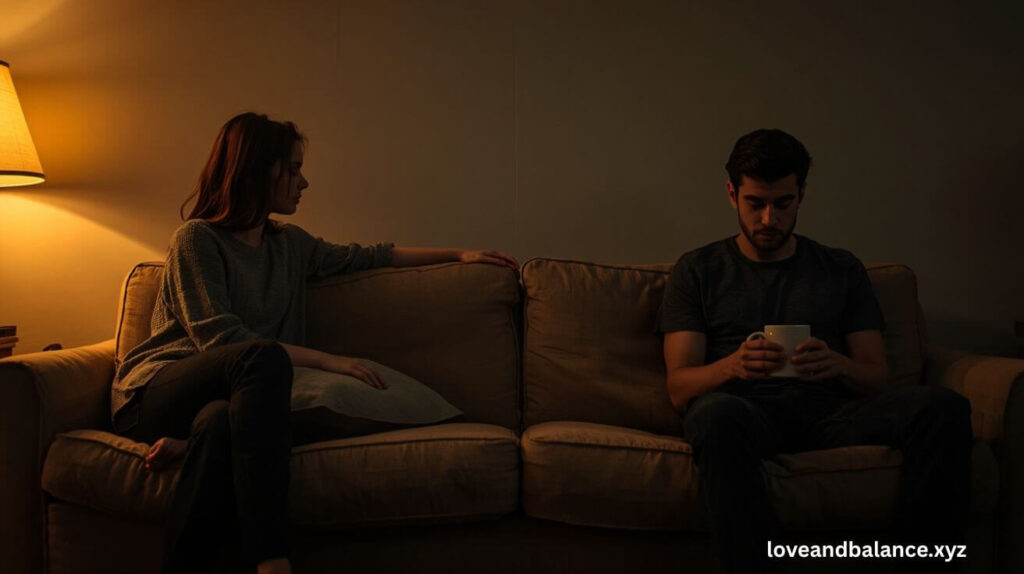
How to Love Someone With Avoidant Personality Disorder: 11 Proven Ways to Build Real Closeness
Last updated: September 2026
By Love and Balance Team
The message arrives in some version of the same sentence, over and over: “He isn’t cold. He’s terrified. But I’m exhausted.”
If you love someone with avoidant personality disorder, you know the strange arithmetic of it. They want you. They also flinch when you get close. You compliment them, and they change the subject. You plan dinner with friends and at 5 p.m. there is a stomachache that is genuinely real and also not the whole story. You ask what’s wrong and get the one word that ends conversations: nothing.
Most articles on this subject are written about avoidant people. This one is for the person who loves one, and it starts with a correction that changes everything. Avoidant personality disorder (AvPD) is not an avoidant attachment style. Confusing the two is the single biggest reason kind, patient partners end up using strategies that make things worse.
What follows draws on the DSM-5-TR criteria, relationship science from the Gottman Institute and Emotionally Focused Therapy, and the trials showing what actually shifts AvPD, plus the mistakes, a composite case, and an honest section on when love is not the answer.
Key Takeaways
● AvPD affects roughly 2.4% of adults and is driven by shame, not indifference.
● People with AvPD usually crave closeness; withdrawal is damage control.
● Small, frequent bids beat long emotional conversations by a wide margin.
● Treatment works: 81.4% recovered three years after starting schema therapy in one large trial.
● Your job is to be a safe environment, not their therapist, not their only relationship.
AvPD vs. Avoidant Attachment: The Distinction That Changes Everything
In pop psychology, “avoidant” almost always means dismissive-avoidant attachment: someone who downplays intimacy, prizes independence, and has learned to need less. The standard advice that follows, give space, stop chasing, become less available, is built for them.
AvPD is a different animal. The DSM-5-TR describes a pervasive pattern of social inhibition, feelings of inadequacy and hypersensitivity to negative evaluation beginning by early adulthood, with diagnosis requiring at least four of seven criteria (a clinical overview is available via StatPearls). In a real relationship, those criteria look like this: avoiding work that involves people, refusing to risk connection without a guarantee of being liked, holding back inside intimacy for fear of being shamed, scanning constantly for criticism, freezing in new situations, and believing themselves socially inept.
Here is the part partners miss. Someone with AvPD usually wants closeness desperately. They are convinced that if you ever see them clearly, you will leave, so they manage the risk by staying out of focus. Telling that person to “give them space and they’ll come to you” leaves them alone with the belief that keeps them stuck.
| Avoidant Attachment Style | Avoidant Personality Disorder |
What it is | A relational pattern learned in childhood. Not a diagnosis. | A clinical diagnosis in the DSM-5-TR, Cluster C. |
Core driver | Discomfort with dependence; closeness feels suffocating. | Shame and fear of judgement; closeness feels dangerous. |
Wants intimacy? | Often ambivalent; may genuinely prefer distance. | Usually wants it intensely, but expects rejection. |
Self-image | Frequently positive, even inflated self-reliance. | Sees self as inadequate, unappealing, inferior. |
Response to criticism | Dismissal and emotional distance. | Collapse, rumination, withdrawal lasting days. |
Scope | Mostly romantic and family ties. | Pervasive: work, friends, strangers, family. |
What helps | Communication skills, attachment repair. | Structured psychotherapy with graded exposure. |
What the Research Actually Says (and Why It Should Give You Hope)
This is not a rare condition. The National Epidemiologic Survey on Alcohol and Related Conditions, which interviewed over 43,000 American adults, estimated that 2.4% of the population meets criteria for AvPD, about 4.9 million people (NIAAA). In psychiatric outpatient samples, the rate climbs to around 15%.
It is also not a character flaw they chose. A Norwegian study of 1,427 twin pairs in the American Journal of Psychiatry put the heritability of AvPD at 37%, almost identical to social phobia at 39%, and found the genetic influences on the two entirely overlapping, while environmental influences were unique to each (Reichborn-Kjennerud et al., 2007). Which genes you carry is inherited; which disorder develops appears to depend heavily on what happened to you. A later PLOS ONE study identified childhood neglect as a meaningful difference between people with AvPD and those with social phobia alone.
Now the hopeful part. In a 12-site Dutch randomised trial of 323 patients, 90% with Cluster C diagnoses, estimated recovery three years after starting treatment was 81.4% for schema therapy, compared with 60.0% for clarification-oriented psychotherapy and 51.8% for treatment as usual (Bamelis et al., 2014). An earlier trial found cognitive behavioural therapy outperformed brief dynamic therapy for AvPD specifically. Personality disorders were once thought near-permanent. The evidence no longer supports that pessimism.
11 Proven Ways to Love Someone with Avoidant Personality Disorder
1. Read the withdrawal correctly before you respond
When they go quiet, your nervous system reads abandonment. Theirs is running shame. Same silence, two different emergencies. Ask one question before reacting: is this a wall (shutting me out) or a shield (protecting themselves from being seen)? With AvPD it is almost always the shield. Treating a shield like a wall, “so you don’t even care”, confirms they are defective, and the shield thickens. Try a line with no hook in it: “I’m not going anywhere. Come find me when you’re ready.” Then go do something else.
2. Trade big talks for small bids
In the Gottman Institute’s apartment lab, newlyweds were filmed responding to each other’s small attempts at connection. Six years later, couples still together had turned toward those bids 86% of the time. Couples who divorced: 33%. For AvPD partners, this is the cheat code. A two-hour state-of-the-relationship talk is a rejection exam. Fifty tiny moments a week, a hand on the shoulder, looking up when they say “look at this”, carry the same message with none of the exposure.
3. Give reassurance before it is asked for, and make it specific
Generic praise, “you’re amazing”, is unfalsifiable, so an AvPD brain file it under pity. Specific, behavioural, low-wattage praise is harder to argue with: “The way you handled that call with your mum was patient.” Say it once, then don’t hover. Requiring someone to receive a compliment gracefully turns a gift into a test.
4. Build a pause protocol instead of a pursuit
Gottman’s physiological work found that once someone is flooded, reasoning goes offline and the body reaches for escape; recovery takes roughly twenty to thirty minutes. Agree in advance, on a calm day, on three things: a signal either of you can use, a fixed time you come back, and what happens in between (a walk, not a rehearsal of the fight). The return is the half that matters. A pause without a guaranteed return is abandonment with extra steps.
5. Name the cycle, not the character
Emotionally Focused Therapy treats the pursue-withdraw loop as the enemy, not either partner. Compare “you shut me down” with “when I get anxious, I push, and when I push you protect yourself, and we both end up alone in the same house.” The second gives them something to fight alongside you. A meta-analysis of the most rigorous EFT trials found 70–73% of couples moved from distress to recovery.
6. Use a closeness ladder, not a leap
Effective AvPD treatment is graded: small, repeatable exposures where the feared outcome fails to arrive. Apply that socially. Instead of your cousin’s wedding, 200 people, six hours, no exit, try coffee with one friend for forty-five minutes with a stated finish time. Repeat that rung until it is boring, then add one. Big leaps make bad memories, and bad memories kill the next invitation.
7. Make the exit visible
Counter-intuitively, people with AvPD can do more when leaving is easy. Take two cars. Agree out loud that you leave at nine. Sit near the door. Autonomy lowers threat, and a guaranteed escape route is often what makes staying possible. Removing the exit does not increase commitment; it increases the odds they cancel next time.
8. Protect their dignity in public, ruthlessly
No affectionate teasing in front of friends. No “oh, he’s just shy!” as an icebreaker. No venting to your family in a way that circles back. Hypersensitivity to negative evaluation is not a preference to be gently challenged; it is the disorder. One well-meant joke at a dinner table can undo months of progress, and they may never tell you it did.
9. Ask small, answerable questions
“What’s wrong?” is an open field with a trapdoor in it. “Is this a today thing or an us thing?” or “one to ten, how bad is tonight?” gives them something answerable without narrating an interior they may have no language for. Some people with AvPD genuinely cannot find words in the moment, and treating that as stonewalling ends the conversation for good.
10. Support treatment without becoming the therapist
This has the strongest evidence behind it, and your role is smaller than you think. Helpful: making the first appointment easy, noticing effort rather than outcome, never asking what happened in session. Unhelpful: diagnosing them mid-argument, reading their homework, or letting your warmth rise and fall with their progress. You cannot be both the safe place and the examiner.
11. Keep your own life, and your own limits
Partners of avoidant people tend to shrink: fewer friends, fewer plans, fewer needs said out loud, hoping less friction produces more closeness. It never does. It builds a smaller cage for two. Keep your friendships. State your needs plainly, once, without a case file attached. Hold limits without ultimatums: “I’m at my sister’s on Saturday. I’d love you there. I’m going either way.”
What 18 Months of Real Progress Actually Looks Like
A composite drawn from patterns in the clinical literature and reader correspondence. Not one real couple; no identifying details belong to any individual.
Priya and Arun had been married four years when she started counting cancellations: eleven social plans abandoned in a year, always for a reason she could not quite argue with. When she finally said the word “disorder” out loud, he did not speak for three days.
Months one to nine: she stopped asking what was wrong and left low-stakes openings instead, tea set down without comment, a question about a football match. He answered about a third. They built the pause protocol; he used it badly at first, vanishing for two hours instead of thirty minutes. They kept the agreement and adjusted the time. He started therapy in month seven, mostly to stop her worrying.
Months ten to eighteen: the ladder. One friend, forty-five minutes. Then two. Then a family lunch with an agreed exit. At fourteen months he told her something about his father he had never told anyone, then apologised for it, and she said thank you and changed the subject, which was exactly right.
At eighteen months he was not cured. He still left parties early and went silent after criticism. But the silences lasted hours instead of days, and he came back on his own. That is what progress looks like here: not transformation, but a shorter distance between rupture and repair.
5 Things That Make AvPD Worse (Even with Good Intentions)
● Pulling away to teach a lesson. Strategic distance works on dismissive-avoidant patterns. On AvPD it just confirms that people leave.
● Surprise social exposure. The “I signed us up; it’ll be good for you” move turns a manageable fear into a betrayal.
● Endless reassurance on demand. Answering the same question forty times a week trains the anxiety, not the confidence. Answer once, warmly, then change the activity.
● Explaining their childhood mid-fight. Insight offered as ammunition stops being insight.
● Becoming their entire social world. It feels like devotion. It works like a locked door for both of you.
When Love Is Not the Answer
An explanation is not a permission slip. AvPD explains withdrawal, sensitivity and avoidance. It does not explain contempt, control or cruelty, and a diagnosis should never make you permanently responsible for managing someone else’s behaviour.
It is reasonable to reconsider the relationship if they refuse all treatment for years while things visibly deteriorate; if you are the only person adapting; if avoidance is used tactically to escape every difficult conversation; if your own health is declining; or if you are blamed for the distress your reasonable needs cause. Speaking to a therapist, including on your own, is not disloyalty. It is due diligence on your life.
How to Love Someone With Avoidant Personality Disorder: 11 Proven Ways to Build Real Closeness
Frequently Asked Questions
Is avoidant personality disorder the same as avoidant attachment?
No. Avoidant attachment is a relational pattern anyone might have; AvPD is a DSM-5-TR diagnosis involving pervasive social inhibition, inadequacy and hypersensitivity to criticism across every area of life. The advice for one is often the opposite of the advice for the other.
Can someone with avoidant personality disorder fall in love?
Yes, and often very deeply. The difficulty is not feeling love but tolerating being loved, because being loved means being seen closely enough to be found wanting. Many describe intense attachment alongside an equally intense urge to hide it.
Do people with AvPD ever get better?
Frequently. In a large multicentre trial, estimated recovery three years after starting schema therapy reached 81.4%, against 51.8% for usual care. CBT also has trial support. Improvement is gradual rather than dramatic.
Why do they pull away right when things are going well?
Closeness raises the stakes. The better it gets, the more there is to lose. Withdrawal after a good week is not a verdict on the week; it is a reaction to how much it mattered.
Is AvPD just severe social anxiety?
The overlap is substantial and genuinely debated. Twin data suggest the genetic influences on both are essentially the same, with environment shaping which emerges. In practice, AvPD is more pervasive, more tied to a negative self-image, and more persistent.
Should I give them space or move closer?
Neither extreme. Offer frequent, low-pressure contact with no obligation to respond, small bids rather than big conversations. Prolonged silence confirms their fears; intense pursuit overwhelms them.
Can a relationship with someone who has AvPD last long-term?
Yes, particularly where the person is in treatment, the non-avoidant partner keeps an independent life, and both treat the withdrawal cycle as a shared problem. Durability comes from repairing faster, not from rupturing.
How do I stop taking the withdrawal personally?
Note what was happening in the twenty minutes before each shutdown. Most partners find the trigger is rarely them; it is a perceived evaluation, often from an unrelated part of the day.
Keep Reading: Related Guides from Love & Balance
If this article named something you have been circling for a while, the three guides below go deeper into the patterns that sit beside avoidant personality disorder, and they are worth reading in this order.
Start with Why Do I Push People Away When I Love Them? 7 Painful Truths (And How to Finally Stop) if you recognised yourself, rather than your partner, in the withdrawal described above. Then read Signs of Relationship Anxiety in Women: What It Really Looks Like, because the anxious half of this cycle deserves as much compassion as the avoidant half. And if something feels less like fear and more like manipulation, read What Are the Signs of a Covert Narcissist in a Relationship? 17 Red Flags. Withdrawal born of shame and withdrawal used as control look almost identical from outside, and telling them apart changes everything you do next.
If You Are the One Trying to Hold a Marriage Together
Understanding why your partner withdraws is one thing. Knowing what to say on a Tuesday night when the silence is in its third day is another. If you are a husband trying to reach a wife who has gone quiet, it helps to have a script instead of a theory. The Last-Ditch Marriage Saver for Men is a self-guided programme built for exactly that moment, the point where you can feel the distance growing and nothing has closed it. It is not therapy, and not a substitute for treatment if AvPD is in the picture. But if you want a concrete plan for the next thirty days while you work out your longer-term options, take a look and decide whether it fits your situation.
Disclaimer
Medical disclaimer: This article is for general information and education only. It is not medical or psychological advice, diagnosis or treatment, and it is not a substitute for care from a qualified mental health professional. Avoidant personality disorder can only be diagnosed by a licensed clinician after a full assessment; please do not diagnose your partner, or yourself, from an article. If you or someone you love is struggling, speak to a doctor, a licensed therapist or a local mental health service. If you are in immediate crisis, contact your local emergency number or a crisis helpline in your country.
Affiliate disclosure: This article contains affiliate links. If you buy through one, we may earn a commission at no extra cost to you. We only recommend resources we believe may help our readers, and an affiliate relationship never changes the information or opinions in our articles. Results vary, and no programme can guarantee a specific outcome for any relationship.

About the Author
Written by the editorial team at Love & Balance. Our articles are researched against primary sources, peer-reviewed journals, diagnostic manuals and clinical bodies, and every claim here links to the study it came from. We are not licensed clinicians, and where clinical judgement is needed, we point readers toward it.