
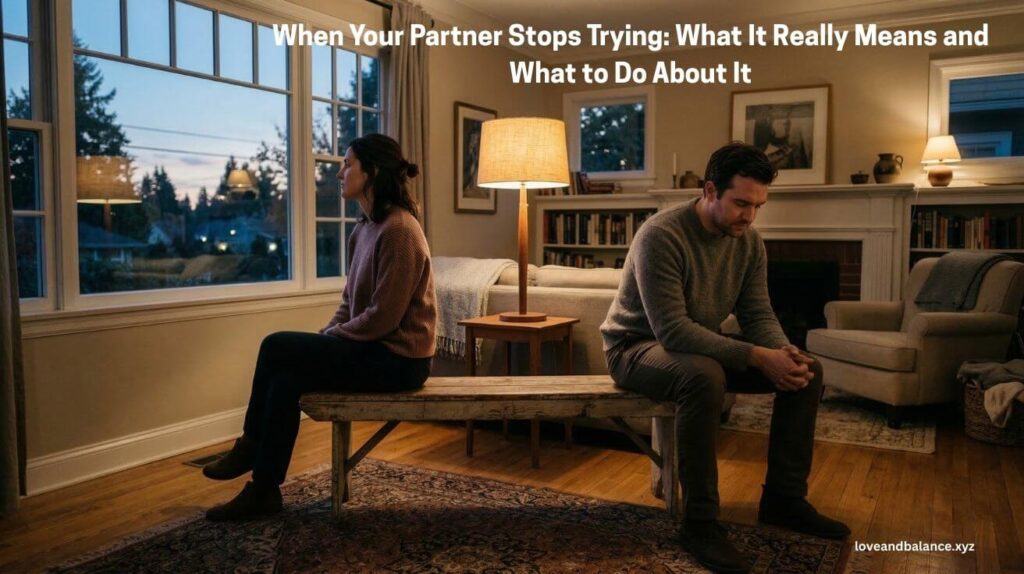
When Your Partner Stops Trying: What It Really Means and What to Do About It
By | Love and Balance | Relationship Psychology & Wellness
There’s a specific kind of heartbreak that doesn’t announce itself. It doesn’t come with a slammed door or a tearful confession. It arrives quietly — in the form of unanswered texts, cancelled plans, and the hollow feeling of lying beside someone who used to feel like home.
If you’ve found yourself wondering, “Is it just me, or has my partner stopped trying?” — you’re not imagining it. And you’re certainly not alone.
This isn’t a topic people talk about easily, partly because it’s painful, and partly because it’s confusing. When someone stops making an effort in a relationship, it doesn’t always look dramatic. It often looks like nothing — and that nothing can be the loudest thing in the room.
What “Stopping Trying” Actually Looks Like
Before we dive into the why and what to do, let’s get real about what this actually looks and feels like in daily life.
A few years ago, I spoke with a woman named Priya — a 29-year-old teacher from Bangalore — who described her three-year relationship deteriorating not through fights, but through a slow erosion of presence. “He stopped asking about my day,” she told me. “He stopped planning anything. He was physically there, but I felt like I was talking to a wall.”
This pattern — what psychologists and relationship researchers are increasingly calling “relationship quiet quitting” — is far more common than most people admit. Much like the workplace phenomenon where employees do the bare minimum without formally resigning, a partner who has quietly given up continues to stay in the relationship while withdrawing emotionally, physically, and mentally.
Here are the clearest signs to watch for:
Conversations become transactional — They talk to you about logistics (bills, schedules, kids), but nothing personal or meaningful anymore
They stop being emotionally responsive — Arguments no longer escalate because they’ve stopped caring enough to engage
Affection disappears quietly — Fewer compliments, less touch, no spontaneous romantic gestures
They avoid vulnerability — Anything deep or emotionally intimate is met with silence, deflection, or visible discomfort
They stop fighting for the relationship. When problems arise, they don’t suggest counselling, don’t ask what they can do differently, and don’t seem troubled by the breakdown
They’re no longer curious about your inner world — Dr. John Gottman’s research calls this your “love map” — the mental space you hold for your partner’s dreams, fears, and daily experiences. When someone stops updating that map, the connection erodes fast
The Psychology Behind It: Why Partners Disengage
Understanding why your partner stopped trying won’t automatically fix things, but it is essential groundwork. Disengagement rarely happens overnight — it’s almost always the result of a slow accumulation.
Emotional Burnout and Feeling Unseen
One of the most common reasons partners disengage is emotional exhaustion—the quiet burnout that comes from feeling as if their efforts were never noticed or reciprocated. Research on effort-reward imbalance consistently shows that when people invest effort without feeling a fair emotional return, they experience a kind of relational burnout that leads to withdrawal. In relationships, this often shows up as one partner slowly pulling back after years of feeling their love language went unacknowledged.
Consider the story of Marcus and Leila, a couple in their mid-thirties who came close to divorce after seven years together. Marcus had spent years planning dates, initiating difficult conversations, and trying to connect — all while Leila, struggling with her own childhood emotional neglect wounds, responded with distance. Eventually, Marcus stopped trying. Not because he didn’t love Leila, but because the constant effort without reciprocity had drained him completely. It was only through couples therapy that both could see the cycle they’d both contributed to.
Avoidant Attachment Patterns
Research published in the Journal of Marital and Family Therapy found that individuals high in attachment avoidance are significantly more likely to emotionally disengage from their partners — particularly during conflict or when their partner expresses high emotional needs. In practice, this means an avoidant partner doesn’t stop trying because they’ve “fallen out of love” — they stop trying because closeness itself feels threatening to them. Their withdrawal is a regulatory strategy, not a verdict on you.
Unresolved Resentment
Dr. John Gottman’s decades of research at the University of Washington identified contempt as the single greatest predictor of relationship failure. Contempt is what resentment looks like after years of being unaddressed. When a partner stops trying, there is often a mountain of small, unaddressed grievances underneath — moments they felt dismissed, disrespected, or unheard, that were never fully processed or repaired.
Life Circumstances and Depression
Sometimes, the disengagement has nothing to do with the relationship itself. Depression, anxiety, career burnout, grief, or chronic stress can all cause a person to withdraw from the people they love most. A 2025 study confirmed that emotional disengagement and reduced affective commitment are strongly linked to feelings of low control and helplessness, which mirrors how unmanaged depression presents in romantic relationships. If your partner seems withdrawn from everything — not just you — this context matters enormously.
The Difference Between a Rough Patch and a Real Problem
Not every period of low effort is a relationship death sentence. Life gets hard. People go through seasons. There’s a meaningful difference between a partner who is temporarily withdrawn because they’re overwhelmed and one who has fundamentally checked out.
Ask yourself these questions honestly:
Has this been going on for weeks or months, not just days?
When you’ve raised concerns, have they been dismissed or deflected rather than engaged with?
Do they show disinterest in repairing the relationship — refusing counselling, minimising your concerns, or seeming relieved when conflict resolves without resolution?
Has the emotional indifference spread across all areas of life together — physical intimacy, shared plans, conversations, and celebrations?
Research published in Psychology Today found that the three key dimensions of someone checking out emotionally are: emotional indifference, behavioural withdrawal, and cognitive distancing (mentally detaching or daydreaming to escape closeness). The more of these that are present simultaneously, the more serious the situation.
What to Do When Your Partner Stops Trying
This is where most advice gets frustratingly vague. “Communicate more!” isn’t helpful if you’ve been trying to communicate for months and hitting a wall. Here’s what actually works — and what doesn’t.
1. Choose the Right Moment for the Conversation
Don’t bring this up mid-argument, or at the end of a draining day. Wait for a calm, private moment when neither of you is flooded with stress hormones. Gottman’s research showed that even a 20-minute break during difficult conversations — long enough for heart rates to return to baseline — dramatically changed the quality of the exchange that followed. Timing is not a minor detail. It’s the container everything else sits in.
2. Speak From Observation, Not Accusation
Instead of “You never make an effort anymore” — which triggers defensiveness — try: “I’ve noticed I’ve been the one initiating lately, and I’m feeling disconnected from you. I miss us.”
The shift is subtle but powerful. You’re naming a pattern and your emotional experience, not prosecuting a case. Experts consistently recommend being candid and vulnerable about how the lack of effort is making you feel, rather than cataloguing what your partner is failing to do.
3. Ask Curious Questions Before Drawing Conclusions
Before you decide what their withdrawal means, get curious about what it is. “Have you been feeling burnt out lately?” “Is there something between us that’s been bothering you that we haven’t talked about?” You might discover that what looked like indifference was actually shame, depression, or a feeling of helplessness — none of which are resolved by accusation.
4. Be Honest About What You Need — And What You Won’t Accept
Communicating your needs is essential, but so is being honest about your limits. If you’ve been the only one investing in this relationship for a long time, it’s okay to say clearly: “I love you, and I want this to work. But I can’t keep going if things don’t change.” That’s not an ultimatum for manipulation — that’s the voice of someone who has self-respect.
5. Suggest Professional Support
Couples therapy isn’t a last resort. It’s a resource. A 2024 study in a peer-reviewed family therapy journal found that Gottman Method Couples Therapy was significantly effective in restoring trust and conflict management in distressed couples — particularly when both partners were willing to engage. If your partner refuses to consider therapy even when the relationship is clearly struggling, that refusal itself tells you something important about their investment.
6. Evaluate Whether the Effort Is Mutual
This is the hardest step, and the most necessary one. Sometimes, after you’ve communicated honestly, set clear boundaries, and offered the opportunity for change, nothing shifts. At that point, the loving thing you can do for yourself is to stop pouring energy into a container that has a hole in it. Recognising when to release someone is not failure. It is wisdom.
A Note for Anyone Who Has Been the One Who Stopped Trying
If you’re reading this and recognising yourself in the role of the disengaged partner, you’re brave for being honest with yourself. Disengagement is often the mind’s way of protecting itself from vulnerability, pain, or resentment that feels too big to name. Before you fully withdraw, ask yourself: Is there something I need that I haven’t asked for? Is there a hurt I’ve been carrying silently?
Reconnection is possible — but it requires you to stop retreating and start talking. Couples who went through 15 weeks of structured therapy showed a meaningful overall decrease in romantic disengagement in both partners, suggesting that the pattern is reversible when both people choose to engage.
When It’s Time to Let Go
There is no shame in arriving at the conclusion that a relationship has run its course. If your partner has shown you, repeatedly and clearly, that they are not willing to invest in what you’re building together, believing your own eyes is not giving up. It is self-honesty.
The healthiest relationships aren’t those that never face disconnection. They’re the ones where both people, when disconnection happens, choose to turn toward each other instead of away. That choice — that daily, ordinary turning toward — is what love actually looks like in action.
When Your Partner Stops Trying: What It Really Means and What to Do About It
Frequently Asked Questions
Q: How do I know if my partner has stopped trying or is just going through a hard time?
Duration and pattern matter most. A rough patch is usually tied to a specific stressor (job loss, family illness, grief) and tends to be temporary. Disengagement is more persistent, extends across multiple areas of your relationship, and is typically accompanied by a reduced responsiveness to your emotional needs — even when you name them directly.
Q: Can a relationship recover after one partner completely disengages?
Yes — but only if both people want it to. Research shows that romantic disengagement can decrease over the course of couples therapy when both partners actively participate. The key variable is mutual willingness. One person cannot do the work of two.
Q: Why does my partner get defensive when I bring up their lack of effort?
Defensiveness is one of Dr. Gottman’s “Four Horsemen” — communication patterns that predict relationship decline. When someone feels accused or criticised, the brain’s threat response activates, making genuine listening nearly impossible. Framing conversations around your feelings (“I feel disconnected”) rather than their behaviour (“You never try”) tends to reduce defensive reactions significantly.
Q: Is it normal to feel more like roommates than partners?
It’s unfortunately common — but it’s not something to normalise or accept indefinitely. The “roommate phase” often signals a breakdown in emotional intimacy and shared meaning, both of which are foundational to long-term relationship health according to Gottman’s Sound Relationship House model. It’s a signal worth taking seriously and addressing directly.
Q: What if my partner says they’re trying, but I don’t feel it?
This often points to a love language mismatch — where your partner is expressing effort in ways that don’t register as love to you. Have a specific, honest conversation about what feeling loved actually looks like to you. Not in general terms, but in concrete, daily ones. “I feel connected to you when you ask me how I’m doing at the end of the day” is far more actionable than “I need to feel appreciated.”
Q: Should I stop making an effort to see if my partner notices?
This strategy is sometimes suggested, and it can briefly clarify whether your partner registers the absence of your contributions. However, use it with caution — it’s not a long-term strategy and can breed resentment on both sides. It’s better used as a diagnostic tool for short periods, not as a way to “win” a power dynamic.
If this resonated with you, you might also find value in exploring attachment styles and how they shape the effort patterns in your relationships. You deserve a relationship where both people are actively choosing each other — not just tolerating each other.