Introduction: The Quiet Exhaustion of Unreciprocated Effort
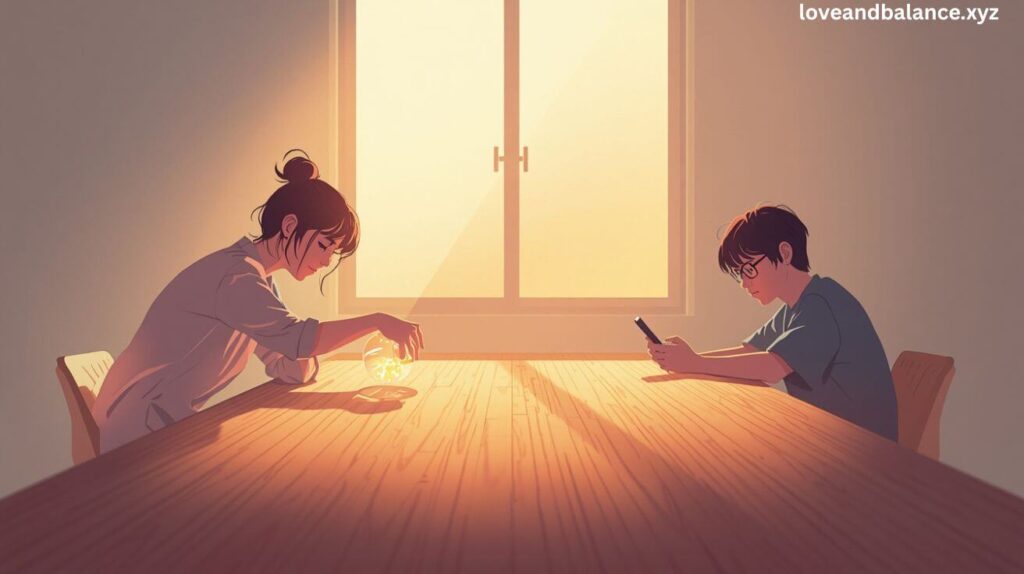
Have you ever left a coffee catch-up with a long-time friend or walked out of a conversation with your romantic partner feeling strangely heavier than when you arrived? You might not be able to point to an explicit argument, a harsh word, or a dramatic betrayal. Yet, in the pit of your stomach, a quiet, persistent realisation settles in: if you had not initiated, checked in, planned, listened, or compromised, this connection simply would not exist.
This emotional sensation is the hallmark of a one-sided connection. Whether it occurs between best friends or romantic partners, chronic relational imbalance drains your vitality, fuels persistent self-doubt, and leaves you questioning your worth.
Consider the story of Elena, a 32-year-old project manager who spent years navigating two vastly different yet strangely identical dynamics. On one hand, she had Maya, her childhood best friend of eight years. Elena was always Maya’s designated crisis counsellor, birthday planner, and late-night listener. But when Elena went through a painful career transition, Maya’s responses turned into distracted, one-word text messages.
On the other hand, Elena was dating David. With David, Elena was the sole architect of date nights, the initiator of every deep conversation, and the constant seeker of emotional reassurance. While Maya neglected Elena casually, David neglected her intimately. Both connections left Elena with the same agonising conclusion: she was working full-time to sustain connections that the other person was merely visiting.
While one-sided friendships and one-sided romantic relationships share the core root of uneven effort, they manifest through distinctly different behavioural patterns and psychological consequences. This comprehensive guide breaks down the science of relational balance, compares seven critical warning signs across both dynamics, and provides actionable steps to help you reclaim your emotional power.
The Psychology of Reciprocity: Why Imbalance Hurts So Deeply
Human beings are wired for reciprocity. From an evolutionary perspective, mutual support within social groups ensured survival. When reciprocity breaks down, our nervous system interprets the lack of response as emotional rejection or social isolation.
Dr Elaine Hatfield’s Equity Theory
In social psychology, Dr Elaine Hatfield’s Equity Theory posits that individuals are happiest in relationships where the rewards and costs experienced by both parties are roughly equal. When a relationship is inequitable, both participants experience discomfort, the under-benefited partner feels resentful, angry, and exhausted, while the over-benefited partner may feel guilty or, more commonly, entitled and emotionally detached.
The Anxious-Avoidant Trap & Intermittent Reinforcement
One-sided dynamics often persist because of psychological attachment styles and intermittent reinforcement. When one partner or friend displays avoidant behaviours, the anxiously attached individual often responds by over-functioning, initiating more, giving more, and fixing more in an effort to close the emotional gap.
Furthermore, occasional breadcrumbs of warmth or enthusiasm from the other person act like a slot machine. This intermittent reinforcement triggers dopamine releases in the brain, keeping you hooked on the fantasy of what the relationship could be, rather than accepting the reality of what it currently is.
📚 Psychological Research Insight
According to research published by the American Psychological Association (APA) and the Journal of Social and Personal Relationships, perceived relational equity is one of the strongest predictors of long-term life satisfaction and emotional resilience.
External Reference: American Psychological Association (apa.org) – ‘Understanding Interpersonal Wellness & Reciprocity in Adult Relationships.’
7 Unmistakable Signs: One-Sided Friendship vs. One-Sided Romantic Relationship
To understand where your connection stands, let’s examine how relational imbalance manifests across seven critical dimensions, comparing platonic friendships against romantic partnerships.
Sign 1: The Initiation Deficit (Who Always Reaches Out?)
Initiation is the lifeblood of connection. In a healthy dynamic, reaching out flows naturally back and forth like a game of catch.
• In a One-Sided Friendship: You are exclusively the person sending the first text, organising coffee dates, and remembering birthdays. If you don’t initiate contact, weeks or months pass in total radio silence. When you finally reach out, they offer polite excuses like ‘Life has been so crazy busy!’ without ever attempting to reschedule.
• In a One-Sided Relationship: The initiation gap moves into physical, emotional, and structural intimacy. You initiate conversations about where the relationship is going, touch, affection, date nights, and quality time. Your partner accepts your effort passively but rarely takes proactive ownership of the relationship’s momentum.
Sign 2: The Emotional Vulnerability Asymmetry (Therapist Trap vs. Emotional Wall)
Vulnerability requires a safe, mutual exchange. In unbalanced dynamics, vulnerability becomes a tool for exploitation or avoidance.
• In a One-Sided Friendship (The Therapist Trap): Your friend treats you as an unpaid therapist or an emotional dumping ground. They spend 45 minutes venting about their boss, partner, or family drama. However, the moment you attempt to share a challenge in your own life, they give brief, generic advice before steering the conversation back to themselves.
• In a One-Sided Relationship (The Emotional Wall): Instead of emotional dumping, you encounter complete emotional stonewalling. You open up about your deep fears or desire for closer connection, only to meet a wall of indifference, deflection, or criticism. They accuse you of being ‘too needy’, ‘dramatic’, or ‘overthinking everything’.
Sign 3: Placement in Their Hierarchy (Convenience Option vs. Hidden Partner)
Where you sit on someone’s list of priorities dictates how they treat your time and presence.
• In a One-Sided Friendship: You are a ‘filler friend’. They call you when their primary social circle is unavailable, when they need a favour, or when they want free entertainment. You are routinely cancelled on at the last minute if a better offer comes along.
• In a One-Sided Relationship: You are ‘pocketed’ or compartmentalised. They avoid introducing you to their inner circle, family, or colleagues. They keep the future vague (‘Let’s just live in the moment’) and refuse to make firm commitments, keeping you conveniently available without giving you a seat at the table.
Sign 4: Conflict Resolution Dynamics (Soft Ghosting vs. Gaslighting & Deflection)
How a relationship handles friction reveals its core strength and structural integrity.
• In a One-Sided Friendship: When you express hurt or point out an imbalance, the one-sided friend employs ‘soft ghosting’. They fade out, respond with cool distance, or act offended that you dare question their loyalty, waiting for you to apologise for bringing it up.
• In a One-Sided Relationship: Bringing up feelings of being underappreciated triggers defensive escalation, gaslighting, or stonewalling. According to research from The Gottman Institute (gottman.com), stonewalling and defensiveness are among the strongest predictors of relational breakdown. They flip the narrative to make your reasonable request sound like an unbearable demand.
Sign 5: Public & Social Integration Disparity
Healthy connections weave lives together in transparent, visible ways.
• In a One-Sided Friendship: You discover through social media that group dinners, trips, and milestone celebrations occurred without your knowledge, despite you considering this person your ‘best friend’.
• In a One-Sided Relationship: You are systematically excluded from major financial, career, or life decisions. They make choices that affect both of you unilaterally, treating you as a spectator rather than an equal partner in building a shared life.
Sign 6: The Reciprocity Audit (Financial, Labour, & Milestone Support)
Effort manifests in practical, everyday actions, not just verbal promises.
• In a One-Sided Friendship: You show up for their baby showers, housewarmings, and career wins with thoughtful gifts and heartfelt excitement. When your milestones arrive, you receive a rushed text message or complete radio silence.
• In a One-Sided Relationship: Domestic, emotional, and mental labour fall disproportionately on you. You manage the schedule, remember dates, buy gifts, plan holidays, and keep the home functioning while they act as a passive consumer of your labour.
Sign 7: The Toll on Your Mental Health & Identity
The ultimate litmus test of any relationship is how you feel about yourself when you are in their presence.
• In a One-Sided Friendship: You feel chronically drained, energetically depleted, and resentful. You feel used as a convenience, leaving you wary of investing in new friendships.
• In a One-Sided Relationship: You experience chronic relationship anxiety, hyper-vigilance, and a steady erosion of self-esteem. You walk on eggshells, constantly tweaking your behaviour in the desperate hope that being ‘better’ will finally make them love you.
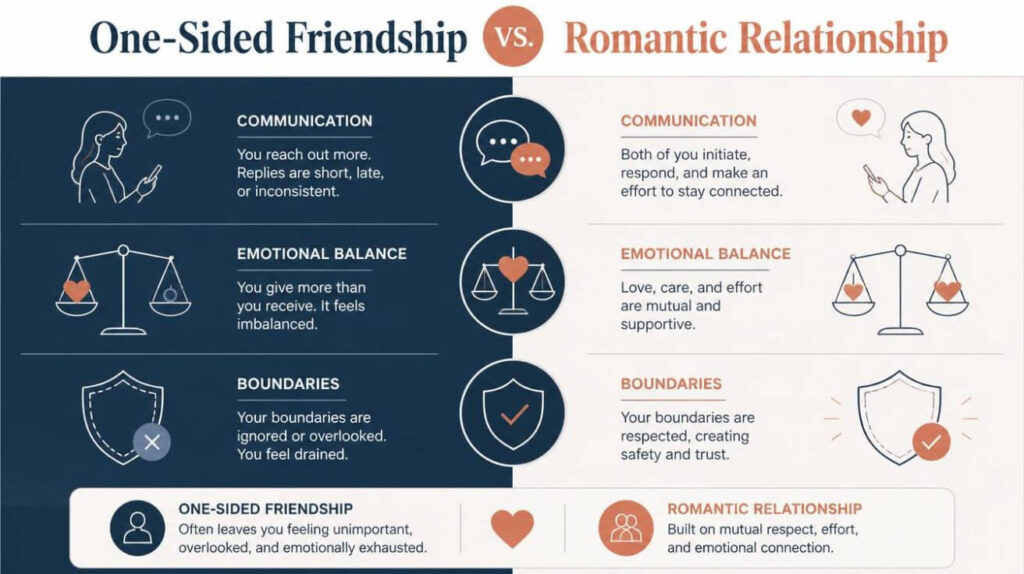
Side-by-Side Comparison: Friendship vs. Relationship Imbalance
To quickly assess where your connection stands, review this direct comparative breakdown:
Dimension | One-Sided Friendship | One-Sided Romantic Relationship | Priority Action |
Initiation | Sole initiator of texts, calls, and hangouts. | Sole initiator of intimacy, dates, and plans. | Execute the ‘Reciprocity Pause’. |
Vulnerability | Unpaid therapist listening to non-stop venting. | Met with emotional stonewalling or dismissal. | Set conversational boundaries. |
Life Priority | Convenient backup option when others are busy. | Compartmentalized/kept away from inner circle. | Stop accepting breadcrumbs. |
Conflict Response | Soft ghosting, fading out, or taking offence. | Gaslighting, defensiveness, or stonewalling. | Require direct accountability. |
Milestones | Your wins are ignored; theirs are celebrated. | Unilateral life choices without consulting you. | Re-evaluate long-term fit. |
Energy Balance | Leaves you exhausted, drained, and resentful. | Triggers severe anxiety and self-worth loss. | Prioritise self-preservation. |
Core Root | Friendship of convenience or narc-leaning dynamic. | Attachment mismatch or partner lack of investment. | Decouple emotional dependence. |
Why Do We Tolerate One-Sided Connections?
If one-sided connections are so painful, why do smart, self-aware individuals stay stuck in them for months or even years? Psychological research identifies three primary traps:
1. The Sunk Cost Fallacy: We convince ourselves that because we have invested five years in a friendship or three years in a romantic relationship, leaving or stepping back means wasting that history. In reality, staying only increases the emotional deficit.
2. The Fantasy Bond: We fall in love with someone’s potential or cling to how wonderful the connection was during the honeymoon phase. We keep waiting for that version of the person to return, ignoring who they are actively demonstrating themselves to be today.
3. Core Beliefs & Unhealed People-Pleasing: Many of us learned in childhood that love and acceptance must be earned through non-stop giving, compliance, and over-functioning. We assume that if we give a little more, listen a little better, or become more understanding, the other person will finally love us back.
How to Reclaim Your Power: 4-Step Healing Framework
Breaking free from the cycle of one-sided effort requires shifting your focus away from changing the other person and toward honouring your own boundaries.
Step 1: Execute ‘The Reciprocity Pause’ (Drop the Rope)
Stop over-functioning immediately. For the next 2 to 3 weeks, step back and match their level of investment. Do not send the text, do not initiate the date, and do not fix their problem. Observe what happens without judgement. If the connection completely dissolves in your absence, you have your answer: You weren’t holding hands; you were holding a rope.
Step 2: Have a Direct, Boundary-Centred Conversation
If you wish to give the relationship a chance to recalibrate, speak up clearly using I-statements rather than accusations:
💬 Scripts for Setting Boundaries
• For Friendship: ‘I value our friendship deeply, but recently I’ve felt that our check-ins have been largely one-sided. I need a friendship where there’s space for both of us to share and support each other. How do you feel about our current flow?’
• For Romance: ‘I feel alone in managing and nurturing our connection lately. For me to feel safe and happy in this partnership, I need mutual effort in initiating date nights, emotional openness, and planning our time together.’
Step 3: Grieve the Connection You Wished You Had
Accepting that a friend or partner cannot meet you halfway involves genuine grief. Allow yourself to mourn the fantasy of what you wanted that relationship to be, without letting that grief pull you back into old habits of over-extending.
Step 4: Re-Anchor in Personal Sovereignty & Balanced Connections
Redirect the massive reservoir of time, emotional energy, and care that you were pouring into an unreciprocated connection back into yourself, your personal goals, and individuals who naturally reciprocate your presence.
Recommended Resources for Deep Healing & Relationship Balance
Healing from one-sided dynamics requires taking an honest look at your personal relationship patterns, attachment habits, and boundary systems. If you recognise that you often over-give to keep peace, dive into our comprehensive guide on
👉 Read More: 17 Signs of People-Pleasing in Relationships You Might Be Missing and How to Finally Stop Losing Yourself
Furthermore, your willingness to accept uneven effort is deeply tied to how you view your intrinsic value. Rebuild an unshakeable sense of self-worth that protects you from settling for breadcrumbs by exploring our core truths guide:
👉 Discover Truths: Self-Worth in Relationships: 7 Powerful Truths About How Self-Worth Shapes Every Relationship You Have
If you are currently experiencing profound emotional distance with your partner and feeling constantly unseen or neglected, read our deep dive into the hidden factors driving romantic disconnect:
👉 Explore Solutions: Why Do I Feel Unloved in My Relationship? The Real Reasons No One Talks About
Scientific References & External Reading
For readers seeking deeper academic research on relational equity and psychological well-being, explore these verified institutions:
• The Gottman Institute: , Research-backed analysis on bids for emotional connection, stonewalling, and relationship longevity.
• American Psychological Association (APA): Clinical studies on social support networks, relational stress, and coping mechanisms.
• Journal of Social and Personal Relationships (SAGE): Peer-reviewed research on equity theory and relational reciprocity in adult friendships.
• Psychology Today: Expert insights on boundary setting, attachment styles, and breaking people-pleasing habits.

 Empowerment Resource: The Menopause Survival Guide
 Claim Your Survival Guide & Reclaim Your Energy Today:
  Transparency & Affiliate Disclosure