7 Attachment Styles in Dating Apps: How Modern Love Changes the Rules
By the Love & Balance Editorial Team | Updated: September 2026 | 10-minute read
You’re Not “Bad at Dating Apps.” Your Attachment Style Is Running the Show.
Here’s something nobody on dating apps tells you: You could have the most perfectly curated profile, the wittiest opener, and the sharpest photos, and still crash every match into a wall before the third date. Not because of bad luck. Not because everyone online is emotionally unavailable. But because of something far more invisible: the attachment style you built long before you ever downloaded an app.
I got this wrong for years. I used to think my pattern of hyper-analysing texts, feeling suffocated when someone got close, or chasing people the moment they pulled back, was just “my personality.” It wasn’t. It was a survival blueprint my nervous system wrote during childhood, and I was running it on autopilot inside every DM, every date, every relationship.
The good news? Once you understand how attachment theory plays out in modern dating, including the very specific ways Tinder, Hinge, and Bumble amplify each style, you gain enormous power to change the story.
This guide is that starting point.
1. What Is Attachment Theory, And Why Does It Matter on Hinge in 2026?
Attachment theory was first developed in the 1960s and 70s by British psychiatrist John Bowlby and later expanded by psychologist Mary Ainsworth through her famous “Strange Situation” experiments. The core idea: the bonds we form with our primary caregivers in infancy create mental templates, called “internal working models”, for how safe, worthy, and loveable we believe we are in relationship to others.
In 1987, researchers Cindy Hazan and Phillip Shaver extended Bowlby’s model into adult romantic relationships, publishing a landmark paper in the Journal of Personality and Social Psychology that found roughly 55% of adults are securely attached, 25% are anxious-preoccupied, and 20% are dismissive-avoidant. Later researchers added a fourth style: fearful-avoidant (also called disorganised).
Fast forward to 2024–2026. A generation of daters has grown up inside swipe culture. According to Pew Research Center’s 2023 Dating App Report, 53% of adults under 30 in the US have used a dating app, and nearly 1 in 3 say their experience left them feeling “more anxious about relationships” than before they joined. A 2024 study published in the journal Cyberpsychology, Behavior, and Social Networking found that people with anxious attachment styles spend on average 2.3× more time on dating apps than their secure counterparts, and report significantly lower satisfaction with matches.
The algorithm didn’t create your attachment style. But it mirrors it right back to you, and then it supercharges it.
2. The 4 Attachment Styles on Dating Apps: What They Actually Look Like
Let’s be specific. Because “secure” and “anxious” are just words until you recognise yourself in the behaviour.
 Secure Attachment, The Rarest Find in the App Store
Securely attached people approach dating apps as one option among many, interesting, useful, but not defining. They can take time to respond to a match without it meaning anything catastrophic. They handle rejection without it triggering a spiral. When conversations go quiet, they don’t catastrophise. They communicate boundaries naturally (“I’m not looking for anything casual” lands as a statement, not a test).
Real-world example: Sarah, 29, a nurse from Edinburgh, told me she once matched with someone on Hinge, had three great conversations, then didn’t hear back for five days. “I just assumed he got busy,” she said. “When he texted again, I was happy. When he didn’t text again after that, I deleted the match and moved on. No drama.” That ease is secure attachment in action.
 Anxious Attachment, The Notification Checker
Anxiously attached individuals are hypervigilant to signs of rejection or withdrawal. Dating apps are essentially an anxiety machine for this style, every “seen” without a reply, every dropped conversation, every unmatched is fuel for an internal inferno of self-doubt.
Common patterns: Over-texting to fill silence. Reading tone into one-word replies. Swiping right on almost everyone out of fear of missing connection. Feeling crushing rejection from someone they’ve never even met. Placing enormous emotional weight on early conversations.
The science backs this up. A 2022 study in Personality and Individual Differences found that anxious attachment was the strongest predictor of compulsive social media and app use, with participants reporting that “checking for messages” temporarily soothed their anxiety, creating a reinforcement loop that is functionally similar to gambling behaviour.
 Avoidant Attachment, The Ghost Before It Was a Trend
Avoidantly attached people value independence above emotional closeness. Dating apps initially feel perfect for them, low stakes, controlled distance, no obligation. But the moment a connection starts to deepen, the pull toward escape intensifies.
They may have dozens of matches but rarely meet any of them. They’re brilliant at the witty banter stage, then abruptly pull back. They rationalise disengaging with convenient stories: “she was too keen,” “he was moving too fast,” “I just got busy.” They are, in many ways, the architects of modern ghosting culture.
Real-world example: Marcus, 34, a graphic designer from Manchester, described keeping four ongoing app conversations for months without ever arranging a date. “I tell myself I’ll meet them when things calm down at work,” he said. “But honestly, the conversations are comfortable. Dates feel like… pressure.” That discomfort at the threshold of real connection is avoidant attachment protecting itself.
 Fearful-Avoidant (Disorganised), I Want You, But I’m Terrified of You
The most complex and often most misunderstood style. Fearful-avoidants deeply crave connection and simultaneously dread it. They tend to idealise potential partners quickly, then find reasons to flee the moment things get real. They often attract and are attracted to anxious types, creating the push-pull dynamic that relationship therapists call “the anxious-avoidant dance.”
On dating apps, this can look like: intense early investment, then sudden withdrawal. Cycling through matches at speed. Feeling simultaneously drawn to and overwhelmed by the same person. According to attachment researcher Dr. Diane Poole Heller, fearful-avoidant individuals often oscillate between the other three styles depending on how emotionally safe they feel.
3. How Dating App Architecture Is Designed to Trigger Insecure Attachment
This is the part most blogs skip. Dating apps are not neutral platforms. They are attention-capture systems, and their design features map almost perfectly onto the vulnerabilities of insecure attachment styles.
Variable reward loops: Tinder and similar apps use intermittent reinforcement, the same psychological mechanism behind slot machines. You swipe and sometimes get a match, sometimes don’t. This unpredictability is precisely what makes anxious attachment more painful and avoidant attachment feel safer (you can control when you engage).
The paradox of choice: A 2000 Columbia University study by Sheena Iyengar and Mark Lepper (later expanded in Barry Schwartz’s The Paradox of Choice) found that more options lead to lower satisfaction and more regret. In 2024, the dating app space confirmed this: Hinge’s internal research revealed that users who limit their daily likes to under 10 are significantly more likely to form meaningful connections than those who swipe liberally. An abundance mindset is an avoidant person’s favourite excuse not to commit.
Read receipts and typing indicators: These are activation triggers for anxious attachment. The moment someone “sees” a message and doesn’t respond, the anxious brain launches into threat-detection mode. What did I say wrong? Are they losing interest? Should I send a follow-up?
Disappearing matches and unmatching: Ghosting, now practically institutionalised through app mechanics, is uniquely devastating for anxious and fearful-avoidant individuals, who interpret sudden disappearance as confirmation of their deepest fear: that they are fundamentally unlovable.
4. The Anxious-Avoidant Trap: Why Dating Apps Keep Us Stuck in It
Here’s a phenomenon that relationship therapists across the world are seeing in 2025–2026: apps are turbocharging the anxious-avoidant pairing, the most volatile and most common relationship dynamic in Western dating culture.
Why does this happen? Anxious individuals are drawn to partners who feel “just out of reach”, it mirrors the dynamic with their primary caregiver, where love was inconsistent or conditional. Avoidant individuals are drawn to warmth and pursuit, but withdraw when closeness actually arrives. Dating apps create the perfect storm: infinite options, minimal accountability, and the ability to maintain emotional distance indefinitely.
A 2023 qualitative study published in Frontiers in Psychology interviewed 62 adults in their 20s and 30s about their dating app experiences. The most commonly reported pattern was “intense initial chemistry followed by one person pulling back and the other pursuing harder.” Sound familiar?
This is the anxious-avoidant dance, and apps are its favourite dance floor. The only way out is awareness, recognising when you’re playing your side of the pattern, and choosing differently.
5. Real Stories: When Attachment Styles Meet Modern Dating
Priya’s Story, The Anxious Swiper
Priya, 27, an accountant from London, downloaded Bumble after her three-year relationship ended in 2023. “I became obsessed,” she told me. “I was on it five, six hours a day. Every match felt like oxygen. Every unmatch felt like confirmation I was the problem.” After eight months and zero relationships she felt proud of, she started working with a therapist who specialised in attachment. “I was basically using the app to rehearse the anxious patterns from my childhood, chasing people who weren’t fully there, ignoring people who were consistently kind.” Priya took a 60-day break from apps. When she returned with more awareness, she matched with someone she’d have previously dismissed as “too available.” They’ve been together nine months.
James’s Story, The Avoidant Architect
James, 38, a solicitor from Dublin, describes himself as someone who “never really wanted to be in a relationship but also hated being alone.” He’d been on dating apps on and off since 2015. He had no trouble getting first dates. Third dates were rare. Anything after four dates had never happened. “I always found something wrong with them,” he said. “Too needy. Too boring. Too intense.” James eventually enrolled in a men’s emotional intelligence programme after a female friend told him bluntly: “The problem isn’t your matches. It’s your inability to let anyone in.” He’s now in couples therapy with a woman he’s been seeing for five months, the longest relationship of his adult life.
6. 7 Evidence-Based Ways to Shift Toward Secure Attachment While Dating Online
These aren’t affirmations. They’re practical moves backed by attachment research.
1. Name your pattern out loud.
Literally say it to yourself: “I am an anxious-attached person. When someone doesn’t text back quickly, I am likely to catastrophise.” Awareness without judgment is the first act of earned security. Research by Dr. Dan Siegel calls this “name it to tame it”; labelling an emotional state reduces amygdala activation.
2. Set a daily app limit.
Use screen time controls to cap your dating app use at 20–30 minutes a day. Studies from the University of Pennsylvania (2018) found that limiting social media to 30 minutes daily significantly reduced loneliness and depression over three weeks. The same principle applies to dating apps.
3. Move to voice or video faster.
Text-based communication is the natural habitat of insecure attachment; it gives both anxious and avoidant patterns room to spiral. Suggest a 15-minute call within the first week of matching. If someone is unwilling, that is data, not rejection.
4. Notice your physiological response, not just your thoughts.
When you feel your chest tighten because a match hasn’t replied, pause. Put a hand on your chest. Breathe slowly. This is your nervous system, not reality. Somatic regulation (breathwork, cold water on the wrists, movement) is more effective than trying to “think your way out” of attachment anxiety.
5. Learn to sit with the discomfort of being pursued.
If you’re avoidant, practice staying in contact for one more day before your usual withdrawal point. Notice what the discomfort feels like in your body. The discomfort is the wound, not a sign the person is wrong for you.
6. Stop treating matches as identity validation.
A match is not evidence that you are lovable. An unmatch is not evidence that you are not. Your worth does not live in an algorithm. Create a daily ritual that has nothing to do with romantic pursuit, sport, creative work, or deep friendship, to anchor your identity outside the app.
7. Work with a professional.
Attachment patterns formed over decades don’t dissolve through willpower alone. Emotionally Focused Therapy (EFT), Schema Therapy, and EMDR have the strongest evidence base for shifting adult attachment. If 1-1 therapy isn’t accessible, there are excellent structured programmes available online.
7. If You’re a Woman Who Feels Chronically Unseen in Relationships, Read This
One of the most heartbreaking patterns I see in women with anxious or fearful-avoidant attachment isn’t on dating apps; it’s inside long-term partnerships. You might have navigated the early stages of a relationship beautifully, only to find yourself years in feeling invisible, unheard, or like you’re managing the emotional labour for two people.
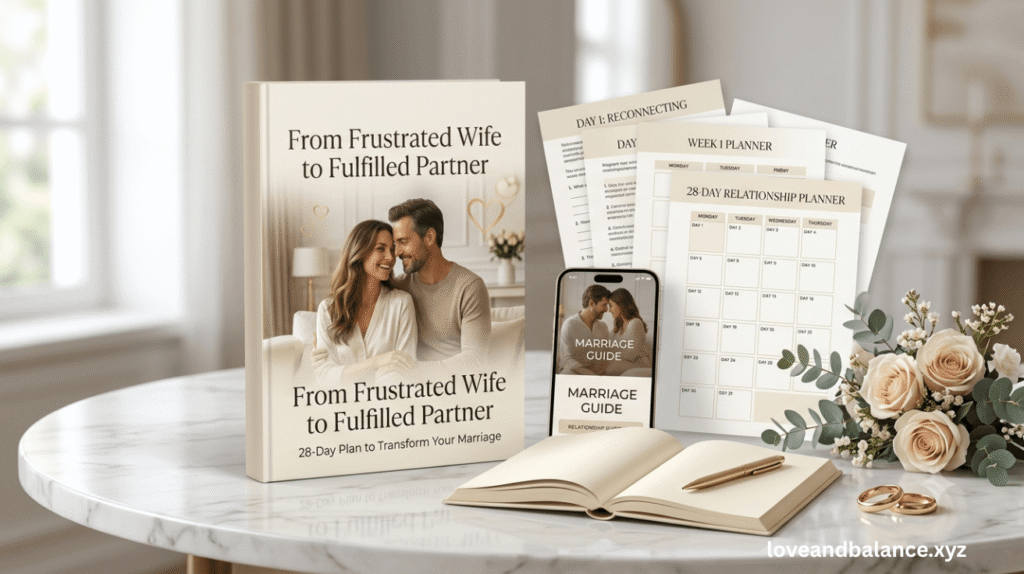
If that resonates, I want to recommend something specific. The “From Frustrated Wife to Fulfilled Partner” programme is one of the most honest, practically grounded resources I’ve come across for women who are done settling for a relationship that drains more than it gives. It addresses the core emotional patterns, including attachment wounds, that keep smart, capable women stuck in dynamics that don’t serve them.
 Click here to explore the “From Frustrated Wife to Fulfilled Partner” programme →
This is not about “fixing yourself.” It’s about understanding yourself deeply enough to finally stop repeating patterns that aren’t working, and to step into the relationship you actually deserve.
 AFFILIATE DISCLAIMER
This post contains affiliate links. If you purchase through the link above, we may earn a small commission at no additional cost to you. We only recommend programmes we genuinely believe can help. Our editorial opinions are never influenced by affiliate relationships.