
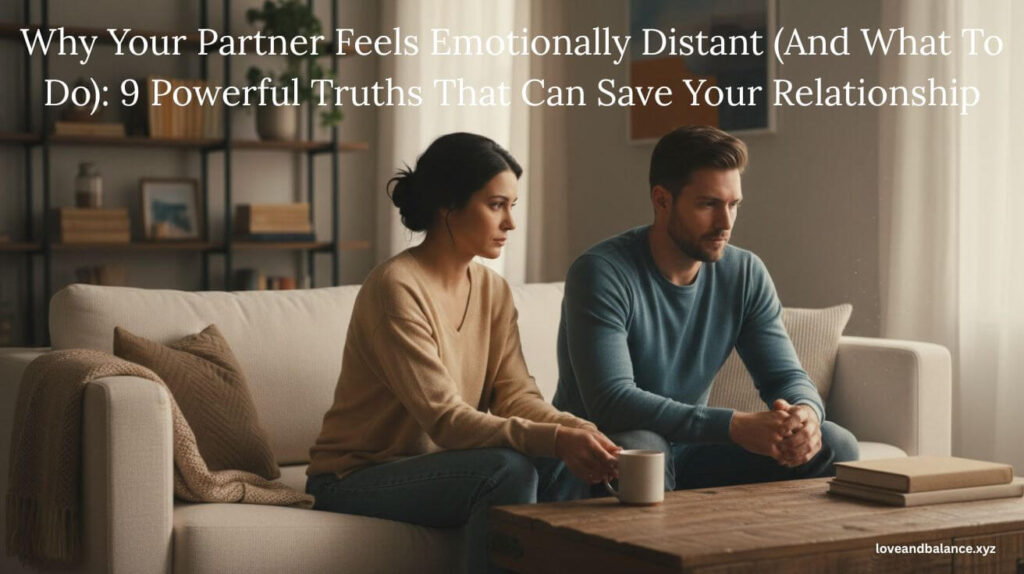
Why Your Partner Feels Emotionally Distant (And What To Do): 9 Powerful Truths That Can Save Your Relationship
Have you ever sat next to your partner and felt completely alone?
You talk. You share space. You go through daily routines. But something feels… off. That warmth, that emotional closeness, that spark — it seems to have faded.
If you’re searching for answers about Why Your Partner Feels Emotionally Distant (And What To Do), you’re not alone. Emotional distance is one of the most common relationship struggles couples face today. The good news? It’s usually fixable.
In this article, we’ll explore:
The real reasons partners grow emotionally distant
Research-backed psychological explanations
Real-life relationship scenarios
Practical steps you can take immediately
FAQs to guide your healing journey
Let’s dive in.
What Does Emotional Distance Actually Mean?
Emotional distance isn’t about physical space. It’s about a lack of emotional connection.
It may look like:
Short or surface-level conversations
Less affection
Avoiding deep discussions
Irritability or defensiveness
Feeling like roommates instead of partners
According to research from the American Psychological Association, emotional withdrawal is often a protective response to stress, conflict, or unresolved hurt.
In simple words: when people feel overwhelmed or unsafe emotionally, they pull back.
Why Your Partner Feels Emotionally Distant (And What To Do): The Real Reasons
Let’s explore the most common causes — supported by research and real relationship examples.
1. Unresolved Conflict That Was Never Fully Addressed
Real-life example:
Sarah noticed her husband stopped sharing his day with her after a major argument about finances. They “moved on” without truly resolving it. But emotionally? He hadn’t.
According to relationship researcher Dr. John Gottman, unresolved conflict leads to emotional disengagement. Small issues pile up, and instead of arguing again, one partner shuts down.
What to do:
Revisit unresolved topics calmly.
Say: “I feel like we never fully worked through what happened. Can we talk about it?”
Focus on understanding, not winning.
2. Chronic Stress or Burnout
Work pressure. Financial strain. Parenting exhaustion.
When someone is overwhelmed, emotional connection often becomes a lower priority.
Research from the Journal of Marriage and Family shows that high stress levels significantly reduce emotional responsiveness between partners.
Stress can make someone:
Quiet
Irritable
Mentally unavailable
What to do:
Ask about their stress, not just their behavior.
Offer support instead of blame.
Create small rituals of connection (10-minute check-ins daily).
3. Feeling Criticized or Unappreciated
Over time, constant criticism — even subtle — creates emotional walls.
If your partner feels:
Judged
Not good enough
Frequently corrected
They may withdraw to protect themselves.
Dr. Gottman identifies criticism as one of the “Four Horsemen” that predict relationship breakdown.
What to do:
Replace criticism with appreciation.
Say: “I really appreciate when you help with dinner.”
Use “I feel” statements instead of “You always…”
4. Emotional Needs Aren’t Being Met
Sometimes distance grows quietly.
Your partner may feel:
Unheard
Unsupported
Not prioritized
But instead of expressing it, they retreat.
Attachment theory suggests that people with avoidant attachment styles cope with unmet needs by becoming emotionally distant rather than confrontational.
What to do:
Ask: “Do you feel emotionally supported by me?”
Listen without interrupting.
Validate their feelings.
5. Loss of Emotional Intimacy Over Time
Long-term relationships require maintenance.
Life gets busy. Romance fades. Conversations become transactional.
You discuss bills. Groceries. Schedules.
But not dreams.
Not fears.
Not feelings.
Emotional intimacy requires:
Vulnerability
Curiosity
Shared experiences
Without these, partners drift apart.
What to do:
Schedule weekly connection time.
Ask deeper questions.
Revisit shared goals and dreams.
6. Depression or Mental Health Struggles
Sometimes emotional distance isn’t about the relationship at all.
Depression often causes:
Low energy
Emotional numbness
Withdrawal
The National Institute of Mental Health explains that emotional detachment can be a symptom of clinical depression.
If your partner seems distant and also:
Sleeps more
Has low motivation
Shows little interest in things
Mental health support may be needed.
What to do:
Encourage professional help gently.
Avoid taking it personally.
Offer patience and understanding.
7. Resentment That Has Built Up Quietly
Resentment grows in silence.
It might stem from:
Unequal responsibilities
Past betrayals
Feeling unheard for years
When resentment isn’t expressed safely, it transforms into emotional distance.
What to do:
Create space for honest conversations.
Ask: “Is there anything you’ve been holding in?”
Consider couples therapy.
8. Fear of Vulnerability
Some people struggle with emotional expression.
Especially if:
They grew up in emotionally unavailable homes
They were taught not to show feelings
They fear rejection
They may love you deeply — but not know how to express it.
What to do:
Model vulnerability first.
Share your own feelings openly.
Create emotional safety.
9. There May Be External Emotional Attachment
In rare cases, emotional distance can stem from emotional involvement elsewhere.
Warning signs include:
Increased secrecy
Emotional withdrawal combined with defensiveness
Sudden lifestyle changes
But caution: don’t jump to conclusions without evidence.
If you suspect this, approach calmly and directly.
How To Rebuild Emotional Connection
Now that we’ve explored Why Your Partner Feels Emotionally Distant (And What To Do), let’s focus on solutions.
Here are research-backed strategies.
1. Improve Communication Skills
Healthy communication includes:
Active listening
Eye contact
No interrupting
Reflecting back what you heard
Try saying:
“What I hear you saying is…”
It reduces defensiveness instantly.
2. Schedule Intentional Connection Time
Don’t wait for spontaneity.
Plan:
Weekly date nights
20-minute daily device-free talks
Monthly relationship check-ins
Consistency builds closeness.
3. Practice Appreciation Daily
Small gratitude shifts dynamics dramatically.
Try:
One compliment per day
Thank-you texts
Acknowledging effort
Gratitude increases relationship satisfaction, according to research from the Greater Good Science Center at UC Berkeley.
4. Address Underlying Issues, Not Just Symptoms
If stress is the root — manage stress.
If resentment is the root — resolve conflict.
If mental health is the root — seek support.
Surface solutions won’t fix deep causes.
5. Consider Couples Therapy
Therapy isn’t a last resort.
It’s a proactive investment.
According to the American Association for Marriage and Family Therapy, over 70% of couples report improved relationships after therapy.
Sometimes you need a neutral space to reconnect.
When Should You Be Concerned?
Emotional distance becomes serious when:
There’s complete avoidance
No willingness to improve
Contempt replaces care
You feel consistently lonely
Why Your Partner Feels Emotionally Distant (And What To Do): 9 Powerful Truths That Can Save Your Relationship
FAQs About Emotional Distance in Relationships
1. Is emotional distance always a sign of cheating?
No. Most emotional distance stems from stress, unresolved conflict, or mental health struggles — not infidelity.
2. How long does emotional distance last?
It depends on the cause. With effort and communication, many couples reconnect within weeks or months.
3. Should I give my partner space if they’re distant?
Yes — but balanced with communication. Space without discussion can increase disconnection.
4. Can emotional distance be fixed without therapy?
Often, yes. But therapy helps when patterns feel stuck.
5. What if my partner refuses to talk?
Start with non-threatening conversations. If refusal continues long-term, professional support may be necessary.
6. Can emotional distance mean the relationship is over?
Not necessarily. Many strong relationships go through phases of distance and come back stronger.
Final Thoughts: Emotional Distance Is Often a Signal, Not the End
Understanding Why Your Partner Feels Emotionally Distant (And What To Do) is the first step toward healing.
Distance doesn’t always mean lack of love.
Sometimes it means:
Unspoken pain
Overwhelm
Fear
Burnout
Relationships are living systems. They require attention, empathy, and courage.
The key is not panic.
The key is curiosity.
Instead of asking:
“Why are they pulling away from me?”
Try asking:
“What might they be struggling with?”
That shift alone can transform everything.
Emotional distance can feel lonely — but it can also be the beginning of deeper intimacy if handled with patience and intention.
You’re not powerless.
You’re not alone.
And with the right steps, connection can return — sometimes even stronger than before.