
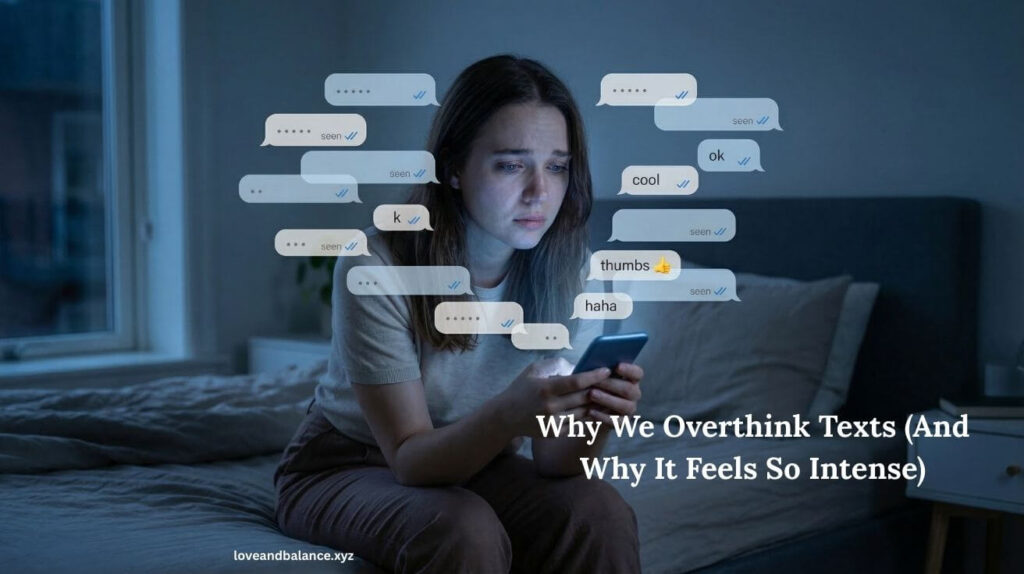
Why We Overthink Texts (And Why It Feels So Intense)
Most people who obsess over texts aren’t “dramatic”; their nervous system has learned to treat silence, short replies, or delays as danger. Because texting removes tone, facial expressions, and body language, the brain fills in the gaps with worst‑case narratives, not neutral ones.
Psychologists call this spiral rumination: replaying conversations, zooming in on one word, and mentally predicting disasters in order to feel prepared. It gives a temporary illusion of control, but research shows it actually keeps anxiety high and makes relationships feel less safe over time.
A Real-Life Story: “Why Didn’t He Put a Heart?”
Let’s imagine a very familiar scenario, based on real clinical patterns therapists see all the time.
Riya has been dating Arjun for a year. Most days, they text good morning, swap memes, and chat casually throughout the day. One Tuesday, she sends, “Reached home, long day, but I’m glad we did that coffee date  .”
.”
He replies 20 minutes later: “Glad you got home safe. Sleep early, tomorrow will be hectic.”
No emoji. No heart. Just a neutral sentence.
For someone with a secure attachment, this might read as caring and normal. For Riya’s anxious attachment, her brain lights up like an alarm system:
“Why didn’t he send a heart back?”
“Is he bored with me?”
“Did I say something wrong at coffee?”
“Is he pulling away so he can leave?”
She opens the chat 10 times, checks when he was last online, types three different follow‑up messages (“Everything okay?” “You seem off” “Are you angry with me?”), and deletes them all. Her heart is racing even though nothing overtly bad has happened.
By the time he texts the next morning again with a casual “Good morning, running late, talk later,” she’s already convinced the relationship is in danger and replies with a long, anxious paragraph. He feels confused and slightly overwhelmed, pulls back a little, and that subtle withdrawal confirms her worst fear.
Nothing “dramatic” happened in the texts themselves. The real story was happening inside her nervous system.
The Psychology Behind Overthinking Text Messages
1. Attachment Styles and Texting
Attachment research shows that anxiously attached people tend to maximise emotional signals and seek frequent reassurance, while avoidantly attached people minimise or shut down emotional expression.
When this meets texting:
Anxious partners may:
Check phones repeatedly
Read into typing bubbles and “last seen”
Send multiple follow‑ups if they don’t get quick responses
Seek reassurance that nothing is wrong
Avoidant partners may:
Reply later, don’t see texting as urgent
Prefer practical messages over emotional ones
Feel pressured by constant check‑ins and pull away a bit
This mismatch doesn’t mean the relationship is doomed; it means the same delay or short reply can feel neutral to one partner and terrifying to the other.
2. Ambiguity and the Brain’s Threat System
Digital communication is missing 70–90% of the nonverbal cues our brain usually uses to interpret safety: tone, facial expression, posture, and eye contact. When information is incomplete, the brain has a bias toward filling gaps with danger, especially if you’ve been hurt before.
Studies on digital communication show that text message overthinking activates stress responses: increased heart rate, tension, cortisol release, and disrupted sleep, even when there is no actual relational threat. Your body reacts to imagined rejection almost as if it were real.
3. Excessive Reassurance Seeking
Attachment research calls the pattern of repeatedly checking that you are still loved and safe “excessive reassurance seeking.” It might look like:
“Are you mad at me?” multiple times in one evening
Asking for a breakdown of why it took 30 minutes to reply
Re‑asking the same safety question in different forms
In the short term, reassurance can calm anxiety. But the daily‑diary data on couples shows that over time, constant reassurance seeking actually reduces trust and increases doubt, especially for anxiously attached partners. The more you ask, the less you believe the answers.
What Actually Happens to Your Relationship When You Overthink Texts
1. You Stop Enjoying the Relationship You’re In
Overthinking texts pulls you out of the present moment and into a hypothetical future where everything has already gone wrong. You stop enjoying:
The sweet messages your partner does send
Real‑life moments when you’re actually together
The stability that may already be there
Research on rumination shows it is linked to higher anxiety, lower mood, and reduced relationship satisfaction, even when the relationship itself is relatively stable.
2. You Miss Their Actual Intentions
When you read texts through a fear filter, you unintentionally distort meaning:
A short “K” becomes “I’m annoyed with you.”
A delayed reply becomes “You’re not a priority.”
A neutral tone becomes “You’re cold and distant.”
Digital communication research notes that the ambiguity of messages leads anxious individuals to assume more negative intentions and to interpret delays as personal rejection. Over time, this builds a parallel fantasy relationship in your head that is far more hostile than the real one.
3. You Accidentally Create Pressure and Conflict
When anxiety drives texting behaviour, partners often respond in protest patterns:
Text bombing after no reply
Over‑explaining, long emotional essays via text
Testing someone by going silent to “see if they care”
Therapists and relationship coaches describe these as protest behaviours—unconscious attempts to pull your partner closer when you feel distant. Unfortunately, they often have the opposite effect: your partner may feel monitored, guilty, or controlled, and may step back to get breathing room.
4. You Attach Your Self-Worth to Blue Ticks
Many clients describe their mood rising and crashing with every ping: a long reply means “I am lovable,” a short one means “I am too much,” and silence means “I am nothing.” Attachment and therapy research consistently shows that when self‑esteem depends heavily on external validation, relationships become fragile and exhausting.
Instead of seeing texts as one channel of communication, they start to feel like a scoreboard for your worth.
Does Texting Itself Ruin Relationships?
Interestingly, research on couples suggests that texting is not inherently harmful. In some cases, it actually supports connection and satisfaction.
Studies have found:
More frequent affectionate, supportive texting is linked with higher relationship satisfaction in many couples.
In long‑distance relationships, higher texting frequency and responsiveness are associated with significantly higher satisfaction compared to geographically close couples.
The problem is less “we text” and more “how we text and how we interpret what we see.”
So texting is a tool. When your internal world is regulated and secure, it enhances connection. When your internal world is flooded with old attachment wounds and anxiety, it becomes a magnifying glass for fear.
Signs You’re Overthinking Text Messages
You might be overthinking texts if you notice:
You check their “last seen” or read receipts repeatedly and feel a physical jolt when they’re online but not replying.
You rewrite messages many times to get the “perfect” sentence and still feel unsure after sending.
Your mood swings dramatically based on how fast they respond.
You re‑read old conversations to prove to yourself that everything is fine—or to collect evidence that they’ve changed.
You frequently ask friends to analyse screenshots and “decode” what your partner meant.
You feel an urge to text again if they haven’t replied “fast enough,” even if it’s only been minutes.
If several of these feel like you, you’re not alone; digital communication research suggests a large majority of people in modern dating report some level of text‑related overthinking and anxiety.
How Overthinking Texts Shows Up in Different Relationship Phases
1. Early Dating
In the first months, there’s naturally more uncertainty. Your brain doesn’t know yet if this person is safe, committed, or consistent. For anxiously attached people, this uncertainty can be almost unbearable.
Common patterns:
Obsessively tracking response times
Interpreting normal busy periods as a total loss of interest
Trying to manage your image through “perfect” texting instead of an authentic connection
2. Established Relationships
Even in long‑term relationships, texting spirals can appear around:
Schedule changes (“He replied short because he’s bored of me.”)
Conflicts (“Her one‑word reply means she’s done with this.”)
Changes in routine (fewer good‑morning texts equals “I’m not special anymore.”)
Research on excessive reassurance seeking shows that in longer relationships, repeatedly checking for safety through texting is associated with lower trust and more emotional exhaustion for both partners.
3. Long-Distance Relationships
Texting is a lifeline in long‑distance relationships, and studies show frequent, responsive texting in LDRs is generally linked with higher satisfaction. But that also means:
When texts slow down, anxiety can spike faster.
The entire relationship can start to feel like it lives inside your phone.
Here, the line between healthy connection and unhealthy overthinking can feel very thin.
How to Stop Overthinking Text Messages (Without Ghosting Your Own Feelings)
You don’t have to eliminate anxiety completely for your relationship to thrive. You just need to change how you respond when it shows up.
Step 1: Name What’s Really Happening
Therapists often recommend labelling the process: “I’m not discovering a hidden truth; I’m ruminating.” This simple step creates mental distance.
You might tell yourself:
“My brain is filling in gaps with worst‑case stories.”
“This is my anxious attachment talking, not reality.”
“Texting is the trigger, not the root problem.”
Labelling your state (anxious, triggered, spiralling) reduces intensity by reminding you that thoughts are not facts.
Step 2: Separate Facts From Fear Stories
Write down:
Facts: “He replied yesterday; he said he was busy today; it’s been 40 minutes.”
Story: “He’s losing interest; I said something stupid; he’s talking to someone else.”
Psychologists emphasise that slowing down to separate observable facts from fear‑based interpretation helps interrupt the overthinking loop. You are training your brain to see that the absence of information is not evidence of rejection.
Step 3: Regulate Your Nervous System Before You Text Again
When you feel the urge to text “Are you mad at me?” in a panic, your body is in a stress response. Before acting from that state, try:
3–5 minutes of slow belly breathing, lengthening the exhale
Grounding through your senses: name 5 things you see, 4 you can touch, 3 you hear, 2 you smell, 1 you taste
Moving your body: a short walk, stretches, or shaking out tension
Research on anxious attachment and emotional regulation shows that building self‑soothing capacity reduces the intensity and frequency of reassurance‑seeking behaviors.
Step 4: Set “Wait Windows” for Yourself
Many people find it helpful to decide on a personal rule, such as:
“I won’t check the chat for 20 minutes after sending a message.”
“If they haven’t replied, I’ll wait at least 2–3 hours before following up, unless it’s urgent.”
This isn’t about playing games; it’s about giving your nervous system time to calm down so you respond, not react.
Step 5: Communicate Your Needs Clearly (Not Through Tests)
Instead of hinting or testing, have a direct conversation during a calm moment:
“Hey, I’ve noticed that when messages suddenly slow down, my anxiety spikes. I’m working on it, but it helps a lot when you give me a quick heads‑up like ‘super busy today, talk later.’ Could we try that?”
Relationship education experts highlight that secure reassurance is specific, consistent, and grounded in reality, while constant validation on demand tends to feed anxiety. You can ask for small, realistic adjustments that don’t require your partner to become your anxiety regulator.
Step 6: Create “Real World Anchors”
If all your safety comes from texts, any disruption will feel huge. Therapy for anxious attachment often focuses on building other anchors:
Real‑life quality time and rituals
Phone or video calls where tone and body language are clearer
Personal routines that don’t depend on your partner’s availability (hobbies, friendships, work focus)
The more your life has structure and meaning outside of your phone, the less each message will feel like a verdict on your worth.
Step 7: Consider Deeper Healing (Therapy, Courses, or Groups)
If overthinking texts has become a pattern across relationships, it’s rarely just about texting. It may be about:
Fear of abandonment
Old experiences of emotional inconsistency or neglect
Low self‑worth and shame around being “too much”
Evidence‑based therapies that work with attachment and anxiety can help you build a more secure internal base so that daily texting rhythms feel manageable instead of catastrophic.
When Is Overthinking Actually a Signal You Should Listen To?
Not every uneasy feeling is an old wound. Sometimes your body is picking up on real patterns:
Your partner consistently disappears for days with no explanation.
Important conversations are always avoided or minimised.
You get defensive or blame‑shifting responses when you share feelings.
Their words and actions are chronically misaligned.
Healthy relationship work distinguishes between anxiety coming from the past and information coming from the present. A helpful self‑check:
“Is this a one‑off change, or a stable pattern?”
“Have I brought this up clearly, and have they made any effort to address it?”
“If a close friend described this, what would I tell them?”
If your overthinking consistently revolves around genuine, repeated disrespect or emotional unavailability, the work might not be to calm down—but to honour what you see and make harder decisions.
Why We Overthink Texts (And Why It Feels So Intense)
FAQs About Overthinking Text Messages in a Relationship
1. Is overthinking texts always a sign of anxious attachment?
Not always, but it’s very common in people with anxious or disorganised attachment patterns. Stress, past betrayal, or current life pressure can also temporarily make anyone more sensitive to texting changes.
2. Can a secure person overthink texts, too?
Yes. Even people who are mostly secure can spiral if they’re going through a vulnerable period (illness, job loss, grief) or if the relationship is genuinely inconsistent. The key difference is that secure people usually come back to baseline faster and trust conversations more than assumptions.
3. Should I tell my partner that I overthink their texts?
In most cases, yes—if you share it in a grounded way and take responsibility for your part. For example: “Sometimes my anxiety makes me overanalyse texts. I’m working on it, but it would help me if we could be a bit clearer about when we’re busy.” This invites collaboration instead of blame.
4. How do I know if I’m asking for “too much” texting?
There’s no universal right amount of texting, only what is sustainable and respectful for both of you. If your partner feels chronically pressured, guilty, or monitored, and you feel chronically deprived even when they’re trying, it might mean your anxiety needs additional support outside the relationship (therapy, coaching, tools), not that they must endlessly increase texting.
5. Can overthinking texts actually ruin a good relationship?
Yes, if it leads to constant accusations, tests, and emotional volatility, it can erode trust and safety over time. The relationship doesn’t have to be perfect, but if one person’s nervous system feels like it is always under threat, both people eventually get tired and disconnected.
6. Is it okay to set boundaries like turning off read receipts?
Absolutely. Boundaries such as turning off read receipts, muting notifications during work, or agreeing not to resolve major conflicts only via text can protect both your mental health and the relationship. Healthy boundaries are not games; they are agreements that support clearer, kinder communication.
7. What if my partner calls me “crazy” or “needy” for feeling this way?
Pathologising language is a red flag. While you are responsible for working on your anxiety, a caring partner will be willing to understand and collaborate rather than mock or dismiss you. Feeling too much does not make you too much.
If you imagine your future self a year from now, what kind of texting dynamic would help you feel both free and connected—more constant contact, or fewer but clearer, more intentional messages?