
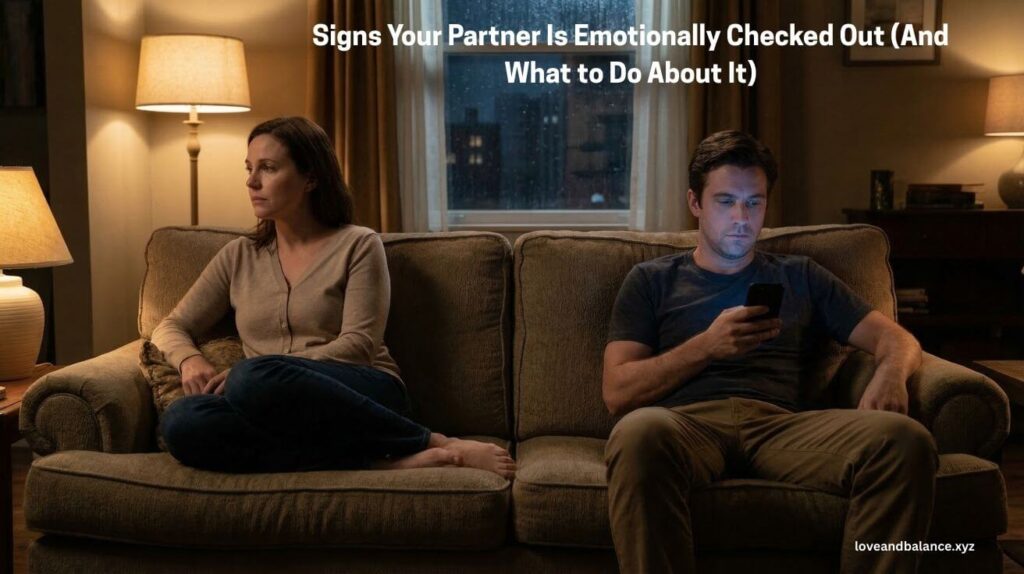
Signs Your Partner Is Emotionally Checked Out (And What to Do About It)
There’s a specific kind of loneliness that hits hardest when you’re not alone — when you’re lying right next to someone, and you still feel like you’re reaching for them through glass.
I’ve heard this described by so many people in the relationship community I work with. They don’t use dramatic words like “betrayal” or “abuse.” They say things like: “He’s here, but he’s not really here.” Or, “I feel like I’m talking to a wall.” That quiet, creeping distance is one of the most painful things a person can experience in a committed relationship.
And it has a name: emotional withdrawal.
This isn’t just a feeling. It’s a documented psychological pattern — and once you understand the real signs, you stop second-guessing yourself.
What “Emotionally Checked Out” Actually Means
Before we dive into the signs, let’s be clear about what we’re talking about. Emotional withdrawal doesn’t always mean your partner hates you or wants to leave. In psychology, it refers to a gradual process where a person begins to disengage from the emotional core of a relationship — the vulnerability, the curiosity, the investment in you as a person.
Researchers studying relationship disengagement have identified three distinct dimensions of this process: emotional indifference (feeling apathetic toward a partner), behavioral withdrawal (avoiding time together or refraining from sharing), and cognitive distancing (mentally detaching or daydreaming to escape closeness). What’s striking is that researchers found the more emotionally disengaged a partner becomes, the less committed and satisfied they feel — even when controlling for other factors like conflict frequency.
This isn’t something that happens overnight. It builds. Slowly. Which is exactly why it’s so easy to miss until the gap feels enormous.
10 Signs Your Partner Is Emotionally Checked Out
1. They’ve Stopped Being Curious About You
Think back to the early days of your relationship. Your partner probably asked about your day — your work stress, your weird dream, the friend drama you were dealing with. That curiosity was a form of intimacy.
When someone emotionally withdraws, one of the first things to disappear is that genuine interest. Psychology research shows that emotionally withdrawing people dramatically reduce what’s called “bidding for connection” — the small, consistent attempts to understand and engage with a partner. It’s no longer that they’re too busy. It’s that they’ve stopped wondering.
If you notice you’re the only one asking questions in your relationship — about feelings, about plans, about what’s going on in each other’s lives — that asymmetry is worth paying attention to.
2. Conversations Stay Permanently Surface-Level
There’s a difference between a quiet night at home and a relationship where deep conversation has quietly disappeared. When your partner has emotionally checked out, discussions that once flowed naturally — about the future, about fears, about what you both want — suddenly get redirected or shut down.
You bring up a concern about your relationship; they suddenly need to check their phone. You try to talk about where you’re headed as a couple; they change the subject. This isn’t accidental avoidance. It’s what psychologists call cognitive distancing — mentally pulling back from any conversation that would require authentic emotional engagement.
3. Arguments Have Mysteriously Stopped — But Not in a Good Way
People often assume that fewer fights means a healthier relationship. But there’s a type of conflict silence that is actually a red flag: the silence that happens when one partner simply stops caring enough to engage.
Dr. John Gottman, the renowned relationship researcher, identified stonewalling — where one partner emotionally shuts down during conflict — as one of the “Four Horsemen” that predict relationship breakdown. When someone has checked out, they don’t fight back because they’ve already mentally left. Arguments no longer escalate because the other person no longer has enough investment to argue. That’s not peace. That’s indifference wearing peace’s clothing.
4. Physical Affection Feels Mechanical or Has Disappeared
Physical intimacy in a relationship isn’t just about sex. It’s the hand held across the table, the hug that lasts a second longer than necessary, the forehead kiss on a Tuesday morning for no particular reason.
When emotional withdrawal sets in, physical warmth tends to follow. A 2024 study published in a couples therapy research journal found that stonewalling and emotional loneliness are significantly linked to sexual disengagement, and that emotional isolation acts as a mediating factor between communication breakdown and physical withdrawal. In plain language: when your partner disconnects emotionally, their body follows. Intimacy starts to feel transactional — or stops entirely.
5. They’ve Dropped “We” From Their Vocabulary
This one is subtle, but it cuts deep when you notice it.
Couples who are emotionally connected naturally use inclusive language — “we should go there,” “our plans,” “what are we going to do?” But a partner who has emotionally checked out begins unconsciously shifting to “I” and “my.” Future plans become yours, not shared ones. Holidays are booked for one. Goals are spoken about individually.
Research in relationship linguistics confirms that couples who use “we” language consistently report higher emotional connection and long-term relationship satisfaction. The opposite is also true: when the “we” disappears from language, it often disappears from the heart first.
6. They Show No Emotional Responsiveness
You get a promotion at work. They offer a flat “congrats.” Your dog passes away. They say “that’s sad” and go back to scrolling. You cry during a difficult conversation. They stare at the ceiling.
Emotional responsiveness — the ability to feel with a partner in their highs and lows — is one of the cornerstones of attachment. When your partner has checked out, this responsiveness dulls into something closer to indifference. They don’t know how to engage with your emotional world because they’ve already stepped outside of it.
This is particularly painful because it can feel like they never cared. But often, the truth is more complicated: something changed.
7. They Make Big Decisions Without You
A partner who is emotionally present thinks of you as part of their equation — naturally, automatically, without being reminded. When emotional withdrawal takes hold, that sense of “us” erodes, and major decisions start getting made solo: job changes, financial choices, social plans, even relocations.
This isn’t just inconsiderate behaviour. It’s a symptom. When someone no longer includes you in their mental model of the future, they’re not just being selfish — they’re revealing that you’ve become separate in their mind.
8. They’ve Become Emotionally Unavailable During Conflict
Every couple has fights. What matters is what happens inside those fights. Healthy couples — even when angry — remain emotionally accessible. They stay in the room, literally and figuratively.
An emotionally checked-out partner, by contrast, will shut down, go physically silent, walk away, or give you the cold shoulder for hours after. Clinical research identifies this stonewalling behaviour as more than conflict avoidance — it’s a reflexive emotional wall that makes resolution impossible and leaves the other partner feeling dismissed and chronically unheard.
9. You Feel Lonelier in the Relationship Than You Would Alone
This sign lives in your gut, not in any specific incident. You can’t point to one thing they did. But you feel it — a hollow, consistent ache that tells you something essential is missing.
Research on emotional loneliness in romantic relationships confirms that this internal experience is often an accurate signal: when one partner withdraws emotionally, the other partner genuinely experiences loneliness within the relationship, which is distinct from — and often more painful than — being single. If you frequently think, “I feel alone even when we’re together,” that feeling deserves to be taken seriously.
10. They’ve Stopped Investing in Your Future Together
Emotionally present partners plan. They talk about trips you’ll take next year, the house you’ll eventually get, the dog you’ll name someday. These conversations aren’t just fantasy — they’re a form of commitment, evidence that someone is building a mental life that includes you.
When a partner checks out, these conversations stop. They avoid making plans beyond the immediate present. Invitations to think about the future are deflected or met with vague non-answers. What they’re communicating — even if they haven’t admitted it to themselves — is that they’re not sure you’re in their future anymore.
Why Partners Check Out: The Real Reasons
Understanding the why doesn’t excuse the behaviour, but it helps you respond wisely instead of just reactively.
Avoidant attachment style: Many people who withdraw emotionally learned early in life that vulnerability leads to pain. Emotional distance becomes a self-protective default.
Accumulated resentment: Unresolved conflicts, unspoken needs, and years of feeling unheard can quietly erode a partner’s emotional investment.
Burnout or depression: Sometimes, emotional withdrawal has nothing to do with the relationship. Mental health struggles, chronic stress, and burnout can make a person emotionally unavailable to everyone, including themselves.
Relationship dissatisfaction: In some cases, the withdrawal genuinely signals that a partner is processing doubts about the relationship’s future.
What You Can Do Right Now
Recognizing the signs is only half the battle. Here’s a grounded, realistic path forward:
Name it without blame. Instead of “You never talk to me anymore,” try “I’ve been feeling disconnected from you lately, and I’d love to understand where you’re at.” Opening with your experience — not their failure — keeps the conversation from shutting down immediately.
Create low-pressure connection moments. Emotionally withdrawn partners often respond better to side-by-side activities (walking, cooking, watching something together) than to face-to-face emotional demands. Reconnection often starts in the body before it reaches the heart.
Get curious about their inner world. Ask about their stress, their fears, their needs. Sometimes a partner who has withdrawn is drowning in something they don’t know how to share.
Consider couples therapy. A skilled therapist provides a neutral, structured space for conversations that feel impossible at home. Research consistently shows that couples therapy significantly improves emotional intimacy and communication patterns, even in relationships with significant withdrawal.
Know your limits. If your attempts at reconnection are consistently met with contempt, indifference, or hostility — and your partner refuses any form of help — that’s important information. You cannot rebuild a relationship alone.
When Emotional Withdrawal Becomes a Pattern You Can’t Ignore
There’s a difference between a partner going through a hard season and a partner who has fundamentally disengaged from the relationship. The former is a human being struggling — and deserves compassion and patience. The latter is a relationship in serious trouble — and deserves honesty.
The way to tell the difference? Pattern and duration. Occasional emotional distance is normal. A consistent, months-long pattern where your partner shows no curiosity about you, no investment in your future, no warmth during your pain, and no willingness to work on it together — that’s a different story.
You deserve a relationship where you are seen. Not just housed. Not just cohabited with. Actually seen, chosen, and emotionally present with.
Signs Your Partner Is Emotionally Checked Out (And What to Do About It)
Frequently Asked Questions
Q: Can a relationship recover after a partner has emotionally checked out?
Yes — but only if both partners are willing to acknowledge the problem and actively work on it. Couples therapy, honest communication, and genuine effort from the withdrawn partner can restore emotional connection. However, recovery requires willingness from both sides. If one partner refuses to engage, the chances of recovery are significantly reduced.
Q: What’s the difference between an emotionally unavailable partner and one who has checked out?
Emotional unavailability is often a longstanding personality pattern, frequently rooted in attachment style. Checking out, on the other hand, usually represents a change — a person who was once emotionally present has gradually withdrawn. The latter often has a specific cause (resentment, dissatisfaction, burnout) that can potentially be addressed.
Q: Is emotional withdrawal the same as the silent treatment?
Not exactly. The silent treatment is a deliberate, punishing form of withholding communication. Emotional withdrawal is broader and often less conscious — it’s a gradual pulling back from emotional engagement, intimacy, and shared investment in the relationship.
Q: How long does emotional withdrawal last before it becomes irreversible?
There’s no universal timeline, but research suggests that when emotional disengagement is left unaddressed for extended periods, it becomes progressively harder to reverse. The longer withdrawal continues without intervention, the more it normalises — and the harder it becomes for either partner to remember what genuine connection felt like.
Q: Should I confront my partner if I think they’ve checked out?
“Confront” isn’t quite the right frame. Approach it as a vulnerable, honest conversation rather than an accusation. Share how you’ve been feeling, ask open questions, and express that you want to understand what’s happening for them. This is much more likely to open a real dialogue than leading with blame.
Q: Is emotional withdrawal always about the relationship?
No. Sometimes emotional withdrawal is driven by external factors — depression, anxiety, work stress, grief, or burnout — that have nothing directly to do with you or the relationship. This is why curiosity and compassion matter as much as boundary-setting.
If you found this helpful, share it with someone who might need it. And if you’re walking through this right now — you are not imagining it, and you are not alone.
About the Author: This blog is part of Love and Balance, a relationship wellness space dedicated to helping people navigate love with clarity, self-awareness, and emotional intelligence. All content is grounded in peer-reviewed research, clinical psychology frameworks, and real experiences shared within our community.