
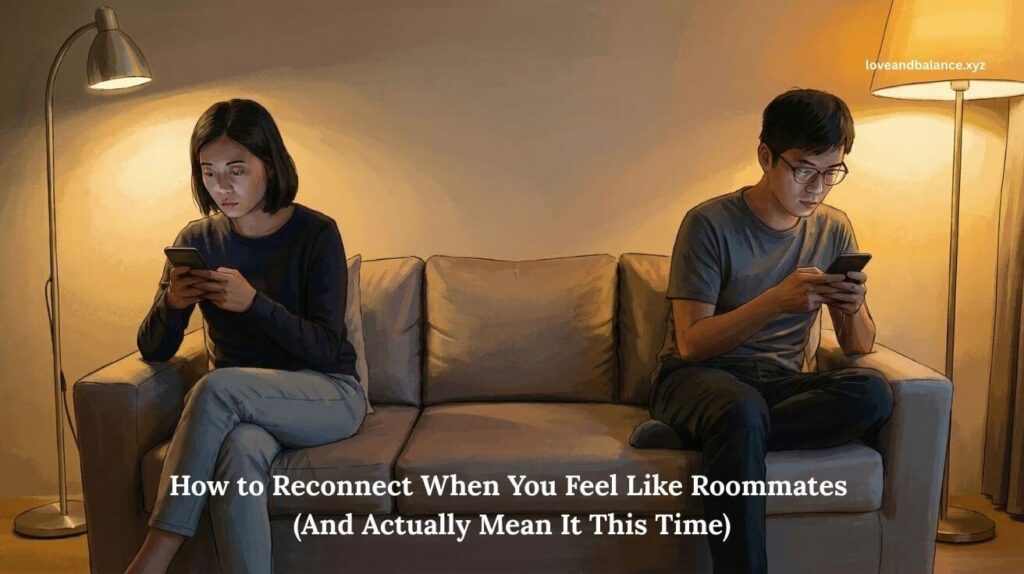
How to Reconnect When You Feel Like Roommates (And Actually Mean It This Time)
There’s a particular kind of loneliness that doesn’t announce itself loudly. It doesn’t come with screaming matches or dramatic ultimatums. It slips in quietly — through dinners eaten while scrolling phones, through “fine” and “good” as the full extent of a day’s conversation, through lying next to someone in bed and feeling like you’re somehow miles apart.
If you’ve ever looked at your partner and thought, When did we become roommates? — You’re not broken. You’re not alone. And this is far from the end.
What “Roommate Syndrome” Actually Means
Roommate syndrome is the term therapists and relationship researchers use to describe couples who are functionally cohabitating — managing a household together, being polite to each other — but have lost the emotional and physical intimacy that makes them partners rather than just co-tenants.
Dr. Mark Travers, a psychologist writing for Forbes, identifies the hallmarks clearly: conversations are almost entirely logistical, affection has dropped off, and the relationship operates on autopilot. You’re not necessarily fighting. In fact, many couples in this phase get along perfectly well on the surface. But beneath that civility is a quiet ache — a hunger for something that used to be there.
Therapists at South Denver Therapy report that a staggering 69% of couples experience some version of roommate syndrome during the course of their relationship. Research published in the Journal of Social and Personal Relationships and referenced by the National Institutes of Health further found that couples with smaller social networks and less shared emotional investment face significantly higher risks of relationship dissatisfaction and eventual dissolution. This isn’t rare. This is a near-universal chapter of long-term love — one that most couples quietly endure rather than actively address.
Why It Happens: The Science Behind the Drift
Understanding the “how” of reconnection starts with understanding the “why” of disconnection.
Your brain stops producing dopamine the same way. In early romantic love, the brain floods with dopamine, norepinephrine, and serotonin — chemicals that make your partner feel endlessly fascinating. Neuroscientists call this “new stimulus response.” Over time, the brain habituates. Your partner becomes familiar, and familiar, by neurological design, does not trigger the same chemical high. This isn’t a failure of love. It’s the biology of long-term bonding shifting gears.
Busyness becomes the default relationship killer. Dr. Carla Manly, a clinical psychologist, explains that decreased communication, hurried schedules, and built-up resentments are among the most common — and least discussed — reasons intimacy fades. You don’t decide to stop connecting. You just keep postponing it: We’ll take that trip later. We’ll have that conversation after the kids are in bed. We’ll reconnect this weekend. Weekends pass. The gap widens.
Openness to Experience matters more than most couples realize. A 2025 personality science study from Truity found that one of the strongest predictors of couples staying emotionally connected over time is the trait of “Openness to Experience” — the willingness to seek new shared adventures, conversations, and ways of seeing each other. Couples high in agreeableness often run smooth households, but can still feel like strangers in their own relationship, because smooth logistics are not the same as emotional intimacy.
The most common reason sex fades isn’t physical at all. According to licensed Marriage and Family Therapist Jacob Brown, the most common reason physical intimacy drops off in long-term relationships is not a loss of desire — it’s a loss of emotional closeness. When couples stop feeling emotionally safe with each other, the body follows. And when they try to “fix” the physical without addressing the emotional, they often end up fighting instead of connecting.
Real Couples, Real Patterns
Consider Erica and Carlos — a couple described by therapist Robert Taibbi in Psychology Today. They rarely argue. They get along “okay.” But there’s no affection, no real conversation, no intimacy. Their days orbit around logistics — who’s picking up groceries, who’s paying the internet bill. On a good day, their relationship is a 4.5 out of 10.
Sound familiar? Maybe not exactly like your situation. Maybe your version looks like two people who still laugh together sometimes, but haven’t had a real conversation in months. Or partners who love each other — genuinely — but have quietly stopped choosing each other.
These patterns don’t mean love is gone. They mean love has gone unattended. And unattended things, whether a garden or a relationship, drift toward neglect.
The Gottman Principle You Actually Need to Know
Dr. John Gottman’s decades of research at the University of Washington produced one of the most cited findings in relationship psychology: the 5:1 ratio. For couples to thrive emotionally, they need five positive interactions for every one negative one. Not five grand romantic gestures. Five anything — a genuine smile, a touch on the shoulder, “I noticed you worked hard today.”
What roommate syndrome does, quietly and systematically, is erode that ratio. The positive interactions don’t become negative — they just disappear. And a neutral, logistics-only relationship reads to the emotional brain as coldness, not safety.
Gottman also introduced the concept of “turning toward” — those small moments when one partner makes a bid for connection (a comment, a question, a touch) and the other either turns toward them with attention, or turns away with indifference. Couples in the roommate phase, almost universally, have stopped turning toward each other. Not out of cruelty — out of habit.
How to Actually Reconnect (Not the Generic Advice)
Here’s where most articles tell you to “schedule date nights” and “communicate more.” And while those things are true, they’re incomplete without the emotional groundwork beneath them. Here’s what actually works — and why.
1. Name It Out Loud — Together
The most powerful first step isn’t a date night. It’s saying, “I miss you. I think we’ve become roommates and I don’t want that.” Vulnerability researcher Brené Brown’s work consistently shows that naming a shared experience defuses its power and opens the door for real connection. You can’t fix what you’re both pretending doesn’t exist.
This conversation doesn’t have to be confrontational. It can be as simple as: “I’ve been thinking about us lately, and I want more with you — I want us to actually feel like partners again.” That sentence, said honestly, changes the air in a room.
2. Rebuild Emotional Safety Before Physical Intimacy
As Jacob Brown, MFT, explains, trying to rebuild physical connection without emotional connection first almost always backfires. Instead, start with curiosity. Ask questions about your partner’s inner world — not their to-do list. What are they hopeful about? What’s been quietly weighing on them? What’s something they haven’t told anyone lately?
Arthur Aron’s famous “36 Questions That Lead to Love” — a study first published in 1997 and still widely referenced in relationship research — demonstrated that mutual vulnerability and progressive self-disclosure create closeness even between strangers. Between partners who already know and care for each other, it works even faster.
3. Create a Daily “Micro-Ritual” of Connection
Research consistently shows that it’s not the big gestures but the small, consistent ones that rebuild intimacy. A micro-ritual could be:
Six-second hugs (Dr. Gottman recommends this specifically — long enough for oxytocin to release)
A daily “rose and thorn” check-in over coffee — one good thing, one hard thing from the day
Putting phones away for the first 20 minutes after both arrive home
Texting one genuine appreciation each day — not “thank you for doing dishes,” but “I noticed how patient you were today and it made me proud to know you”
These aren’t dramatic. They’re not Instagram-worthy. But neurologically, they are exactly what rewires a relationship from coexisting to connecting.
4. Rediscover Each Other’s Changing Selves
Here’s something nobody talks about enough: the person you fell in love with five or ten years ago has changed. So have you. Many couples drift apart not because they stopped loving each other, but because they stopped being curious about who the other person is becoming.
Psychologists call this “partner novelty.” You don’t need to create a new relationship — you need to discover the new version of your existing one. Ask your partner: What do you want more of in your life right now? What’s something you’ve been wanting to try or learn? The answers might surprise you. And surprise, as we established, is one of the few things that actually reactivates the brain’s dopamine response in long-term relationships.
5. Touch More — Non-Sexually, Intentionally
Physical disconnection is both a symptom and a cause of emotional distance. Neuroscience research shows that non-sexual touch — hand-holding, a hand on the back, sitting close on a sofa — releases oxytocin (the bonding hormone) and lowers cortisol (the stress hormone). This isn’t about pressure for physical intimacy. It’s about reestablishing the language of physical safety and warmth that emotional intimacy grows from.
Start small. Reach for your partner’s hand while watching television. Stand close enough to touch while cooking. These micro-moments of physical presence communicate that I still choose you without a single word.
6. Fight Fair — and Fight for Each Other, Not Against Each Other
Roommate syndrome often includes a particular kind of conflict avoidance where couples stop fighting and stop connecting, because both feel equally risky. But Emotionally Focused Therapy (EFT), a research-backed couples therapy model, teaches that conflict is not the enemy — disconnection is. The goal isn’t to eliminate tension, but to learn to navigate it without pulling further apart.
EFT helps couples identify the “negative cycle” they’re stuck in — usually a pursuer-withdrawer dynamic — and map the fear underneath it. One partner withdraws because they fear rejection. The other pursues because they fear abandonment. Both are actually asking the same question: Are you still here? Do I still matter to you? Learning to answer that question — even imperfectly — is the beginning of real reconnection.
7. Seek Help Without Shame
If you’ve tried and the distance feels too wide to bridge alone, couples therapy is not a sign of failure — it’s one of the most proactive, loving things two people can do for their relationship. Research cited in a 2025 study found that 45% of couples who feel like roommates can successfully reconnect within six months by actively addressing the underlying issues — many of them with professional guidance.
Emotionally Focused Therapy (EFT), developed by Dr. Sue Johnson, has one of the highest evidence-based success rates of any couples intervention, with studies showing 70-75% of couples moving from distress to recovery and 90% reporting significant improvement.
What Reconnection Actually Feels Like
It rarely arrives like a dramatic scene from a romantic film. Reconnection tends to show up quietly at first — in the way a conversation extends past logistics, in the moment you catch your partner’s eye and actually smile, in the night you reach for each other without thinking.
The Gottman Institute describes it beautifully: “The house feels warmer. Conversations flow. Laughter sneaks back in. Silence shifts from tense to peaceful. You choose each other not out of routine, but because it genuinely feels good.”
That’s the destination. And it’s entirely reachable from where you are right now.
Signs You’re Making Progress (Even If It Feels Slow)
You don’t need a dramatic breakthrough to know things are shifting. Watch for these smaller signals:
Conversations that start with logistics and drift into something real
Moments of laughter that feel unforced and genuine
A sense of curiosity about your partner returning — wondering about their day, their thoughts, their mood
Physical closeness that doesn’t feel forced or awkward
Feeling seen in at least one small moment per day
Progress in relationships is rarely linear. Some weeks feel like tremendous growth; others feel like sliding backwards. What matters is the direction of the overall trend — and the shared intention to keep moving toward each other.
How to Reconnect When You Feel Like Roommates (And Actually Mean It This Time)
Frequently Asked Questions (FAQs)
Q: How do I know if we’re in the “roommate phase” or if the relationship is actually over?
The key difference is desire — specifically, whether both partners still want to reconnect. Roommate syndrome is characterised by emotional distance and disconnection, but usually coexists with an underlying wish that things were different. If you find yourself missing your partner even while you’re in the same room, that longing itself is data: love is still present. It just needs tending. A relationship that is genuinely over typically involves indifference — not longing.
Q: What if my partner doesn’t think there’s a problem?
This is one of the most common and painful asymmetries in relationships. One partner feels the disconnection acutely; the other has adapted to it or doesn’t recognize it. Rather than presenting it as a problem that needs to be “fixed,” try framing it as something you want — more closeness, more connection, more of what you had. Saying “I miss us” is harder to dismiss than “We have a problem.”
Q: Can a relationship recover from years of emotional distance?
Yes — with honesty and consistent effort. Research shows that even deeply entrenched patterns can shift when both partners are willing to engage. The caveat is that recovery takes longer when the distance has been sustained for years, and professional support (couples therapy or EFT) can dramatically accelerate the process.
Q: Is it normal to love someone but not feel in love with them anymore?
Completely normal — and also completely workable. Dr. John Gottman distinguishes between passionate love (early-stage, high-dopamine) and companionate love (deep attachment, trust, and commitment). Many couples mistake the fading of passionate love for the ending of love itself. In reality, companionate love is more durable — it just requires intentional cultivation rather than the automatic fuel of novelty. Reigniting intimacy often involves creating new shared experiences that generate fresh emotional and neurological responses.
Q: How long does it take to reconnect after feeling like roommates?
This varies enormously by couple and the depth of disconnection. Research suggests that couples who actively address the underlying issues — through communication, daily connection rituals, and professional support if needed — can experience meaningful reconnection within three to six months. However, even small shifts can produce noticeable warmth within weeks. The first conversation, the first genuine vulnerability — those can change the emotional temperature of a home almost immediately.
Q: Should we be worried if we don’t argue much?
Not necessarily — but it depends on why. Low conflict rooted in genuine security and mutual understanding is healthy. Low conflict rooted in avoidance, apathy, or fear of rocking the boat is often a sign of disconnection rather than harmony. If your lack of fighting feels more like emotional flatness than peaceful understanding, that’s worth paying attention to.
Q: Can individual therapy help with roommate syndrome?
Yes, especially if one partner is more resistant to couples therapy. Individual therapy can help you understand your own attachment patterns, communication habits, and emotional needs, which in turn change how you show up in the relationship. Many couples find that one partner starting individual therapy creates enough of a shift in the relational dynamic that the other partner becomes more open to joint work.
A Final Word
Feeling like roommates doesn’t mean your relationship is broken — it means it’s asking for attention. Every long-term partnership hits this chapter. The couples who come out the other side with a love deeper and more honest than the honeymoon phase aren’t the ones who avoided this season. They’re the ones who chose to walk through it — honestly, imperfectly, and together.
The fact that you’re reading this, asking these questions, looking for a way back — that already means something.
At Love and Balance, we write about the real, layered, sometimes uncomfortable truths of modern relationships — backed by research, grounded in lived experience, and always written with the belief that connection is worth fighting for.