
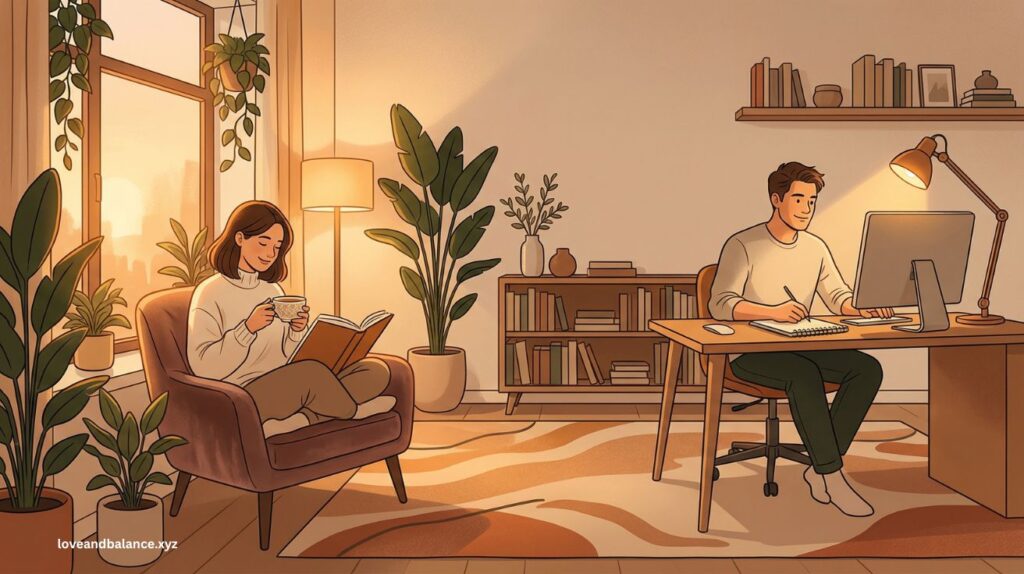
Healthy Ways to Take Space Without Damaging Trust
By the Love and Balance Editorial Team | Relationship Psychology & Emotional Wellness
Last Updated: March 2026 | 12-min read
Let me be honest with you — the first time I needed space in a relationship, I didn’t know how to ask for it. I went quiet. I became distant. And instead of getting the breathing room I desperately needed, I ended up with a partner who felt abandoned, a conversation that spiralled into blame, and a trust that took weeks to rebuild.
That experience taught me something nobody tells you upfront: taking space is a skill. And when done right, it is one of the most loving and powerful things you can do for yourself and your relationship.
This isn’t just my story. Research, real couples, and relationship therapists all confirm it — healthy space doesn’t push people apart. It brings them closer.
Why “Space” Has Such a Bad Reputation
The word space in a relationship often carries the weight of dread. For many people, hearing “I need space” triggers immediate panic — a fear of abandonment, a sign that something is deeply wrong, or the beginning of a slow goodbye.
But this emotional association is largely a myth shaped by avoidant behaviour and poor communication, not by space itself.
A 2023 study published in the Journal of Personal Relationships using the relational turbulence theory examined couples during COVID-19 lockdowns — a period when many couples were forced into too much togetherness. The study found that relationship uncertainty, rather than the act of needing space itself, was the source of emotional distress. In other words, it wasn’t that partners wanted time apart — it was the lack of clarity around that need that caused damage.
This is a crucial distinction. Space, when communicated with honesty and warmth, is not a threat to the relationship. It is an investment in it.
The Psychology Behind Needing Space
Every human being — no matter how deeply in love — has what psychologists call self-regulatory needs: the internal requirement to return to your own sense of self, to process emotions privately, and to replenish your emotional reserves.
Dr. Susan Heitler, a Denver-based clinical psychologist and author of The Power of Two, has long argued that the healthiest couples operate from a place of “two whole people” rather than two halves completing each other. When one partner feels suffocated, it’s often because the relationship has unconsciously shifted into enmeshment — where individual identity dissolves into the couple’s identity.
Attachment theory also plays a significant role here. Research on adult attachment styles consistently shows that anxiously attached individuals tend to interpret a partner’s need for space as personal rejection, while avoidantly attached partners may use “needing space” as a defence mechanism to escape emotional vulnerability. Neither is truly taking space in a healthy sense — one runs toward in panic, the other runs away in avoidance.
Healthy space sits right in the middle: intentional, communicated, and time-bounded.
7 Healthy Ways to Take Space Without Damaging Trust
1. Have the Conversation Before You Disappear
The single most damaging thing you can do when you need space is to simply go quiet without explanation. Silence is not space — it is emotional abandonment, and it leaves your partner’s nervous system in a state of high alert.
According to psychologist Dr. Mark Travers, writing for Forbes, the difference between healthy space and harmful distance comes down to one thing: communication that comes early and clearly. He emphasises that when you express your needs before withdrawing, you give your partner a framework to understand your behaviour — and that framework is what preserves trust.
A simple script that works:
“I’ve been feeling a little overwhelmed lately, and I think some solo time this weekend would really help me recharge. This isn’t about us — I just need to fill my own cup. Is that okay with you?”
This sentence does three things simultaneously: it names the need, removes blame from the partner, and invites collaboration. That combination is the foundation of trust-safe space.
2. Define What Space Means — For You, Specifically
“Space” is not a universal experience. For one person, space means spending a Saturday afternoon alone with a book. For another, it means a weekend trip to visit a friend in another city. For someone else, it means taking a temporary pause from heavy emotional conversations.
The mistake most couples make is using the word “space” without defining it — leaving the other partner to fill in the blanks with their worst fears.
Before you ask for space, get specific with yourself:
Is this physical space (time alone in a room, a day out by yourself)?
Is this emotional space (a pause from deep discussions for a day or two)?
Is this social space (time with your own friends without your partner)?
Is this mental space (a weekend with no relationship-related texts or calls)?
When you’re clear on what you actually need, your partner can understand it — and even support it — rather than spending the entire time wondering if you’re about to leave them.
3. Offer Reassurance — Don’t Just Vanish
A 2021 study on emotional neglect published in The Journal of Early Adolescence found that emotional absence — even brief and unintentional — correlates with diminished emotional clarity in partners, particularly those with histories of abandonment or neglect. This means that when you take space without reassurance, the people who love you most are left not just confused, but emotionally disoriented.
Reassurance doesn’t mean checking in every hour. It means giving your partner a simple emotional anchor before you step away.
Examples of reassuring language:
“I love you. I just need a day to myself. I’ll be back to normal tomorrow evening.”
“This has nothing to do with you or us. I just process things better with some quiet time.”
“I’ll text you tonight so you know I’m okay.”
These small sentences cost you almost nothing — but they protect your partner’s emotional security entirely.
4. Use Space Productively, Not Passively
There is a meaningful difference between restorative space and avoidance space.
Restorative space is intentional: you journal, you rest, you pursue a hobby, you spend time with a friend, you sit with your feelings and process them. When you come back to the relationship, you feel genuinely recharged — with more patience, more presence, more love.
Avoidance space is reactive: you scroll social media for hours, you ruminate on grievances, you build a mental case against your partner, or you simply numb out. When you come back, you’re no more resolved than when you left — and your partner senses it.
Many therapists, including those at BetterHelp’s editorial team, suggest using the time apart to genuinely reconnect with yourself — not to mentally rehearse arguments or create emotional distance. The quality of what you do with your space directly determines the quality of what you bring back to the relationship.
Ideas for productive space:
Long walks or solo exercise
Journaling your emotions without editing them
Calling a close friend or sibling
Pursuing a creative project you’ve been neglecting
Meditation or a digital detox afternoon
5. Set a Loose Time Frame
One of the most anxiety-inducing aspects of “I need space” is the open-endedness of it. When your partner doesn’t know if you mean two hours or two weeks, their brain will almost always catastrophise.
You don’t need a rigid schedule — but a loose time frame goes a long way in maintaining trust.
“I’d like some personal time this weekend, and I’ll be in a much better headspace by Sunday evening” is worlds apart from a silent withdrawal that stretches into unexplained days.
This principle is also practical. When you give space a container — a start and an end — it becomes a healthy habit rather than a destabilising pattern. Both partners know the shape of what’s happening, and that predictability is deeply calming to the nervous system.
6. Honour Individuality as an Ongoing Practice, Not a Crisis Response
The biggest mistake couples make is that they only think about personal space when someone is overwhelmed, burned out, or on the verge of emotional shutdown. By that point, asking for space feels urgent and loaded — and it almost always triggers alarm in the other person.
The healthier approach is to build space into the architecture of your relationship from the beginning.
Real couples who do this well share a common trait: they actively encourage each other’s individual lives. They celebrate solo friendships, personal hobbies, and independent goals. A 2025 relationship wellness report highlighted by HealthyHCL noted that partners who scheduled individual “me time” proactively — treating it like a standing appointment, not an emergency exit — reported significantly lower rates of resentment and emotional burnout in their relationships.
This shifts space from being a warning sign to a wellness ritual.
7. Reconnect Intentionally After Space
Taking space is only half the equation. The other half — the part most people skip — is the intentional return.
When the space ends, come back to your partner with presence. Not just physically — emotionally. Check in with them. Acknowledge that the time apart may have created some anxiety, and appreciate that they held space for your needs.
A simple “Thank you for giving me that time — I feel so much more myself and I’m really happy to be back with you” does more for relationship trust than almost anything else.
This closing ritual transforms space from a disconnection into a cycle of growth. Your partner learns that space doesn’t mean loss. It means return. And every healthy return deepens the trust between you.
Real Story: What Happened When Maya Asked for Space the Right Way
Maya, 31, a marketing professional from Bangalore, had always been the “more social” one in her relationship. Her partner Arjun, preferred quieter evenings at home. After two years together, Maya started feeling a subtle but growing need to have whole weekends to herself — not because she loved Arjun less, but because she felt like she had lost touch with her own life.
The first time she tried to take space — without this framework — she simply started making plans without explaining why she was pulling back. Arjun, who had an anxious attachment style, spiralled into self-doubt and resentment. They had one of their worst arguments.
The second time, Maya did something different. She sat down with Arjun over tea and said: “I’ve realised I need some solo time once a month — maybe a full weekend. It genuinely helps me come back happier and more present. Can we talk about what that could look like?”
That single conversation changed everything. Arjun, who initially feared the worst, actually felt respected and included by being part of the solution. He used Maya’s solo weekends to visit his own friends. They both came back to each other recharged.
Within three months, they described their relationship as closer than it had ever been — not despite the space, but because of it.
What the Research Tells Us About Space and Relationship Health
The science on this is surprisingly consistent:
A 2023 SAGE Journals study on spatial proximity in couples found that while physical closeness increased shared reality in relationships, it did not automatically predict relationship satisfaction. Emotional quality, not quantity of time together, was the real driver of contentment.
Research from BYU’s ScholarsArchive found that the way couples use space — either as a diagnostic tool or as a growth strategy — directly correlates with relationship quality. Distressed couples used space reactively; thriving couples used it proactively.
A COVID-19 lockdown study using relational turbulence theory found that it was relationship uncertainty, not physical distance, that damaged emotional bonds — confirming that communication around space is far more important than the space itself.
The data points to one clear conclusion: space, paired with communication and reassurance, is not a risk factor for relationships. It is a protective factor.
Signs You’re Taking Space in a Healthy Way
Ask yourself these questions when you step back from a relationship:
Did I tell my partner I needed space before going quiet?
Did I define what kind of space I need?
Did I offer reassurance that this is about my needs, not a rejection of them?
Did I give a loose time frame?
Am I using this time to genuinely restore myself?
Do I plan to reconnect intentionally when the space ends?
If most of these are yes, you are taking space in a way that builds — not breaks — trust.
Signs Space Is Becoming Avoidance
Healthy space has limits. Watch out for these red flags:
You consistently use “space” to avoid difficult but necessary conversations
Space never has a defined end — it just drifts
You feel relief at being away from your partner, but dread returning
You offer no reassurance and don’t check in at all
Your partner consistently feels punished when you withdraw
Space has become your go-to response to every conflict
If you recognise these patterns, it may be time to explore what’s actually going on beneath the surface — ideally with a therapist or relationship coach.
Healthy Ways to Take Space Without Damaging Trust
FAQs: Healthy Ways to Take Space in a Relationship
Q1: How do I ask for space without my partner thinking I want to break up?
Use clear, reassuring language that separates the need for space from the health of the relationship. Say something like: “I need some time to recharge — this is about filling my own cup, not stepping away from us.” Specificity and warmth remove the ambiguity that leads to panic.
Q2: How much space is too much space in a relationship?
There is no universal number, but the quality matters more than the quantity. Space becomes harmful when it is used to avoid the relationship rather than restore yourself, when it has no time frame, or when your partner consistently feels abandoned rather than supported during it.
Q3: Is needing space a sign that the relationship is failing?
No. In fact, the opposite is often true. Research consistently shows that couples who maintain individual identities and pursue personal interests are more satisfied in their relationships than those who are entirely enmeshed. Needing space is a sign of self-awareness, not relationship failure.
Q4: What if my partner doesn’t respect my need for space?
Start by having a calm, non-defensive conversation about why personal space matters to you and how it actually benefits the relationship. If your partner continues to resist, this may point to their own attachment wounds around abandonment — something worth exploring together or with a couples’ therapist.
Q5: Can taking space actually make a relationship stronger?
Absolutely — and the research backs this up. Couples who proactively build individual time into their relationship report higher levels of trust, lower resentment, and deeper appreciation for each other. The absence of space often creates the very resentment and disconnection that couples fear space will cause.
Q6: How is a healthy space different from the silent treatment?
The silent treatment is punitive — it is withdrawal used as emotional punishment or manipulation. Healthy space is communicative — you name your need, reassure your partner, and return intentionally. One builds anxiety; the other builds trust.
Q7: Should I check in with my partner while taking space?
A brief, warm check-in (not a lengthy emotional conversation) can be genuinely reassuring to your partner without undermining your space. A single text saying “Just wanted to say I love you — I’ll be back to myself by tomorrow” costs you almost nothing and protects them enormously.
A Final Word from Love and Balance
Space is not the enemy of love. Silence, confusion, and unmet needs are.
When you learn to ask for space with clarity, offer it with compassion, and return from it with presence — you stop treating space as a threat to your relationship and start using it as one of its greatest tools.
The couples who last aren’t the ones who are always together. They are the ones who trust each other enough to be apart.
At Love and Balance, our content draws on peer-reviewed research, real relationship experiences, and the insights of licensed therapists and relationship psychologists. We are committed to giving you honest, practical guidance that reflects both the science and the lived reality of modern relationships.
If you found this helpful, explore more on our blog:
[Can Anxious and Avoidant Relationships Work? The Honest Truth No One Tells You], [How to Reconnect When You Feel Like Roommates], [Relationship Advice That Actually Works].