
Lonely in a Relationship? 7 Hidden Causes and 9 Fixes That Work
By Love and Balance team| Last updated: October 2026 | 12-minute read
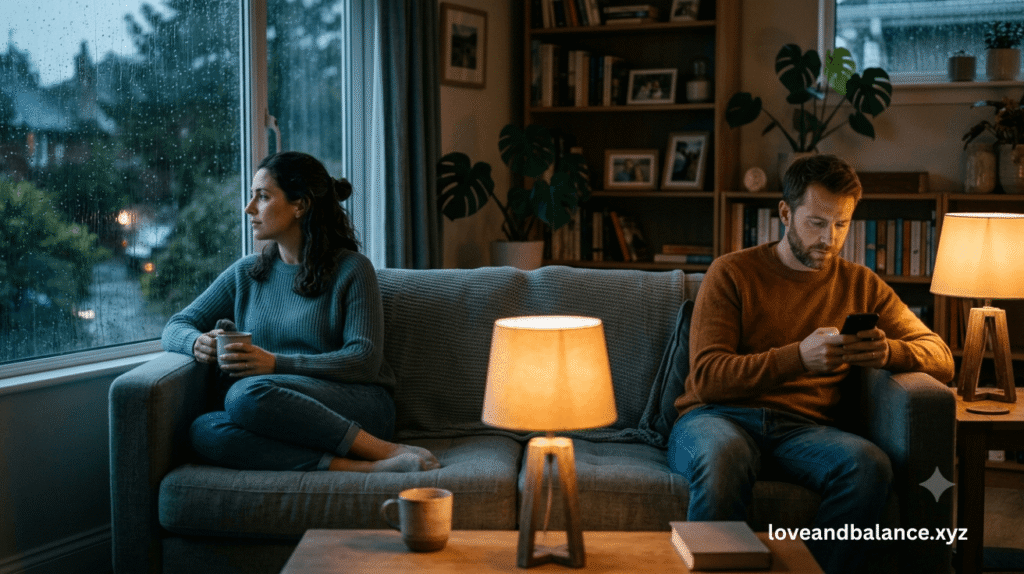
You are lying next to someone you love. They are three feet away, scrolling through their phone, and you have never felt further from another human being.
If that sentence hit a nerve, you are in far bigger company than you think. Feeling lonely in a relationship is one of the most common and least discussed problems couples face, partly because it feels like a betrayal to say it out loud. After all, you have a partner. You are not supposed to be lonely.
But loneliness was never about how many people are in the room. It is about whether you feel seen, heard and emotionally safe with the people around you. In this guide, we will walk through why this happens, what the research actually says, and nine practical steps you can start using this week, whether your relationship is three months old or thirty years old.
Quick takeaways: Loneliness inside a relationship is usually a connection problem, not a love problem. It often grows quietly from small, repeated moments of emotional distance. The good news: connection skills can be rebuilt, and most of the fixes below cost nothing.
Why Feeling Lonely in a Relationship Is More Common Than You Think
Let’s start with the bigger picture. In 2023, the U.S. Surgeon General, Dr. Vivek Murthy, issued a public advisory calling loneliness and isolation an epidemic, noting that lacking social connection carries health risks comparable to smoking up to 15 cigarettes a day (U.S. Surgeon General’s Advisory). In mid-2025, the World Health Organization’s Commission on Social Connection reported that roughly 1 in 6 people worldwide is affected by loneliness, linking it to an estimated 871,000 deaths a year.
Those numbers reflect society as a whole, but here is the part that rarely makes the headlines: being partnered doesn’t make you immune. Loneliness researchers distinguish between social loneliness (not having enough people around) and emotional loneliness (not having someone who truly gets you). You can be surrounded by family, have a full calendar and share a bed every night, and still live with the second kind.
A landmark meta-analysis by Julianne Holt-Lunstad and colleagues, published in PLOS Medicine and covering 148 studies and more than 300,000 people, found that people with stronger social relationships had a 50% greater likelihood of survival over the study periods. The quality of your closest relationships matters for far more than your mood.
The long-running Harvard Study of Adult Development, which has followed participants since 1938, reached a similar conclusion. Its current director, Dr. Robert Waldinger, has noted that satisfaction with relationships at age 50 predicted health at 80 better than cholesterol levels did. In plain language: how connected you feel to your partner is not a soft, optional extra. It is part of your health.
What Does Loneliness in a Relationship Actually Feel Like?
Everyone experiences it a little differently, but these are the signs people describe most often:
• You share the day’s logistics (kids, bills, dinner) but not your real thoughts.
• You feel more understood by a friend, a coworker or even a stranger online than by your partner.
• You stop bringing up what bothers you because it feels pointless.
• Physical closeness feels mechanical, or you start avoiding it altogether.
• You feel relieved when your partner is out of the house, then guilty about that relief.
• You daydream about being known by someone, anyone, in a way you currently are not.
If you nodded at three or more of these, that does not mean your relationship is doomed. It means something in the connection needs attention, and that is exactly what the rest of this article is for.
7 Hidden Causes of Feeling Lonely in a Relationship
1. Emotional disconnection that builds quietly
Most couples do not drift apart in one dramatic moment. They drift through thousands of tiny ones. The relationship researcher Dr. John Gottman calls these moments “bids for connection”: a sigh, a comment about your day, a request to look at something funny. In his lab studies of newlyweds, couples who were still married six years later had turned toward each other’s bids about 86% of the time, while couples who later divorced did so only about 33% of the time (The Gottman Institute). Loneliness often grows in that gap, one ignored bid at a time.
2. Phones, screens and “phubbing”
There is even a word for snubbing your partner in favour of your phone: phubbing. A 2016 study by Meredith David and James Roberts in Computers in Human Behaviour found that nearly half of the people surveyed said their partner had phubbed them, and that this behaviour was linked with more conflict and lower relationship satisfaction. A phone on the dinner table says, without a single word, “something out there is more interesting than you.”
3. Unequal emotional labour and exhaustion
When one person is carrying the planning, the parenting, the remembering and the emotional check-ins, they end up feeling like a manager, not a partner. Add chronic tiredness, and there is simply no energy left for curiosity about each other. Exhaustion does not feel like loneliness at first. It feels like irritation. Underneath, it often is loneliness.
4. Big life transitions
A new baby, a job loss, a move to a new city, caring for ageing parents, retirement. Each of these reshuffles roles and routines. Couples often say, “We were fine until…” That is not a coincidence. Transitions pull attention outward, and unless you consciously protect time together, the relationship quietly drops to the bottom of the list.
5. Unspoken needs and fear of rejection
Many people believe a loving partner should simply know what they need. They do not, because nobody can read minds. So, the need goes unspoken, goes unmet, and turns into quiet resentment. Others stay silent for the opposite reason: they did speak up once, felt dismissed, and learned it was safer not to try again.
6. Different attachment styles
Attachment theory, first developed by John Bowlby, suggests we carry patterns from early relationships into adult love. One common mismatch is the anxious partner who seeks closeness when stressed paired with an avoidant partner who withdraws when stressed. The more one pursues, the more the other retreats, and both end up feeling alone. If that loop sounds familiar, our article on why your partner feels emotionally distant digs into it further.
7. Unresolved hurt, neglect or betrayal
Sometimes the loneliness is the symptom of something deeper: an old argument that never got repaired, a broken promise, or a long stretch of being emotionally overlooked. If you recognise years of feeling invisible, read about the signs of emotional neglect in a relationship. Naming it is often the first step in healing it.
A Few Real-Life Patterns (Composite Examples)
The following scenarios are illustrative composites based on patterns commonly described in couples counselling literature, not individual case studies.
The “roommates” couple. After their second child, Maya and Dev (names changed) ran their home like a well-oiled machine. Nobody was fighting. But at the end of one very ordinary week, Maya realised she could not remember the last time Dev had asked her a question that was not about schedules. Nothing was “wrong”, and that was precisely the problem. The distance was silent, which made it hard to point to.
The “always online” couple. Tom worked remotely, and Anna worked hospital shifts. When they were finally in the same room, Tom was catching up on messages, and Anna was too drained to start a conversation. Both thought the other did not care. In reality, both were hungry for connection and too tired to ask for it.
Notice what these stories share: no villain, no affair, no big blow-up. Just two people who stopped feeling like a team. That is also why repair is more achievable than most people think.
9 Practical Solutions for Feeling Lonely in a Relationship
1. Name it without blaming
Start with how you feel, not what they did wrong. Compare “You never talk to me anymore” with “I’ve been missing you lately, and I’d love for us to reconnect.” The first invites defence. The second invites a response. Pick a calm moment, not mid-argument or at midnight.
2. Turn toward small bids every day
Remember Gottman’s 86%? You do not need grand gestures, only consistency. When your partner shares something, even something trivial, pause, look up and respond. Make it a personal experiment for seven days and watch what changes.
3. Create a screen-free ritual
Choose one small window, maybe 20 minutes after dinner or the first coffee of the morning, where phones live in another room. Ritual works because it removes the need to “find time”, which, let’s be honest, never appears on its own.
4. Ask better questions
“How was your day?” gets “fine.” Try “What was the best part of today?”, “What’s been on your mind lately?” or “Is there anything I could do to make this week easier for you?” Curiosity is the antidote to being taken for granted.
5. Share one vulnerable thing a week
Intimacy grows when you reveal something real: a worry, a small fear, a hope you have not said aloud. You are not asking your partner to fix it. You are letting them in. Many couples find that one honest ten-minute conversation does more than a month of date nights.
6. Rebuild your own world, too
Counterintuitively, a healthy relationship is not one where your partner meets every need. Reconnect with friends, pick up a hobby, join a class, move your body. People with full lives bring more to the relationship and feel less desperate when it is going through a rough patch. Just be careful this does not become an escape from the relationship.
7. Rediscover play and physical affection
Hold hands. Hug for a full 20 seconds. Cook something new together. Play a silly game. Non-sexual touch and shared laughter release the same bonding chemistry as bigger romantic moments and rebuild the sense of being on the same side.
8. Look at the pattern, not the person
Most couples fight the same fight in different clothing. Ask yourselves: “What is our cycle?” For instance, you push and they pull away, or you criticise and they shut down. When both of you see the loop as the enemy, you stop seeing each other as the enemy.
9. Get professional support early
A couples therapist is not a last resort. Emotionally Focused Therapy (EFT), developed by Dr. Sue Johnson, was designed specifically to repair emotional bonds, and researchers behind it report that around 70 to 75% of couples move from distress to recovery, with roughly 90% showing significant improvement. Gottman Method therapy is another evidence-informed option. If your partner will not go, individual therapy can still help you understand your own patterns and options.
When Loneliness Is a Red Flag, Not Just a Rough Patch
Everything above assumes a basically safe relationship where both people are willing to try. Loneliness can also signal something more serious, such as controlling behaviour, constant criticism, contempt, being isolated from friends and family, or fear of your partner’s reaction. If you feel unsafe, or if sadness has tipped into hopelessness, please talk to a qualified professional or a trusted person in your life, or contact a local crisis or domestic violence helpline. Your wellbeing comes first.
A Gentle Reality Check
Reconnection takes weeks, sometimes months, not days. You may try something and get a shrug. That does not mean it failed; it means you are starting from a long stretch of distance. Consistent, small, kind effort beats one dramatic gesture every time. And if, after sincere effort, your partner will not engage at all, it is reasonable to ask what kind of future you want. That is a decision for you, ideally with professional guidance, and I will not pretend there is a one-size-fits-all answer.
Final Thoughts
Feeling lonely in a relationship doesn’t make you ungrateful, needy, or broken. It makes you human, someone who needs to be known. The loneliness is information, pointing to a connection that needs tending. Start small: one honest sentence, one phone-free evening, one question that goes beyond “how was your day?” You might be surprised how much your partner has been waiting for the same thing.
Lonely in a Relationship? 7 Hidden Causes and 9 Fixes That Work
Frequently Asked Questions (FAQs)
Is it normal to feel lonely in a relationship?
Yes. Emotional loneliness inside a relationship is very common, especially during stressful phases like parenting young children, career changes or after a conflict that was never repaired. It is a sign that your need for connection is not being met, not proof that the relationship is over.
Why do I feel lonely even though my partner is always around?
Physical presence is not the same as emotional presence. If conversations are mostly practical, or if screens and stress take up the space where connection used to be, you can feel alone even in the same room.
Can a relationship survive when one person feels lonely?
Often, yes. Loneliness is usually the result of a pattern, not a character flaw, and patterns can change when both people are willing to communicate and put in consistent effort. Couples therapy can speed this up significantly.
How do I tell my partner I feel lonely without starting a fight?
Choose a calm moment, start with “I” statements, and describe your feelings rather than their faults. For example: “I’ve been feeling distant from you and I miss us. Can we spend some time together this week?”
Is feeling lonely in a marriage a sign of divorce?
Not by itself. Persistent loneliness combined with contempt, no willingness to repair and no effort from either side is a bigger warning. Loneliness alone is a signal to reconnect, not a verdict.
Why do I feel lonely in a relationship with a good partner?
A good person can still be a mismatch in communication styles, or may simply be overwhelmed. Attachment differences, stress and unspoken expectations can create distance even when there is genuine love.
Should I see a therapist alone or with my partner?
Both can help. Couples therapy addresses the shared pattern; individual therapy helps you explore your own needs, attachment style and boundaries. If your partner is unwilling, start with yourself.
How long does it take to feel connected again?
Many couples notice small shifts within two to four weeks of consistent effort, such as better conversations and more warmth. Deeper repair may take months. Progress is rarely a straight line.
Keep Reading: More Guides to Strengthen Your Relationship
If this article struck a chord, you do not have to stop here. Understanding why your partner feels emotionally distant and what to do about it can help you see the other side of the story. If you suspect the loneliness has deeper roots, our guide to the 11 signs of emotional neglect in a relationship and how to heal is a must-read. And if you are in the early stage and constantly second-guessing mixed signals, do they like me or am I overthinking texts? 11 real signs will help you read the situation more clearly. Explore all three on Love & Balance and take one small step toward the connection you deserve today.
Want Extra Guidance to Save Your Marriage?
If you are a husband or partner who sees your marriage drifting and wants a structured, step-by-step plan rather than guessing, you may want to look at The Last-Ditch Marriage Saver for Men. It is a digital programme designed to help men understand their partner’s emotional needs and take practical action. Check out the programme here and see whether its approach fits your situation. Remember, no programme replaces honest conversation with your partner or professional counselling when it is needed, but extra guidance can give you a starting point.

Affiliate Disclosure: This article contains an affiliate link. If you click it and make a purchase, I may earn a commission at no extra cost to you. I only mention products I believe may be useful to readers, and the opinions in this article are my own. I have not guaranteed any result, and results vary from person to person.
Disclaimer: This article is for general informational and educational purposes only. It is not medical, psychological or legal advice and is not a substitute for professional diagnosis or treatment. If you are experiencing severe distress, depression, thoughts of self-harm, or you feel unsafe in your relationship, please contact a licensed mental health professional or your local emergency or crisis service immediately.