

Why Love Feels Like Anxiety: 7 Real Reasons
By Love and Balance Team. Last updated: October 2026 | 11 min read
You finally meet someone who makes your whole chest light up. Then, around 2 a.m., you’re staring at the ceiling, replaying a text you sent three hours ago and wondering if that full stop meant something. If that’s you, take a breath. You’re not broken, and you’re not “too much.” Plenty of people ask why love feels like anxiety, and the honest answer is that the two states share a surprising amount of biology.
Below are seven reasons, drawn from real studies (including a 1999 experiment in Pisa that put new lovers next to people with obsessive-compulsive disorder), plus practical ways to turn the volume down without losing the love. I’ll also flag where the research is solid and where it’s thinner than the headlines make it sound.
The short answer Love and anxiety both rev up your nervous system. New love shifts serotonin-related activity, switches on dopamine-driven “wanting,” activates your attachment system and brings stress hormones along for the ride. Add uncertainty or old hurt, and your body can read closeness as risk. It’s common, often temporary, and workable. |
Is It Normal for Love to Feel Like Anxiety?
Yes. Very. Anxiety and excitement are close cousins: your heart speeds up, your stomach flips, your attention narrows, and sleep gets patchy. The body can’t always tell whether a racing pulse means “thrilling” or “threatening,” so it often hands you both at once.
Normal doesn’t mean you should wave it away, though. Sometimes the nerves are simply what caring feels like. Other times they point to an old wound, or to a relationship that really isn’t safe. The sections below help you tell which is which.
1. Early Love Looks a Bit Like Obsession in the Brain
In 1999, psychiatrist Donatella Marazziti and her colleagues at the University of Pisa measured a serotonin-related marker in blood platelets from three groups of 20 people: those who had fallen in love within the previous six months, people with untreated obsessive-compulsive disorder, and a control group. The new lovers and the OCD group looked alike, and both differed from the controls (study abstract). Serotonin helps keep repetitive thoughts in check, so the result fits what many of us live through: one person, on a loop, all day.
Two honest caveats. The sample was small, and a platelet marker is only an indirect clue about the brain. It does not mean love is a disorder. A later research paper summarising this work notes that the marker returned to normal after 12 to 18 months, which matches what many couples report: the mental static settles.
2. Dopamine Makes You Want, and Wanting Is Restless
When Arthur Aron, Helen Fisher and colleagues scanned 17 people who were intensely in love (for anywhere from 1 to 17 months), looking at a photo of the beloved lit up dopamine-rich reward areas, including the ventral tegmental area and the caudate nucleus (Journal of Neurophysiology, 2005). These regions drive motivation and craving, not just pleasure.
That’s the catch. A craving system is, by design, a little uncomfortable. It pushes you to check your phone, plan the next meet-up, seek the person out. When they’re unreachable for a few hours, the circuit that felt like joy can feel like withdrawal. The study’s authors concluded that romantic love is better described as a motivational state than a simple emotion, and anyone who has waited for a reply knows why.
3. Your Attachment System Switches On
Starting in the 1950s, John Bowlby argued that humans are wired to seek a safe base in other people. In the 1970s, Mary Ainsworth watched how toddlers reacted when a parent briefly left the room and sorted them into secure and insecure patterns. Then, in 1987, Cindy Hazan and Phillip Shaver asked whether adult romance follows the same rules. Readers of the Rocky Mountain News filled in a “love quiz,” and roughly 56% described themselves as secure, about 25% as avoidant and about 19% as anxious or ambivalent (Hazan & Shaver, 1987).
Those readers chose to respond, so the percentages are not a census. But the idea stuck for good reason. When someone becomes your main person, your attachment system treats their availability as a matter of safety. If you lean anxious, small signals, like a slow reply or a distracted mood, can set off the alarm. In the original work, anxious-ambivalent lovers described love as intense, full of emotional highs and lows, and shadowed by fear that the other person wouldn’t feel the same.
4. Stress Hormones Join the Party
New love isn’t only warm and fuzzy chemistry. Earlier studies on the early stage of romance have reported raised glucocorticoids (stress hormones such as cortisol) alongside the euphoria, and a mix of positive feelings with relationship anxiety and intrusive preoccupation. You can see that literature summarised in this open-access paper on falling in love and immune gene activity.
It makes sense when you think about it. A new bond is a big, unknown change, and your body prepares for big unknowns with arousal. Poor sleep, extra coffee, skipped meals, and midnight scrolling then pour fuel on it. So, part of what you feel may be a stress response, not a message about the relationship.
5. Old Hurts Teach Your Body to Brace
Your nervous system learns from history. If an earlier partner left without warning, cheated, or ran hot and cold, your body may now treat closeness as a warning sign, even with someone kind. The same can happen if you grew up around affection that came and went unpredictably.
Here’s a composite example (not a real person). Meera was once dumped by text. Now her new partner takes a few hours to reply, and she’s certain it’s over. Nothing in the present supports that. The fear is an old memory wearing today’s clothes.
It also explains why some people feel more anxious when a partner is consistently loving. Calm can feel unfamiliar, and unfamiliar can feel like the quiet before something goes wrong. If that rings true, you’re not being ungrateful. Your system is still learning that this time might be different.
6. The More It Matters, the More You Have to Lose
Nobody loses sleep over a bus timetable they don’t care about. Anxiety follows value. The moment someone matters, you gain something you can lose, and your mind starts running risk assessments: What if they get bored? What if I’m not enough? What if I get hurt again?
Vulnerability is the entry fee. Letting someone see you without a script means handing them the power to disappoint you. For many people, the anxiety isn’t proof that love is going wrong. It’s the physical sensation of caring about an outcome you can’t control.
7. Uncertainty Is Anxiety’s Favourite Fuel
Anxious minds hate a gap. When you don’t know where you stand, the brain fills the blank with its worst draft. Are we exclusive? Do they feel what I feel? Why did they go quiet? Modern dating widens those gaps with read receipts, “last seen” stamps, half-answered messages and feeds that show what an ex is up to.
Here’s the useful part: uncertainty is one trigger you can often shrink with a plain, kind conversation. Plenty of “mystery” worries turn out to be scheduling problems. And when they aren’t, you’d rather know.
Common Signs You’re Feeling Love Anxiety
Love anxiety rarely announces itself. It tends to show up as habits:
• Replaying conversations and texts, hunting for hidden meaning
• Needing frequent reassurance, then watching it fade within hours
• Checking their last-seen status, social media or location
• A tight chest, stomach knots or restless sleep around plans and silences
• Imagining the breakup before anything has actually gone wrong
• Pulling back, or testing them, to see whether they’ll stay
Seeing yourself in several of these doesn’t mean you’re in the wrong relationship. It usually means your alarm system is loud right now.
Butterflies or Red Flag? How to Tell the Difference
Not all anxiety in love is harmless. This quick comparison can help you sort what you’re feeling.
Usually normal love-nerves | Worth taking seriously |
Racing thoughts that ease after an honest chat or a good night’s sleep | Anxiety that spikes because of what they do: put-downs, secrecy, hot-and-cold behaviour |
Fear of losing them, with no real evidence they’re pulling away | Being punished, ignored or guilt-tripped for normal things like seeing friends |
Excitement and nerves mixed, settling over weeks | Feeling afraid of how they’ll react |
You can still eat, sleep and work most days | Weeks of lost sleep, appetite or focus |
A handy test: does the anxiety ease when a consistent partner listens and reassures you? Then it’s probably your own nervous system. If it rises because of how they treat you, take that seriously. And if you ever feel afraid of your partner, reach out to a trusted person or a local helpline; findahelpline.com lists services by country.
6 Practical Ways to Calm Love Anxiety
1. Name it out loud. Try, “This is my attachment alarm, not a fact.” Putting a label on a feeling often takes a little charge out of it.
2. Calm the body first. Slow breathing with longer exhales, a brisk 10-minute walk, water, real food. You can’t out-think adrenaline.
3. Delay the check. Before texting again or rereading their messages, set a 20-minute timer and do something with your hands. Reassurance-seeking feels good for a minute and strengthens the habit.
4. Ask instead of guess. Something like: “I get a bit anxious when plans are vague. Can we pin down Saturday?” Specific, kind, no accusation.
5. Keep your own life running. Friends, hobbies, sleep, movement. A relationship feels safer when it isn’t your only source of oxygen.
6. Get support for deeper patterns. Cognitive behavioural therapy or attachment-informed therapy can show you why certain moments hit so hard. Think of it as physiotherapy for a recurring injury, not a sign of weakness.
How a Partner Can Help (and How to Ask)
Your partner can’t cure your anxiety, and it isn’t fair to make that their full-time job. But they can make it easier by being predictable and kind. Tell them what actually helps, in plain words and at a calm moment rather than mid-spiral. For example: “When I haven’t heard from you all day, I start to panic a little. A quick ‘thinking of you’ text would settle me.” That names a feeling and makes one small, doable request. It doesn’t accuse.
Supportive partners tend to do three things: they respond consistently, they say so when plans change, and they treat the worry as real without being pulled into endless reassurance. If a partner mocks the feeling or uses it against you, that tells you something too. And if you’re the partner of an anxious person, try asking “what would help right now?” instead of guessing.
When to Talk to a Professional
Consider seeing a psychologist or doctor if the worry lasts for weeks, wrecks your sleep or work, comes with panic attacks, pushes you toward controlling or constant-checking behaviour, or ties back to past trauma. The U.S. National Institute of Mental Health explains how anxiety disorders differ from everyday worry. In India, Tele-MANAS (14416) offers free mental health support; elsewhere, findahelpline.com can point you to a local line. If you’re in immediate danger, call your local emergency number (112 in India).
Why Love Feels Like Anxiety: 7 Real Reasons
Frequently Asked Questions
Is it normal to feel anxious when you’re in love?
Yes. Early romance raises arousal, stirs up attachment needs and brings uncertainty, all of which can feel like anxiety. It becomes worth attention when it’s constant, severe or tied to how your partner treats you.
Why do I feel anxious when someone loves me back?
Safety can feel unfamiliar if your past taught you that closeness comes with pain. Your body may stay on guard even when nothing is wrong. Going slowly, and telling a trusted person or therapist what you’re noticing, usually helps.
How long does love anxiety last?
There’s no fixed timeline. In the Pisa research, the serotonin marker had returned to normal levels in follow-up at 12 to 18 months, and many couples report the obsessive edge softening around then. A 2012 brain-imaging study of people married 10 years or more who still felt intense love found reward-system activity for their partner, so the spark doesn’t have to fade even as the jitters do.
Is relationship anxiety the same as an anxiety disorder?
Not necessarily. Relationship anxiety is worry focused on a partner or the bond. An anxiety disorder is broader, more persistent and interferes with daily life. They can overlap, and only a qualified professional can diagnose either.
Can an anxious attachment style change?
Attachment patterns are tendencies, not sentences. Therapy, self-awareness and steady, trustworthy relationships can all shift how safe closeness feels over time.
How do I know if it’s anxiety or my gut telling me something’s wrong?
Look at the pattern. Anxiety that settles when you feel heard and consistent behaviour backs it up is usually your nervous system. Anxiety tied to specific behaviour, like lies, control or cruelty, deserves to be taken seriously.
Keep Reading: Go Deeper on Relationship Anxiety
If this article felt uncomfortably familiar, three of our other guides pick up where it leaves off. If you keep needing to hear “do you still love me?”, start with why constantly needing reassurance in a relationship is more common than you think. If you’re ready to work on the pattern itself, healing relationship anxiety: a real guide for real people gives you practical steps, not just theory. And if your mind replays every conversation on a loop, read why you overthink everything in your relationship and how to finally stop. Pick one and read it tonight; small steps count.
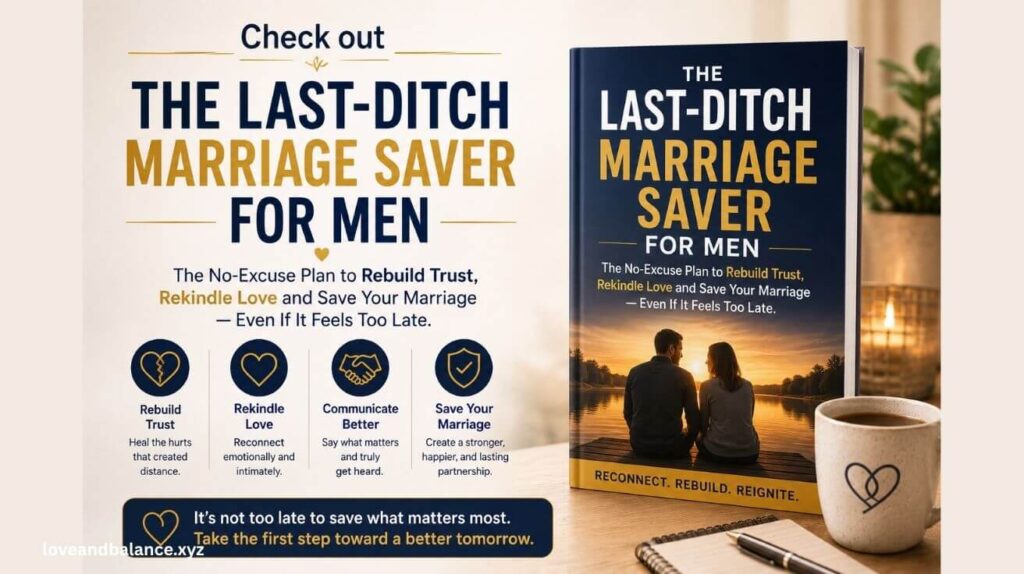
For husbands whose marriage feels shaky Sometimes this kind of anxiety doesn’t arrive in the first months of love. It arrives years in, when a marriage starts to wobble and you’re the one lying awake wondering what to do next. If that’s you, a structured, step-by-step resource can make the problem feel less shapeless. The Last-Ditch Marriage Saver for Men is a digital program aimed at husbands who want to work on a struggling marriage. Take a look at it here and judge for yourself. Read the sales page carefully and check the refund policy before you buy. Results depend on you, your partner and your situation, and no program can guarantee an outcome. |
Disclaimer
Affiliate disclosure: This post contains an affiliate link. If you click it and make a purchase, I may earn a commission at no extra cost to you. This does not change the research or advice shared in the article.
Medical disclaimer: This article is for general education only. It is not medical, psychological or relationship-counselling advice, and it does not diagnose or treat any condition. Please speak with a qualified mental health professional about your own situation. If you feel unsafe or are in crisis, contact your local emergency services or a crisis helpline right away.