

How to Repair After Conflict in a Relationship: 7 Proven Steps
By Love and Balance team | Updated September 2026 | 12-minute read
It’s 11:40 p.m. The argument ended an hour ago, but neither of you has moved. One of you is scrolling a phone in the dark, the other is staring at the ceiling, and the silence feels heavier than anything that was said. If that scene is familiar, you’re in very good company, and you’re also in the exact spot where relationships are either quietly strengthened or slowly worn down.
Here’s the part most of us never hear: the fight itself is rarely what decides whether a relationship lasts. What happens after the fight matters far more. Psychologists call it repair, and learning how to repair after conflict in a relationship is arguably the single most useful skill a couple can build.
This guide walks you through seven steps you can use tonight, backed by decades of research and explained without the jargon. You’ll also find common mistakes, realistic examples, and answers to the questions people ask most.
Why Repair Matters More Than Never Fighting
Let’s clear up a myth first. Healthy couples don’t avoid conflict. They recover from it.
In the 1970s, psychologist John Gottman and his colleagues began inviting couples into a University of Washington lab (the press nicknamed it the “Love Lab”) to record how partners talked through disagreements. Over the years, his team followed many of these couples to see who stayed together. One of the clearest patterns to come out of that work: couples who made successful repair attempts during tense moments, such as a joke, a softened tone or a simple “let’s start over,” tended to stay stable. Couples whose repair attempts kept failing were at much higher risk of breaking up. You can read more in the Gottman Institute’s write-up on the Four Horsemen of conflict.
A different field tells a similar story. Developmental psychologist Ed Tronick’s famous “Still Face” experiments with mothers and infants showed that even in secure, loving pairs, the two are truly “in sync” only about a third of the time. The rest of the time they miss each other, and then reconnect. Tronick’s takeaway is oddly comforting: mismatch is normal; repair is what builds trust. Adult relationships work the same way.
So, if you and your partner keep colliding, it doesn’t automatically mean something is broken. It may just mean you haven’t learned the repair part yet.
Signs You Need to Repair (Even If You Think It’s Over)
Some arguments end with a clear resolution. Many just… stop. Watch for these signs that the injury is still open:
• You’re being extra polite, or extra quiet, around each other.
• The topic feels “off limits” now.
• One of you keeps replaying the argument mentally days later.
• Affection or intimacy has dipped since the fight.
• You feel relief when your partner is out of the house.
If two or more of these fit, the conflict hasn’t been repaired yet. It’s just gone underground, and unrepaired hurt tends to come back louder.
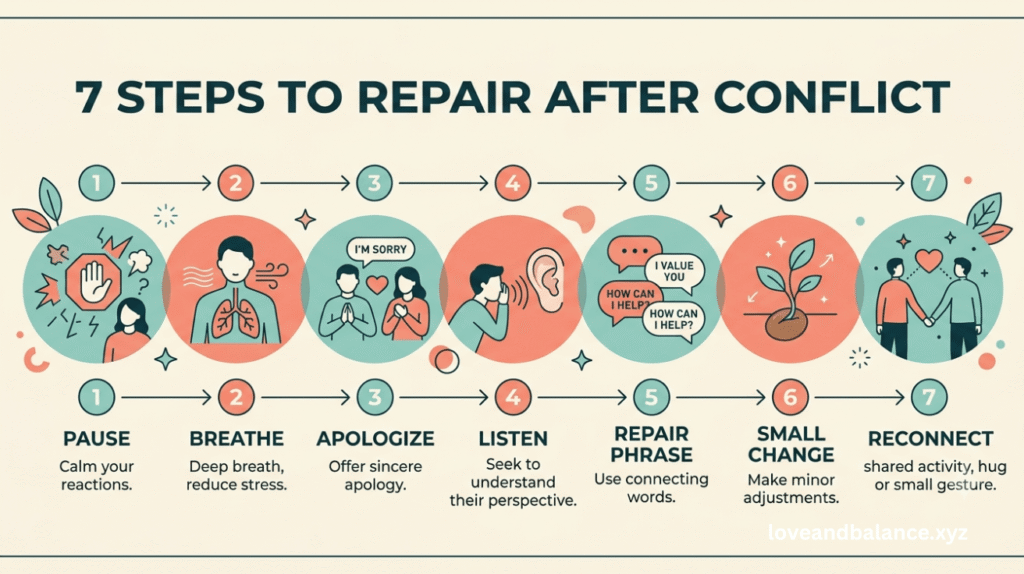
Step 1: Pause Before You Try to Fix Anything
This one surprises people. The first step of repair isn’t talking. It’s stopping.
Gottman’s lab measured partners’ heart rates during arguments and found that when a person’s pulse climbs past roughly 100 beats per minute, they enter what he calls flooding. In that state, you can’t listen well, you can’t think flexibly, and you’re far more likely to say something cruel. Trying to “resolve” things while flooded is like trying to read while someone shakes the page.
So, say something like: “I care about this too much to do it badly. Can we take 20 minutes and come back?” Two details matter. First, name a return time so your partner doesn’t feel abandoned. Second, actually use the break to calm down, not to rehearse your closing argument.
Step 2: Calm Your Body First, Then Your Mind
A break only works if your nervous system settles during it. Some things that genuinely help:
• Slow breathing: in for four counts, out for six to eight. The long exhale nudges your body toward calm.
• Movement: a ten-minute walk burns off stress hormones better than sitting and stewing.
• Cold water or fresh air: a quick splash on your face or stepping outside can interrupt the spiral.
• Skip the group chat: venting to three friends tends to harden your version of the story rather than soften it.
When you feel your shoulders drop and your thoughts slow down, you’re ready. If you’re still fuming after 20 minutes, take longer. Just tell your partner so.
Step 3: Own Your Part (Without a “But”)
A real apology is the heart of repair, and it’s where most of us stumble. Research on apologies, including work by psychologist Karina Schumann, suggests that apologies land best when they show that you understand the harm and take responsibility, rather than just wanting the tension to end.
A useful structure:
• Name what you did: “I raised my voice and called you dramatic.”
• Acknowledge the impact: “I can see that made you feel dismissed.”
• Take responsibility: “That wasn’t fair, and it’s on me.”
• Offer a change: “Next time I’ll ask for a break instead.”
Notice what’s missing: “I’m sorry, but you also…” That single word turns an apology into a counter-attack. Even if your partner contributed to the fight (and they probably did), own your slice first. Their turn will usually come more naturally when they feel safe.
Try this: “I’m sorry I shut down when you brought up money. I know it left you feeling alone with the problem. I want to do better.”
Step 4: Listen Until Your Partner Feels Understood
After you’ve apologised, resist the urge to explain yourself right away. Ask instead: “What was the hardest part of that for you?” Then listen the way you’d listen to a close friend in distress.
Two habits make this much easier:
• Reflect: “So when I checked my phone during dinner, it felt like your day didn’t matter to me. Did I get that right?”
• Validate before you defend: you can say “that makes sense” without agreeing that you were wrong about everything.
Validation isn’t surrender. It’s simply telling your partner that their inner world is real to you. Emotionally Focused Therapy (EFT), developed by Dr. Sue Johnson, is built on this idea: most couple fights are really protests about connection, such as “Are you there for me?” Answer that question and the surface issue often shrinks.
Step 5: Use Repair Phrases That Actually Work
Gottman’s team catalogued small statements that de-escalate tension, and they’re refreshingly simple. Keep a few in your back pocket:
• “Can we start over? I came in too hot.”
• “I’m getting overwhelmed. Can we slow down?”
• “I see your point. Tell me more.”
• “This isn’t about blame. I want us to be okay.”
• “I know this is my issue, not yours. Let me try again.”
They may feel awkward at first, and that’s fine. The point isn’t perfect wording. The point is signalling, in the middle of tension, that you’re on the same team. Just as important: accept your partner’s repair attempts. Many couples fail here. One person offers a joke or a soft touch, the other is still angry and rejects it, and the window closes. If you can’t fully accept it, say, “I want to, I need a few more minutes.” That still counts as a yes.
Step 6: Agree on One Small, Concrete Change
Apologies without action ring hollow. Before you close the conversation, pick one specific thing each of you will do differently. Not ten. One.
Weak: “I’ll be more attentive.” Strong: “When we’re talking at dinner, my phone goes in the other room.”
Weak: “I’ll stop getting so angry.” Strong: “If I feel my voice rising, I’ll say ‘timeout’ and step away for 15 minutes.”
Small promises you actually keep rebuild trust faster than grand ones you forget. If you want more ideas on this, our guide to building trust in a relationship covers 15 research-backed habits.
Step 7: Reconnect With Something Positive
This last step is the one couples skip, and it’s the one that seals the repair. After a hard conversation, both of you are emotionally bruised. Ending on the problem leaves the bruise untouched.
Gottman’s research points to what he calls the 5-to-1 ratio: stable couples tend to have about five positive interactions for every negative one during conflict, and higher ratios in everyday life. You can read the science behind the magic ratio on the Gottman Institute’s site. The practical takeaway is that warmth needs to be deliberately added back after a fight.
Some ideas that take under ten minutes:
• Make tea for each other and sit together without talking about the fight.
• Share one thing you appreciate about your partner. Be specific.
• Hug for 20 seconds. It’s longer than it sounds, and it helps.
• Watch a comfort show or go for an evening walk.
This isn’t avoiding the problem. It’s telling your nervous system that the relationship is safe again.
A Realistic Example: Repair in Action
The following is a composite example based on common patterns, not a real named couple.
Meera and Arjun had the same argument every few weeks: he’d come home late without calling, she’d feel invisible, he’d feel nagged. One evening it blew up. Arjun snapped, “I work all day, and you still complain.” Meera went silent.
In the old days, they’d have slept back-to-back and pretended it never happened. This time, Arjun said, “I’m too wound up to talk well. Can we try again in half an hour?” He walked around the block. When he came back, he said, “I dismissed you, and that wasn’t fair. When I don’t call, I imagine it feels like you don’t matter. Is that close?” Meera teared up and nodded.
They agreed on one change: a two-line text if he’s going to be more than 30 minutes late. Then they ordered dinner and watched something silly. Nothing dramatic happened, and that’s the point. Repair usually looks quiet and small.
7 Repair Mistakes That Quietly Make Things Worse
• Forcing the talk while you’re still flooded. It nearly always restarts the fight.
• The “sorry you feel that way” non-apology. It shifts blame to the other person’s feelings.
• Keeping score. Repair isn’t a ledger of who apologised last.
• Bringing up old fights. Stay with one issue at a time.
• Using silence as punishment. A break has an end time. Stonewalling doesn’t.
• Expecting instant forgiveness. Some hurts take days. Give it time without pressure.
• Skipping the reconnection. Resolving the issue without restoring warmth leaves the relationship thin.
When Repair Isn’t Enough on Its Own
Sometimes the same fight loops for years, or one moment (like a breach of trust) is too heavy to fix with good phrasing alone. That’s when outside help pays for itself. Research on EFT has reported that roughly 70 to 75 percent of couples moved from distress to recovery in early clinical trials, which suggests that structured couples therapy can be genuinely effective, not a last resort.
Seek professional support if you notice contempt (eye-rolling, mockery), repeated stonewalling, betrayal, or if one of you is afraid of the other. If there is any physical violence, threats or controlling behaviour, that is not a communication problem to “repair” together. Please contact a domestic violence helpline or a trusted professional for safety-focused support.
If you want to understand whether your patterns are healthy closeness or something tangled, this breakdown of codependent vs interdependent relationships is a good place to start.
A Note for Husbands Who Want to Do Better
Many men tell therapists the same thing: they want to fix things, but don’t know where to begin once the conversation gets emotional. If that’s you, a structured, step-by-step programme can help you turn good intentions into daily habits. One resource that some readers find useful is The Last-Ditch Marriage Saver for Men, a guide aimed at husbands who feel their marriage is slipping and want a clear action plan. It isn’t a substitute for counselling, but it can be a practical starting point.
Affiliate disclosure: This article contains an affiliate link. If you purchase through it, I may earn a commission at no extra cost to you. I only mention resources I believe could be relevant to readers, but results vary from person to person, and no product can guarantee a particular outcome for your relationship.

How to Repair After Conflict in a Relationship: 7 Proven Steps
Frequently Asked Questions
How long should you wait to talk after a fight?
Most experts suggest at least 20 minutes so your body can calm down, and no more than 24 hours so the silence doesn’t turn into avoidance. What matters is telling your partner when you’ll return to the conversation.
What if my partner refuses to repair?
Start with a low-pressure repair attempt such as a kind text, a small gesture or a brief “I’m ready when you are.” If they consistently refuse to engage over weeks, name that pattern calmly and consider suggesting a counsellor. You can only control your side of repair, but you can make it easy for them to join.
How do you apologize when you think you were only partly wrong?
Apologize for your part specifically and leave theirs out of it. “I’m sorry I interrupted you and raised my voice” is honest even if you still disagree about the original issue. That opens the door for them to own their part.
Can a relationship recover from repeated fights?
Yes, in many cases. Repeated conflict is often a sign of an unmet need underneath, such as feeling unheard, unappreciated or unsafe. When couples learn to identify that need and repair consistently, the fights usually shrink in intensity and frequency. Persistent contempt or safety concerns are the exceptions and deserve professional help.
Is it okay to go to bed angry?
Sometimes it’s better than a midnight argument. If you’re exhausted, agree on a pause: “We’re not done, but we’ll talk tomorrow. I love you.” Sleep often lowers the temperature. Just make sure “tomorrow” actually happens.
What are the signs that repair has worked?
You feel lighter around each other, you can mention the topic without tension, affection returns naturally, and you both follow through on the small change you agreed on.
Should we see a couples therapist?
If you’re stuck in the same argument, if trust has been broken, or if you feel more like roommates than partners, therapy is worth trying. Seeing a therapist early is generally easier than waiting until the resentment runs deep.
Keep Growing Together
Repairing after conflict isn’t a one-time skill. It’s a rhythm you build with practice. If this article helped, these guides on Love and Balance will take you further: learn how trust grows in a new relationship with 15 practical tips, explore 9 research-backed differences between codependent and interdependent love, and discover what women really need to feel happy in a relationship. Read one tonight, share it with your partner, and turn the next disagreement into a step closer rather than a step apart.
Final Thoughts
You will disagree again. That’s not a failure. It’s what happens when two whole people share a life. What changes everything is what you do in the hour after. Pause, calm down, own your part, listen, use a repair phrase, agree on one small change, and end with warmth. Do that consistently and conflict stops being a threat to your relationship and becomes one of the ways it grows.
Start small. The next time tension rises, try just one step. That’s enough to begin.
Disclaimer
This article is for general educational purposes and is not a substitute for professional medical, psychological or legal advice. If you’re experiencing abuse, or if you or someone you know is in crisis, please contact local emergency services or a qualified professional. This post contains affiliate links; see the affiliate disclosure above.
References & Further Reading
• Gottman Institute: The Four Horsemen