Stonewalling in Relationships: 7 Proven Ways to Stop It
Stonewalling in Relationships: 7 Proven Ways to Stop It
SEO META DESCRIPTION (not part of the published article, paste into your SEO plugin): Stonewalling can quietly end a relationship long before anyone says “it’s over.” Backed by 40+ years of Gottman research and a 20-year health study, here’s how to recognise stonewalling and stop it for good.
SUGGESTED URL SLUG: /stonewalling-in-relationships-how-to-stop-it/
It usually starts small. One partner raises a concern, the other partner’s jaw tightens, and within a few sentences, they’ve gone quiet. Not the “I need a minute” kind of quiet, completely quiet. Eyes down, arms crossed, one-word answers, and then nothing at all. The conversation doesn’t end because it’s resolved. It ends because one person has left the room without actually leaving the room.
Psychologists call this stonewalling, and it’s one of the most researched, and most misunderstood patterns in relationship conflict. Dr John Gottman, who has spent over four decades studying couples at the University of Washington’s “Love Lab,” found that this single behaviour, once it becomes habitual, is one of four communication patterns that can predict divorce with striking accuracy after just 15 minutes of observing a couple argue.
If you’ve searched something like “why does my partner shut down every time we argue,” you’re not alone, and you’re not doing anything wrong by looking for an answer. This guide breaks down what stonewalling actually is, what’s happening in the body when it happens, what long-term research says about its real cost, and, most importantly, a step-by-step, research-backed way to stop it, whether you’re the one who shuts down or the one left standing outside a closed door.
What Is Stonewalling, exactly?
Stonewalling is what happens when a person facing conflict withdraws, emotionally, verbally, and sometimes physically, instead of engaging. It can look like a partner going silent mid-sentence, giving flat one-word replies, avoiding eye contact, suddenly finding something urgent to do in another room, or scrolling their phone while the other person is mid-sentence.
Gottman named it one of the “Four Horsemen” of relationship breakdown, alongside criticism, contempt, and defensiveness, a nod to the biblical Four Horsemen of the Apocalypse. In his research, these patterns tend to arrive in sequence: criticism opens the door, contempt walks through it, defensiveness tries to block the blow, and when none of that resolves anything, stonewalling shuts the whole conversation down. Of the four, contempt is the single strongest individual predictor of divorce. But stonewalling is the one that tends to end the conversation itself, and, repeated often enough, the relationship’s ability to have hard conversations at all.
It’s worth saying clearly: stonewalling is not automatically a character flaw, and it isn’t the same as taking a breather. For many people, it’s a stress response happening below the level of conscious choice. Understanding why is where the science gets genuinely useful.
The Science: What’s Actually Happening in the Body
In the 1970s and 80s, Gottman and psychophysiologist Robert Levenson wired hundreds of couples to heart-rate monitors and watched what happened in real time as they discussed a point of tension in their relationship. What they found reshaped how researchers understand “shutting down.”
When a person perceives conflict as a threat, even a purely conversational one, their body can respond much as it would to physical danger. Heart rate climbs. Stress hormones flood the bloodstream. Gottman called this diffuse physiological arousal, or “flooding.” His research identified a specific, measurable threshold: once heart rate climbs past roughly 100 beats per minute (a resting adult’s typically sits between 60 and 80), the parts of the brain responsible for empathy, nuance, and problem-solving start losing bandwidth to a more primitive threat-response system.
In plain terms: once someone is flooded, they aren’t choosing to ignore you. Their nervous system has, temporarily, taken listening off the table. This is why reasoning louder, repeating yourself, or demanding a response during a stonewalling episode seldom works; you’re asking a brain that has shifted into survival mode to do a job it currently isn’t equipped for.
That doesn’t mean stonewalling is harmless, or that the partner on the receiving end should simply accept it indefinitely. It means the fix has to work with the biology, not against it, which is exactly what the steps further down are built around.
Stonewalling vs. Taking Healthy Space: How to Tell the Difference
One of the most common questions couples bring into therapy is whether needing space during conflict is the same thing as stonewalling. It isn’t, and the difference matters.
A Healthy Break | Stonewalling |
Named out loud (“I need 20 minutes”) | Silent, with no explanation |
Time-limited, with a real return | Open-ended, no promise to return |
Followed by re-engagement on the topic | Often left for the other partner to chase or drop |
The behaviour can look almost identical from the outside; someone goes quiet and leaves the room either way. The real difference lives in the communication around it, and in whether the door is left open or closed. Learning to recognise which one you’re doing (or receiving) is the first real step toward changing the pattern.
Why Do People Stonewall? What the Research Points To
1. Physiological flooding
As covered above, this is the most common driver. The nervous system perceives conflict as a threat and pulls the plug on higher-order thinking before the person consciously decides to withdraw.
2. Learned conflict avoidance
Many people grew up in households where conflict meant danger, raised voices, punishment, or a parent who also went silent for days at a time. For them, shutting down in conflict isn’t a strategy; it’s the only script they were ever taught.
3. A documented gender pattern, with real nuance
Gottman and Levenson’s original observational research found that stonewalling appeared disproportionately in male partners within the heterosexual couples they studied, with some analyses of their data citing roughly 85% of stonewalling behaviour coming from men. Researchers have proposed a few explanations, including that male partners in these studies tended to show more sustained cardiovascular arousal during conflict and took longer to physiologically recover from it. It’s important to read this as a pattern found in a specific research sample, not a rule; stonewalling shows up across all genders and relationship types, and plenty of individual men are the pursuer, not the withdrawer, in their relationship.
4. High-performance, low-emotion cultures
Therapists who work with clients in demanding professional environments often note that emotional shutdown, rewarded as “staying composed” at work, doesn’t switch off when someone walks through their front door. A coping skill that’s functional in a boardroom can quietly become corrosive at the kitchen table.
5. Deliberate withdrawal
Not all silence is involuntary. When withdrawal is used consistently and knowingly to punish, control, or “win” an argument by starving it of a response, it stops being a flooding reaction and starts being a form of emotional manipulation. More on that distinction below.
The Real Cost: What a 20-Year Study Found
This is where stonewalling stops being just a communication style and starts being a documented health issue.
Starting in 1989, researcher Robert Levenson at UC Berkeley began tracking 156 middle-aged and older married couples in the San Francisco Bay Area, recording their conflict conversations and following their health outcomes for the next two decades. In a 2016 analysis of that data, published in the peer-reviewed journal Emotion, lead author Claudia Haase (Northwestern University) and colleagues found that specific emotional behaviours during a 15-minute conflict conversation predicted specific physical illnesses 20 years later, even after controlling for factors like age, smoking, and exercise habits.
The pattern was striking. Partners who displayed more anger during conflict were more likely to develop chronic cardiac problems decades later. Partners who stonewalled more were more likely to develop chronic musculoskeletal problems, stiff muscles and chronic back or neck pain.
It’s a genuinely useful finding, because it reframes stonewalling as something with a real physical cost, not just a relational inconvenience. The body that goes rigid and silent during an argument may, over 20 years, become a body that’s rigid and in pain for reasons that trace back to that same nervous-system pattern, repeated thousands of times.
Signs You (or Your Partner) Might Be Stonewalling
• Going quiet mid-conversation and never returning to the topic
• One-word or monosyllabic answers (“fine,” “sure,” “whatever”)
• Avoiding eye contact or physically turning away
• Suddenly finding something urgent to do elsewhere
• A flat, “checked out” facial expression
• Leaving the room or the house without saying when, or if, they’ll be back
• The same disagreement resurfacing, unresolved, week after week
If you recognize three or more of these as a regular pattern rather than an occasional slip, it’s worth working through the steps below, ideally with your partner, not just about them.
How to Stop Stonewalling: 7 Research-Backed Steps
1. Learn your own flooding signals
Before you can interrupt stonewalling, you need to notice it starting in your own body. A racing heart, a tight jaw, heat in your face or chest, or a sudden urge to leave are early flooding signals, often showing up before you’re consciously aware you’re overwhelmed. Spend a week simply noticing when they appear, without trying to change anything yet.
2. Call a structured timeout, out loud
The difference between stonewalling and a healthy pause is often just one sentence. Instead of going silent or walking out, try: “I’m starting to shut down. I need 20 minutes, and then I want to come back to this.” That single sentence tells your partner the door isn’t closed; it’s just paused.
3. Actually self-soothe (this is the step everyone skips)
Gottman’s research found that flooding takes at least 20 minutes to subside, but only if that time is spent genuinely calming the nervous system: a walk, slow breathing, music, stretching. Spend the break replaying the argument or drafting your rebuttal instead, and your heart rate won’t come down. You’ll return just as flooded as you left.
4. Set, and keep, a return time
An open-ended “I need space” without any timeframe often reads as abandonment to the partner left behind, even when that isn’t the intent. Naming a specific window, even a rough one, changes the entire emotional experience of the break for both people.
5. Re-enter with a gentle start-up
How you restart the conversation matters as much as the break itself. Gottman’s research on relationship “masters” versus “disasters” found that conversations reopened with blame or criticism tended to spiral the same way they had before. Starting instead with how you feel and what you need, “I felt overwhelmed earlier, and I want to understand what you were trying to say”, gives the conversation a real chance to go differently the second time.
6. Build a “conflict plan” together, while calm
The best time to agree on how you’ll handle flooding isn’t in the middle of a fight; it’s afterwards, once things have settled. Sit down together and agree on a shared signal for “I’m flooding,” a default break length, and what re-engaging will look like. Couples who agree on this in advance tend to use it far more consistently than couples trying to improvise it mid-argument.
7. Get outside support if the pattern is entrenched
If stonewalling has become the default response, lasting hours or days, or resurfacing every time there’s tension, it’s often a sign the pattern is too automatic to interrupt with willpower alone. Gottman Method couples therapy, typically run over roughly 12 to 20 sessions, is built specifically around identifying which of the Four Horsemen show up most and practising their antidotes in a structured setting. There’s no prize for handling this without help, and couples who bring in a therapist earlier tend to have a much easier time unwinding entrenched patterns than those who wait years.
If You’re the One Being Stonewalled: What Actually Helps
Being on the receiving end of stonewalling is its own kind of hard, often lonelier than the conflict itself. A few things genuinely help:
• Don’t chase harder. Raising your voice, repeating the question, or following your partner from room to room tends to deepen flooding rather than resolve it. It feels counterintuitive to back off when you want resolution most, but it’s what the research supports.
• Take the break at face value. If your partner has named a timeframe, let it run. Checking in every five minutes undoes the point of the pause.
• Notice and respond to small bids for reconnection. Gottman’s newlywed research found that couples who stayed together turned toward each other’s small, everyday bids for connection, a comment, a glance, a shared joke, roughly 86% of the time, compared to about 33% in couples who later divorced. Reconnection after conflict often starts small, not with a grand resolution conversation.
• Raise the pattern itself when things are calm, not mid-argument. “I’ve noticed we both go quiet when things get tense, and I’d like us to figure out a better way through it together” lands very differently over breakfast than it does at 11 pm mid-fight.
When Stonewalling Crosses into Emotional Abuse
There’s an important line between involuntary flooding and weaponised silence, and it’s worth naming clearly. Occasional stonewalling during an overwhelming argument, followed by genuine reconnection, is a common, if unhelpful, human stress response. A pattern of silence used deliberately and repeatedly to punish, control, isolate, or force a partner into compliance is different. Some therapists describe this as the silent treatment used as a tool rather than a symptom, and when it’s sustained or paired with other controlling behaviours, it can constitute a form of emotional abuse.
If withdrawal in your relationship regularly lasts days, is used to “win” arguments, or leaves you managing your partner’s silence more than any actual conflict, it’s worth talking to a licensed couples or individual therapist about what you’re experiencing. If you ever feel unsafe in your relationship, the National Domestic Violence Hotline (1-800-799-7233) is available for confidential support.
Stonewalling in Relationships: 7 Proven Ways to Stop It
Frequently Asked Questions
Is stonewalling a form of abuse?
Not always. Most stonewalling starts as an involuntary flooding response rather than a calculated tactic. It becomes a form of emotional abuse when it’s used deliberately and repeatedly to punish, control, or isolate a partner, especially alongside other controlling behaviours.
How long is “too long” for the silent treatment?
There’s no universal number, but Gottman’s research suggests flooding itself typically resolves within about 20–30 minutes with genuine self-soothing. Silence that regularly stretches into hours or days, with no acknowledgement or plan to reconnect, has moved past a physiological pause into a pattern worth addressing directly.
Can stonewalling be fixed without couples therapy?
Often, yes, especially early on. Learning to recognise flooding, calling structured timeouts, and genuinely self-soothing can interrupt the cycle for many couples. Therapy becomes more valuable when the pattern is long-standing, when one or both partners can’t apply these steps consistently, or when conversations about it keep turning into new arguments.
Is stonewalling always intentional?
No. Research on physiological flooding suggests most stonewalling happens below full conscious control; the nervous system, not a deliberate decision, pulls the person out of the conversation. That said, unintentional doesn’t mean harmless, and it still needs to be addressed.
Why do men stonewall more often than women?
Gottman and Levenson’s studies found stonewalling appeared more often among male partners in the heterosexual couples they observed, and proposed physiological recovery differences as a partial explanation. It’s a documented pattern within their research sample, not a universal rule; stonewalling occurs across all genders and relationship structures.
What’s the difference between stonewalling and just needing space?
Mainly communication and follow-through. Needing space is named out loud, time-limited, and followed by a return to the conversation. Stonewalling is typically silent, open-ended, and leaves the other partner uncertain whether or when the conversation will continue.
Can one partner stop the pattern alone?
One partner can absolutely interrupt their own stonewalling by learning to notice flooding and calling structured breaks. But a lasting fix to the overall cycle, pursue-and-withdraw dynamics especially, usually needs both partners’ participation, since one partner’s changed behaviour naturally invites a different response from the other.
The Bottom Line
Stonewalling rarely shows up because someone stopped caring. More often, it shows up because their nervous system got there first. That distinction doesn’t excuse the pattern, but it does point to a way through it, one that works with the biology of conflict instead of against it. Recognize the flooding, name the break, actually calm down, come back, and keep coming back. That’s the whole model, and decades of research say it works.
Related Reading
Stonewalling often shows up alongside, or gets mistaken for, the silent treatment. If this pattern sounds familiar, it’s worth going deeper into how it affects couples over time in Silent Treatment in Relationships: 9 Long-Term Effects Backed by 20 Years of Psychological Research, and in Silent Treatment in Relationships: Effects, Psychology, How to Heal. And if you’re wondering whether your partner’s withdrawal connects to something deeper in how they bond, Do Men Suffer From Attachment in Relationships? The Truth No One Talks About is a natural next read.
Feeling Alone Even Inside Your Relationship?
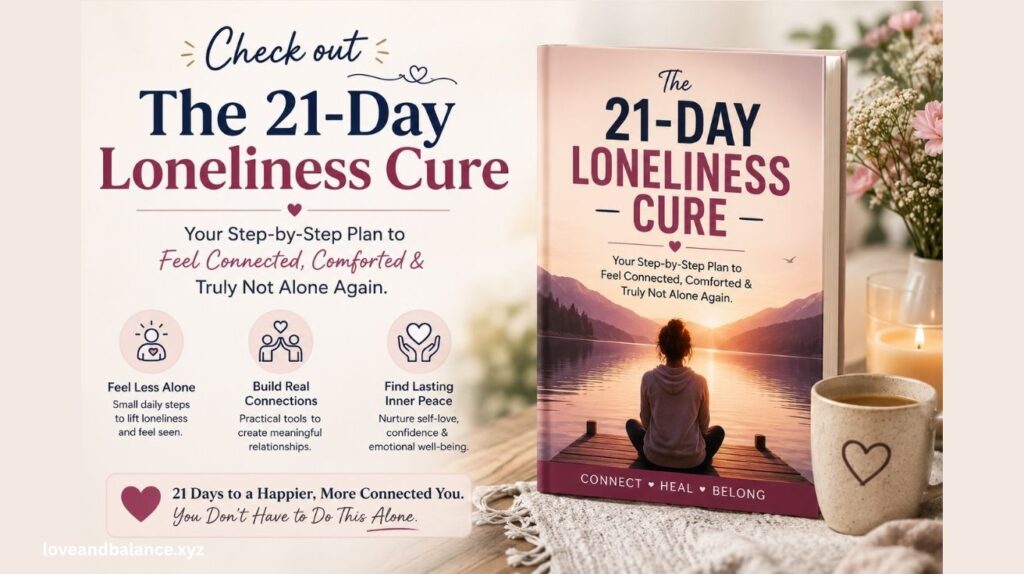
One of the hardest parts of loving someone who stonewalls is the loneliness that creeps in, the specific ache of feeling alone while sitting right next to the person you chose. If that feeling has become familiar, you don’t have to sit with it alone or figure it out from scratch. The 21-Day Loneliness Cure is a structured, day-by-day program built to help you work through persistent loneliness, whether it’s showing up inside your relationship or elsewhere in your life, one manageable step at a time. You can take a look at it here.
Disclosure & Disclaimer: This article contains an affiliate link. If you choose to purchase through it, we may earn a small commission at no additional cost to you; we only share resources we genuinely believe could help our readers. This article is for educational and informational purposes only. It is not a substitute for personalised advice, diagnosis, or treatment from a licensed therapist, counsellor, or medical professional. If you are experiencing distress, relationship abuse, or a mental health crisis, please reach out to a qualified professional or a crisis service in your area.
Sources & Further Reading
• Gottman Institute, “The Four Horsemen: Stonewalling”
• Gottman Institute, “Physiological Self-Soothing”
• Cleveland Clinic, “What Is Stonewalling and How to Stop”
• Psychology Today, “Why Stonewalling Can Be Hazardous to Your Health”