
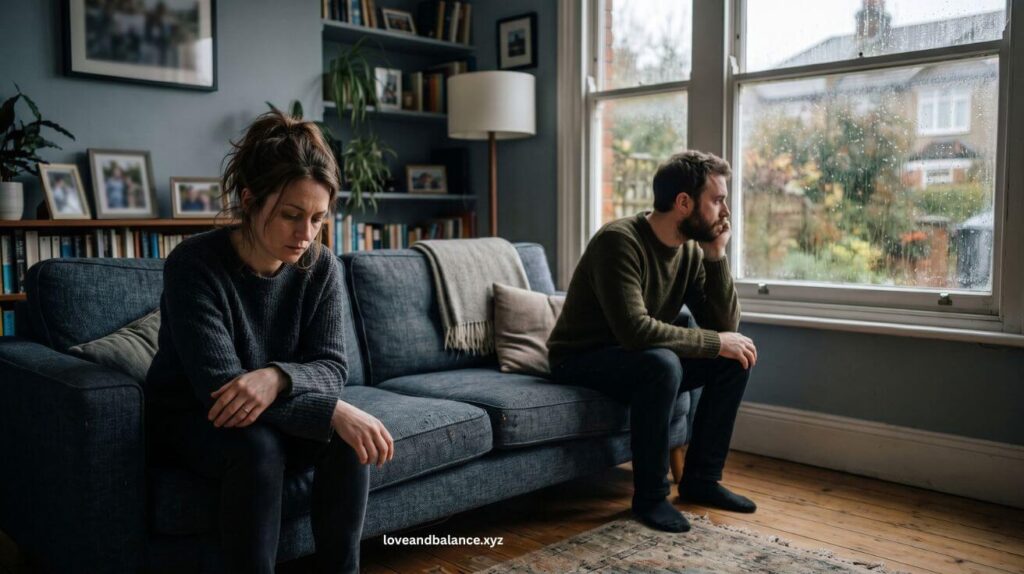
Situationship vs Relationship: What’s the Real Difference? 9 Key Signs (2026 Guide)
By Love and Balance Team
If you’ve ever lain in bed at 1 a.m. trying to figure out what you and this person actually are, you already know the feeling this article is about. You’re not overthinking it. You’re reacting to a very real, very modern gap between two kinds of connection that are talked about as if they’re interchangeable, but aren’t.
I’ve spent a good chunk of the last few years writing about modern dating and talking to people navigating exactly this confusion, the ones stuck between “we’re basically together” and “but we’ve never said it out loud.” What follows isn’t a listicle recycled from ten other sites. It’s a breakdown built on actual survey data, published psychological research, and patterns that recur in real conversations about undefined relationships.
By the end, you’ll know exactly which one you’re in, why it feels the way it does, and what, if anything, you should do about it.
What Exactly Is a Situationship?
A situationship is a romantic or sexual connection that has emotional closeness and regular contact, but no agreed-upon label, no defined exclusivity, and no shared plan for the future. You might text every day, spend weekends together, and know each other’s coffee order, yet neither of you has ever said the words “we’re together.”
Researchers studying this pattern describe it as a connection that resembles dating but lacks the formal commitment or label that turns two people from “seeing each other” into a couple. It can be a stepping stone toward something serious, or it can loop indefinitely with no destination at all.
What Is an Actual Relationship?
A relationship, by contrast, is a mutually acknowledged partnership. Both people have agreed, out loud, not just through assumption, on what they are to each other. That agreement usually includes exclusivity, a shared understanding of where things are headed, and a level of accountability: you check in, you make plans together, you factor each other into decisions.
The difference isn’t about how deep the feelings run. Plenty of situationships involve real emotional attachment. The difference is structural: one has a defined shape and shared expectations, and the other is deliberately left open-ended.
Why Is Everyone Suddenly Talking About Situationships?
This isn’t just a TikTok buzzword. The data backs up how widespread this pattern has become.
• Nearly 6 in 10 adults have been in a situationship, according to a 2024 survey of over 1,000 American adults conducted for Top10.com — and the number climbs even higher among people who actively use dating apps.
• A separate YouGov survey conducted in January 2024 found that 39% of Americans overall — and 50% of adults aged 18 to 34 — say they’ve experienced a situationship firsthand.
• Tinder’s own internal data showed a 49% jump in members adding the word “situationship” to their bios in a single year, with many saying they preferred the low-pressure setup over jumping straight into commitment (as reported by the Institute for Family Studies).
• It’s not just a Gen Z thing. Interestingly, the same research found 45% of Baby Boomers report having been in a situationship at some point, compared with 32% of Gen Z — proof that undefined dating isn’t new; it just finally got a name.
What’s changed is the language, not the behaviour. People have always drifted into ambiguous almost-relationships. Now there’s a word for it, and that word is showing up in therapy sessions, group chats, and, clearly, search engines.
Situationship vs Relationship: 9 Core Differences at a Glance
Here’s the comparison I wish someone had shown me years ago, boiled down to the factors that actually matter:
Factor | Situationship | Relationship |
Labels | Avoided or never discussed | Clearly stated (boyfriend, girlfriend, partner) |
Commitment | Undefined, can end without explanation | Mutually agreed and expected |
Future talk | Rarely happens, feels risky to bring up | Normal part of ongoing conversation |
Exclusivity | Assumed but not confirmed | Discussed and agreed upon |
Meeting friends/family | Usually avoided | Happens naturally over time |
Conflict resolution | Often avoided or ends the connection | Worked through together |
Public visibility | Kept low-key, rarely posted | Openly acknowledged |
Emotional security | Inconsistent, anxiety-inducing | Stable and predictable |
Effort distribution | Often one-sided | Reciprocal and negotiated |
7 Signs You’re Actually in a Situationship
1. You’ve never had “the talk.” No conversation has ever confirmed what this is; you’ve just been going along with it.
2. Plans are last-minute. “Come over tonight?” is common. “Let’s plan next month” is not.
3. You haven’t met the people who matter to them, and they haven’t met yours.
4. Bringing up the future, even lightly, makes the mood shift or the conversation stall.
5. You don’t know if they’re seeing other people, and asking feels like it would “ruin things.”
6. Social media stays silent. No tags, no posts, no public acknowledgement.
7. You feel a low hum of anxiety about where you stand, even on the good days.
6 Signs You’re in a Real Relationship
• You’ve both used a label, boyfriend, girlfriend, partner, and it wasn’t awkward.
• plans come up naturally: a trip, a holiday, next year, without either of you flinching.
• You’ve met each other’s friends and family, and it felt like a normal next step, not a milestone negotiation.
• Disagreements get resolved through conversation rather than silence or ghosting.
• You know where you stand on exclusivity because you talked about it, not because you assumed it.
• The connection feels consistent, not like it depends on their mood that day.
The Psychology Behind Why Situationships Feel So Addictive
If you’ve ever wondered why a situationship can feel more consuming than an actual relationship, there’s real science behind that. Psychologist Leslie Becker-Phelps has described this dynamic as one marked by instability and a lack of clarity about long-term goals, which produces genuine cognitive and emotional distress, not just mild inconvenience.
A 2025 study published in the Indonesia Journal of Sport and Health Psychology, which developed a psychological measurement tool called the Situationship Scale, found that this kind of undefined connection commonly follows a push-and-pull pattern: one person shows interest without fully engaging with the other’s feelings, creating a loop of hope and doubt that’s hard to step out of.
The mechanism is very similar to what keeps people hooked on slot machines rather than vending machines: unpredictable rewards create a stronger pull than consistent ones. When you never quite know if today’s the day you get a warm, reassuring text or radio silence, your brain stays locked in “seeking” mode. That’s intermittent reinforcement at work, and it’s a big part of why situationships can feel more addictive than secure relationships, even though they’re objectively less stable. We’ve broken this exact mechanism down in more depth here: intermittent reinforcement in relationships.
Attachment style plays a role too. Anxiously attached people tend to stay longer in the ambiguity, hoping enough effort will eventually earn commitment. Avoidantly attached people often prefer the undefined setup precisely because it protects them from the vulnerability a real relationship requires. When those two styles pair up, you get the classic situationship loop: one person pursuing, one person retreating, neither one saying it plainly.
A Real-World Pattern: Maya and Alex
To make this concrete, here’s a composite example based on patterns that show up constantly in real conversations about this topic (names changed for privacy).
Maya and Alex met through a dating app and clicked instantly. Within three weeks, they were seeing each other twice a week, texting daily, and Alex had started calling her “babe” in private. But six months in, Maya still didn’t know if Alex was seeing anyone else. She’d never met his friends. When she mentioned a concert three months out, he changed the subject.
Maya wasn’t imagining the closeness; it was real. What was missing wasn’t affection; it was structure: a shared label, a shared plan, and a shared answer to “what are we.” That gap is the entire difference between a situationship and a relationship, and it’s rarely about how much either person cares.
How to Turn a Situationship into a Relationship (Without Scaring Them Off)
8. Get honest with yourself first. Do you want a relationship with this specific person, or do you want a relationship in general and they happen to be available? That distinction matters more than it seems.
9. Watch actions over weeks, not moments. Consistency, not a single great date, is the real signal someone’s ready for more.
10.Set a boundary before you set an ultimatum. A calm, clear boundary (“I’d like us to talk about what this is”) lands very differently than a pressured demand. We’ve covered exactly how to do this without pushing someone away in our guide to setting healthy boundaries in a relationship.
11.Name what you actually need, not just what you’re missing. Undefined connections often fail because core emotional needs, like consistency, reassurance, and feeling prioritised, are quietly going unmet. This list of the core emotional needs most couples never discuss is a useful starting point before you have the conversation.
12.Have the direct conversation. “I really like what we have, and I’d like to know if we’re building toward something exclusive” is clear, low-drama, and gives the other person a real chance to respond honestly.
13.Accept the answer, even if it’s not the one you wanted. A situationship that won’t move toward clarity after an honest conversation has already told you what it is.
When It’s Time to Walk Away from a Situationship
• You’ve brought up the future more than once and been met with deflection each time.
• You’re the one initiating most contact, most plans, and most emotional labour.
• You feel worse about yourself after most interactions, not better.
• You’ve started making excuses for behaviour you wouldn’t accept from a committed partner.
• Months have passed with zero movement toward exclusivity, labels, or shared plans.
None of these means you were foolish for staying. They just mean the situation has answered the question you were too afraid to ask directly.
Situationship vs Relationship: Which One Do You Actually Want?
Before you decide anything about the person, you’re with, it’s worth answering this honestly: do you actually want the structure and accountability of a relationship right now, or does the low-pressure nature of a situationship genuinely suit where you are in life? Neither answer is wrong. What matters is that it’s a decision you’re making, not one that’s happening to you by default because nobody said anything out loud.
Final Thoughts
A situationship isn’t a lesser version of a relationship, and it isn’t automatically a red flag either. It’s a different structure, with different rules, different risks, and, as the research above shows, a very different effect on your nervous system. The problem was never the label. It’s staying in the ambiguity longer than it’s actually serving you, hoping silence will eventually turn into an answer.
If you take one thing from this: the clearest sign of a healthy connection, whatever you call it, is that both people know exactly where they stand. Everything else is negotiable.
Situationship vs Relationship: What’s the Real Difference? 9 Key Signs (2026 Guide)
Frequently Asked Questions
Can a situationship turn into a relationship?
Yes, and it happens often. The shift usually requires one direct conversation where both people agree on exclusivity and a shared direction, rather than assuming it will happen naturally over time.
How long do situationships typically last?
There’s no fixed timeline; some resolve within weeks; others drift on for a year or more. Research on this pattern notes that it can function as a short transitional stage toward commitment, or continue indefinitely without ever resolving.
Is being in a situationship unhealthy?
Not inherently, but studies link the instability and lack of clarity in these dynamics to real emotional and cognitive distress, especially when one person wants more than the other is offering. The health of it depends heavily on whether both people are equally comfortable with the ambiguity.
What’s the difference between a situationship and friends with benefits?
They overlap, but a situationship usually involves more emotional investment, regular check-ins, and date-like behaviour, while friends-with-benefits arrangements are typically framed more explicitly around physical connection with less emotional expectation attached.
How do I ask “what are we” without ruining things?
Frame it around your own feelings rather than an accusation: “I’ve really enjoyed this, and I’d like to know where you see it going,” invites an honest answer instead of putting the other person on the defensive.
Do situationships count as cheating if someone else is seeing other people?
Only if exclusivity was actually agreed upon. Without a clear conversation confirming exclusivity, neither person has technically broken an agreement, which is exactly why the ambiguity of situationships causes so much confusion and hurt.
Why do so many people prefer situationships over relationships right now?
Survey data suggests the appeal is largely about avoiding the pressure of settling for the wrong person and keeping options open, particularly among younger adults navigating dating apps, though older generations report similar experiences at even higher rates.
Can you genuinely love someone in a situationship?
Yes. Emotional attachment doesn’t require a label to be real. The absence of a label affects the structure and security of the connection, not the authenticity of the feelings involved.
Still figuring out where you stand with someone? Start by getting the fundamentals right. Learn how to set healthy boundaries in a relationship before you have the “what are we” conversation, so you walk in clear instead of anxious. Then check whether your core emotional needs are actually being met; most people never audit this, and it’s usually the real reason an undefined connection feels so unsatisfying. And if the back-and-forth of hot-and-cold attention is what’s keeping you hooked, read our science-backed breakdown of intermittent reinforcement in relationships to understand exactly why it’s so hard to walk away, and how to finally do it.
Sources referenced: YouGov (Jan 2024), Top10.com/SurveyMonkey survey (2024), Tinder Year in Swipe Report, Institute for Family Studies, and the 2025 Situationship Scale (SHTS) study published in the Indonesia Journal of Sport and Health Psychology.
Further reading (outbound source): Institute for Family Studies, “Situationships: Stuck in Transition”