
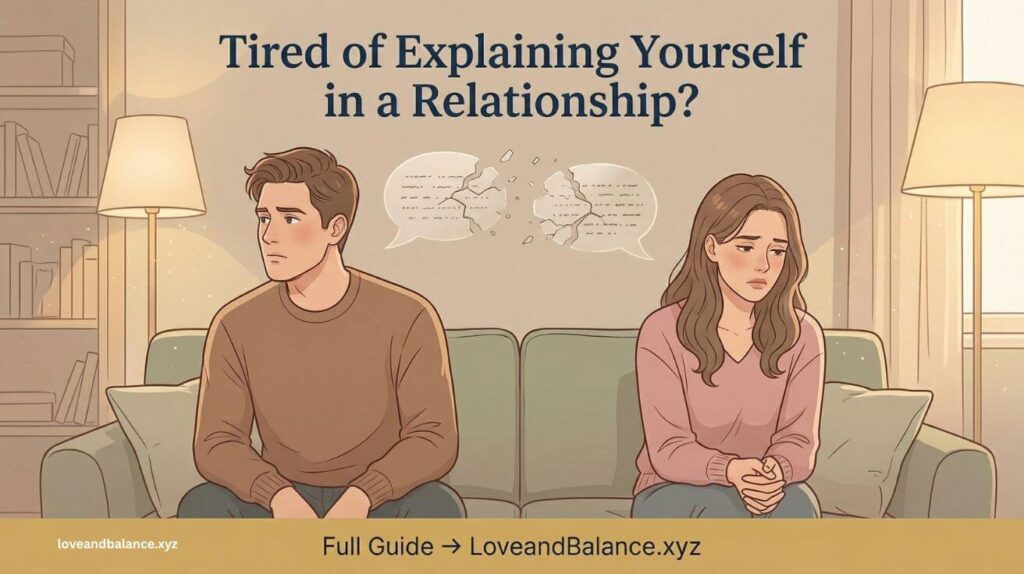
Tired of Explaining Yourself in a Relationship? Here’s What It Really Means
There’s a specific kind of exhaustion that doesn’t come from arguments, but from something quieter… heavier.
It’s the feeling of saying the same thing over and over again —
trying to be understood, trying to be seen — and still feeling unheard.
If you’ve ever thought:
“Why do I have to explain this again?”
“Why don’t they just get me?”
“Am I asking for too much?”
You’re not alone.
Many people don’t leave relationships because of big fights.
They leave because of emotional fatigue — the slow burnout of not being understood.
This article will help you understand:
Why you feel this way
What it says about your relationship
And how to fix it without losing yourself
🧠 Why You Feel Tired of Explaining Yourself
At the surface, it looks like a communication issue.
But deeper than that, it’s often about emotional safety and validation.
When you constantly have to explain yourself, it can mean:
1. You Don’t Feel Emotionally Heard
You’re not just repeating words —
You’re repeating feelings that aren’t being acknowledged.
Research in relationship psychology shows that feeling understood is one of the strongest predictors of relationship satisfaction.
Not agreement — but understanding.
👉 You can disagree and still feel loved.
👉 But you can’t feel loved if you feel invisible.
2. You’re Speaking Different Emotional Languages
Sometimes, both partners are trying — but missing each other.
For example:
One expresses feelings emotionally
The other responds logically
You say:
“I feel hurt.”
They respond:
“But I didn’t do anything wrong.”
Now you’re stuck explaining… again.
3. You’ve Taken the Role of the “Explainer”
In many relationships, one person becomes:
The communicator
The emotional translator
The one who “keeps things working”
This creates an imbalance.
Over time, you start feeling:
Drained
Unappreciated
Alone in the effort
4. Your Partner Avoids Emotional Depth
Some people struggle with emotional conversations.
Not because they don’t care —
but because they were never taught how to process emotions.
They may:
Shut down
Deflect
Change the topic
Minimise your feelings
So you explain more… hoping they’ll finally understand.
💭 A Real-Life Scenario (Experience-Based Insight)
A reader once shared:
“Every time I told him something bothered me, he would say, ‘You’re overthinking.’
So I started explaining more clearly… more calmly… more carefully.
But nothing changed. I just got more tired.”
This is more common than people think.
Because the issue isn’t clarity.
It’s an emotional acknowledgement.
🚨 When Explaining Turns Into Emotional Burnout
You might be experiencing emotional burnout if:
You rehearse conversations in your head
You simplify your feelings just to be understood
You feel frustrated before even speaking
You stop expressing yourself altogether
This is where relationships start to quietly break.
Not from conflict — but from disconnection.
🧠 What This Actually Means (Psychological Insight)
When you’re tired of explaining yourself, it usually means:
👉 Your emotional needs are not being met
👉 You don’t feel seen or validated
👉 The communication pattern is one-sided
This connects strongly to attachment styles:
Anxious partners → explain more to feel understood
Avoidant partners → withdraw when emotions rise
This creates a loop:
You explain → they pull away → you explain more → they withdraw more
🛠 How to Fix It (Without Losing Yourself)
Let’s move from awareness → action.
1. Stop Over-Explaining
This might sound counterintuitive.
But repeating yourself doesn’t create understanding —
it often creates pressure.
Instead, try:
“I’ve shared how I feel. I need to know if you’re willing to understand it.”
2. Focus on Feeling, Not Just Words
Instead of explaining the situation again, say:
“I don’t need you to agree. I just need you to understand how it felt for me.”
This shifts the conversation.
3. Ask for Emotional Responsibility
Healthy relationships require both people to engage.
You can say:
“I feel like I’m doing all the explaining. I need us both to work on understanding each other.”
4. Notice Patterns, Not Moments
Don’t judge based on one argument.
Ask yourself:
Is this a repeated pattern?
Do I feel heard most of the time?
Or only occasionally?
Patterns reveal the truth.
5. Set a Boundary
If this continues, you need clarity.
Example:
“I can’t keep explaining myself without feeling understood. This is important to me.”
Boundaries are not ultimatums.
They are clear.
❤️ When It’s Not Just Communication — It’s Compatibility
Sometimes, the hard truth is:
It’s not that you’re explaining badly.
It’s that the other person isn’t willing (or able) to meet you emotionally.
And that matters.
A relationship can survive disagreements.
But it cannot survive chronic emotional disconnection.
🌱 What Healthy Communication Feels Like
In a healthy dynamic:
You don’t have to repeat yourself constantly
Your partner tries to understand, even if imperfectly
You feel emotionally safe expressing yourself
Conversations feel like connection, not effort
It’s not perfect.
💬 Final Thought
If you’re tired of explaining yourself, listen to that feeling.
It’s not a weakness.
It’s awareness.
Because the real need isn’t to explain better.
It’s to feel understood without having to fight for it.
Tired of Explaining Yourself in a Relationship? Here’s What It Really Means
❓ FAQs (SEO BOOST)
1. Why do I feel tired of explaining myself in a relationship?
Because your emotional needs are not being acknowledged. Repeatedly explaining yourself can lead to emotional exhaustion and disconnection.
2. Is it normal to repeat yourself in a relationship?
Occasionally, yes. But constantly repeating yourself is a sign of deeper communication or emotional understanding issues.
3. What should I do if my partner doesn’t understand me?
Communicate clearly, express your emotional needs, and observe if your partner is willing to engage. If not, it may indicate a deeper compatibility issue.
4. Can over-explaining ruin a relationship?
Yes. It can create pressure, frustration, and imbalance — especially if only one person is making the effort.
5. When should I walk away?
If you consistently feel unheard, emotionally drained, and unsupported despite trying to communicate, it may be time to reevaluate the relationship.