
Anxious Attachment and Overthinking: Why Your Brain Won’t Stop and How to Finally Find Peace
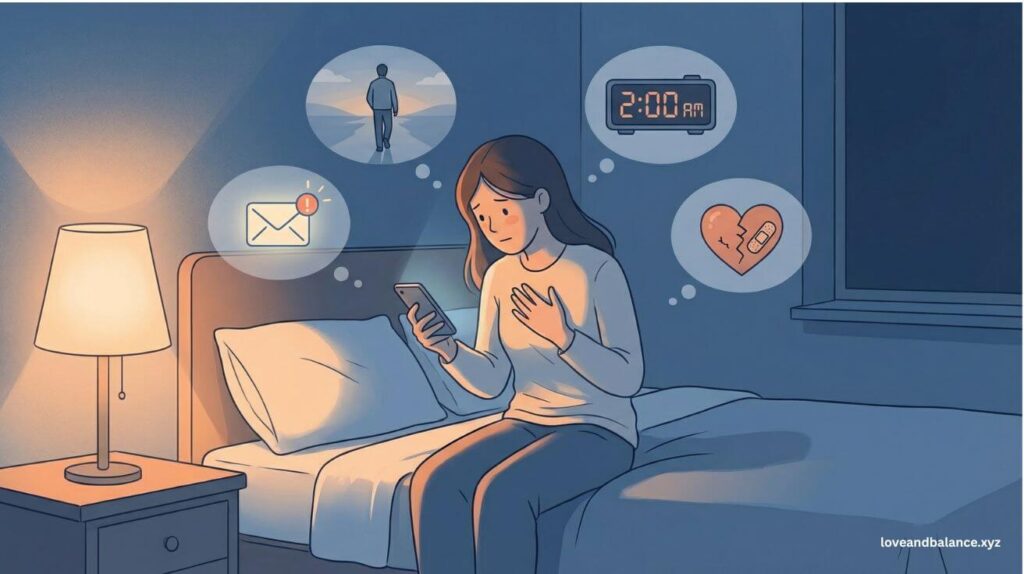
Author’s Note: As someone who has spent years studying relationship psychology and working through the lens of attachment theory, I’ve spoken with hundreds of people who describe the same exhausting experience — lying awake at 2 a.m., replaying a conversation, searching for a tone shift in a text message, wondering if “I’m fine” really means fine. This blog isn’t just theory. It’s a deep, research-backed look at why this happens — and what you can do about it.
What Is Anxious Attachment?
Anxious attachment is one of four core attachment styles psychologists use to describe how people bond emotionally with others—rooted in attachment theory — originally developed by British psychiatrist John Bowlby in the 1960s and later expanded by Mary Ainsworth — an anxious attachment style forms early in life, typically when caregiving is inconsistent.
Think of it this way: as a child, if your emotional needs were sometimes met warmly and sometimes ignored or dismissed, your nervous system never learned to trust that love was reliable. So it adapted — by becoming hypervigilant. By staying on constant alert. By always watching for signs that the person you love is about to leave.
That hypervigilance doesn’t disappear when you grow up. It moves into your adult relationships — and it brings overthinking with it.
Research consistently confirms this. A 2024 study published in the Journal of Social and Personal Relationships found that anxiously attached individuals showed greater emotional reactivity to daily relationship experiences, particularly on negative days — meaning their mental and emotional responses were amplified compared to securely attached people.
The Brain Science Behind the Spiral
Here’s something that might genuinely surprise you: anxious attachment and overthinking aren’t just emotional habits — they are neurological patterns.
When researchers scan the brains of people with anxious attachment, they find something consistent and striking. The amygdala — the brain’s threat-detection centre — is hyperactive. It fires faster, more intensely, and more frequently in response to social stimuli. In plain terms, your brain is treating an unanswered text message the same way it would treat a physical threat.
Studies published in PMC Neuroscience confirm that anxiously attached individuals show heightened amygdala responsivity and increased attentional vigilance toward threatening social information, such as signs of rejection or emotional withdrawal.
But there’s more. Anxious attachment is also linked to weakened prefrontal cortex (PFC) connectivity. The PFC is the rational, calming part of your brain — the one that normally steps in and says, “Hey, maybe he’s just busy.” When that connection is weakened, the amygdala’s alarm bells keep ringing, and there’s no effective “off switch.” The result? Rumination. Catastrophizing. Endless what-if loops.
The Anterior Cingulate Cortex (ACC) adds another layer. In people with anxious attachment, the ACC shows increased activity during social conflict or perceived exclusion—meaning the brain is constantly monitoring for rejection, drawing attention away from the present moment and feeding the overthinking cycle.
In short, an anxiously attached brain is biologically wired to overthink. It’s not weakness — it’s neurology shaped by early experience.
How Overthinking Plays Out in Real Relationships
Let me walk you through a real-world scenario — one that will feel painfully familiar to many of you.
Priya and Arjun have been dating for eight months. Arjun is warm, communicative — but this week has been stressful at work. He replies to texts slower than usual. He says, “I’m just tired” instead of the usual affectionate messages.
For someone with secure attachment, this reads as: He’s tired. Work is rough. I’ll check in tomorrow.
For Priya, who has anxious attachment, this triggers a spiral:
Did I say something wrong last Tuesday?
He used to always text back quickly. Something has changed.
What if he’s losing interest?
If I ask, will I seem needy? But if I don’t ask, I’ll never know.
Maybe he’s been talking to someone else.
Within hours, Priya has mentally rehearsed three different breakup conversations — none of which Arjun is aware of. She’s exhausted. And none of what she feared was actually happening.
This pattern — called an “interpretation loop” by relationship psychologists — is one of the most recognisable signatures of anxious attachment. The mind, trying to protect itself from emotional loss, runs endless simulations of possible threats — even when no real threat exists.
The Overthinking-Social Media Connection
In the digital age, overthinking in anxious attachment has found a terrifying new fuel source: social media.
A meta-analysis published in ScienceDirect examining 45 effect sizes from 11,746 participants found that anxious attachment showed a strong correlation with problematic social media use (r = 0.319), far higher than avoidant attachment. The study also found that social anxiety mediates this relationship — meaning anxiously attached people use social media compulsively partly because of the anxiety it generates.
Think about it: checking if your partner viewed your Instagram story. Refreshing to see if they’ve been active since their last message. Looking at who liked their photo. Every one of these behaviours is the digital equivalent of the brain’s threat-monitoring system doing overtime.
The attachment anxiety doesn’t decrease with each check — it intensifies. This is the loop: anxiety drives checking → checking finds ambiguous signals → ambiguous signals feed more anxiety.
7 Signs You Are Caught in the Anxious Attachment Overthinking Trap
If you recognise yourself in the scenarios above, here are the key signs to watch for:
Replaying conversations — You mentally review what you said, what they said, and what they really might have meant, sometimes hours or days later
Reading tone into texts — A one-word reply feels dismissive, even if it was sent in a rush
Seeking constant reassurance — You need confirmation that you’re loved, multiple times a day, but the reassurance never quite sticks
Mentally rehearsing conflict — You plan what you’ll say if things go wrong before anything has gone wrong
Misreading silence as rejection — When your partner is quiet, your brain immediately links it to emotional withdrawal
Hypervigilance to mood shifts — You notice the slightest change in your partner’s tone or behaviour and assign deep meaning to it
Post-interaction analysis — After a date or conversation, instead of feeling happy, you dissect everything that happened to check if it “went okay”
Why Reassurance-Seeking Never Actually Works
One of the most painful paradoxes of anxious attachment and overthinking is the reassurance trap.
When the overthinking spiral starts, the most immediate relief feels like getting your partner to confirm: “I love you. Everything is fine.” And for a few minutes, it does feel better. But then the anxiety creeps back. And then you need reassurance again. And again.
Research from NIH confirms that highly anxiously attached people perceive insufficient support even when support is given — because the core wound isn’t really about the current moment. It’s about a deep, early-formed belief that love is unreliable and conditional. Reassurance from the outside temporarily quiets the surface anxiety, but it never touches the root belief.
This is why partners of anxiously attached people often feel drained. And it’s why anxiously attached people feel frustrated — they keep asking for what they need, getting it, and still not feeling better.
The Link Between Anxious Attachment, OCD, and Intolerance of Uncertainty
A 2024 study published in Tandfonline found that attachment anxiety significantly predicted OCD symptoms, and that this relationship was mediated by intolerance of uncertainty (IU) — the inability to sit with not knowing. The study found that anxiously attached individuals tend to overestimate responsibility and engage in exaggerated threat appraisals, which feed both overthinking and compulsive checking behaviours.
This doesn’t mean everyone with anxious attachment has OCD — but it does explain why the overthinking can feel compulsive. Why do you know logically that checking their Instagram won’t help, but you do it anyway? Why do you understand that replaying the conversation serves no purpose, but your brain won’t stop?
Intolerance of uncertainty is the engine. The mind keeps thinking because it cannot tolerate not knowing. Anxious attachment makes uncertainty feel genuinely dangerous.
The Stress Amplification Effect
Here’s another layer that rarely gets addressed: anxious attachment amplifies stress reactivity across the board.
A landmark review published in PMC (NIH) found that when highly anxious individuals encounter any stressor — not just relationship-related ones — they perceive their partners and relationships more negatively and behave in more relationship-damaging ways. This means that a bad day at work, financial pressure, or even poor sleep can trigger the overthinking spiral, even when nothing is actually wrong in the relationship.
The stress doesn’t stay in its lane. It bleeds into the relationship because the attachment system is always monitoring for threat, and stress lowers the threshold for what triggers it.
How to Break the Cycle: Evidence-Based Strategies
The good news — and this is important — anxious attachment is not permanent. It is a learned pattern. And learned patterns can be unlearned.
Here’s what actually works, backed by research and therapeutic practice:
1. Name the Pattern in Real Time
When the overthinking starts, say it out loud (or in your journal): “My anxious attachment is activated right now.” This creates distance between you and the thought. It activates the prefrontal cortex — the rational brain — and begins to slow the amygdala’s alarm.
2. Delay the Reassurance-Seeking
Instead of texting your partner immediately when anxiety spikes, wait 20–30 minutes. During that time, ask yourself: Is there actual evidence that something is wrong? More often than not, the anxiety was generated internally — not by your partner’s behavior.
3. Practice “Secure Base” Journaling
Write about your relationship from the perspective of someone who is securely attached. What would a secure person think about this situation? This isn’t toxic positivity — it’s neural re-patterning. The more you practice accessing a secure narrative, the more accessible that neural pathway becomes.
4. Address the Intolerance of Uncertainty
Cognitive Behavioural Therapy (CBT) specifically targets intolerance of uncertainty — one of the core mechanisms linking anxious attachment to overthinking. Exposure exercises that involve intentionally sitting with not knowing (without checking or seeking reassurance) gradually rewire the response.
5. Communicate Needs Clearly — Without the Spiral
Instead of “You’ve been distant lately. Are you losing interest in me?” try: “I’ve been feeling a little anxious this week. Can we have some quality time together?” The first triggers defensiveness. The second invites connection.
6. Build a Consistent Self-Soothing Practice
Because anxious attachment is rooted in nervous system dysregulation, somatic practices matter enormously. Deep breathing (specifically extended exhale breathing, which activates the parasympathetic nervous system), cold water on the face, or a grounding body scan can interrupt a spiral mid-cycle.
7. Seek Attachment-Focused Therapy
Working with a therapist trained in Emotionally Focused Therapy (EFT) or Internal Family Systems (IFS) can help you process the early experiences that created the anxious pattern — not just manage the symptoms.
Can a Relationship Help Heal Anxious Attachment?
Yes — but only under certain conditions.
Research published in Compass Hub (2024) confirms that attachment security can be earned through consistent, reliable relationship experiences. When a partner provides steady, predictable emotional availability — not perfect, but consistent — the anxious attachment system gradually learns that it is safe to relax.
The keyword is consistent. Inconsistency (being loving one day, distant the next) is exactly what created anxious attachment in the first place — and an inconsistent partner will re-activate it and deepen the overthinking patterns.
A relationship cannot replace therapy. But a secure, steady relationship is one of the most powerful healing environments available.
A Note on Self-Compassion
If you have read this far and recognised yourself deeply in these patterns, please hear this: You are not too much. You are not broken. You are not “crazy” for overthinking.
Your brain learned to work this way because, at some point, hypervigilance was the most adaptive response available to you. It was protecting you. The problem is that protection is now costing you peace — and you deserve peace.
Healing anxious attachment isn’t about becoming emotionless or indifferent. It’s about learning that you are safe enough to stop scanning for danger.
Anxious Attachment and Overthinking: Why Your Brain Won’t Stop and How to Finally Find Peace
Frequently Asked Questions (FAQs)
Q1: Can anxious attachment cause overthinking even in happy relationships?
Yes. Anxious attachment is an internal pattern, not a response to external reality. Even in a loving, stable relationship, the anxiously attached brain will generate threat signals because the nervous system hasn’t yet learned to trust consistency. The overthinking comes from within — not from your partner’s behaviour.
Q2: Is overthinking in relationships always a sign of anxious attachment?
Not always — but there is a strong overlap. Overthinking can also stem from past trauma, generalised anxiety disorder, or low self-esteem. However, if your overthinking is specifically activated by relationship cues (silence, tone shifts, delayed replies), and accompanied by a deep fear of abandonment, anxious attachment is very likely a factor.
Q3: What triggers the overthinking spiral most often?
The most common triggers are inconsistency from a partner, conflict or criticism, perceived emotional withdrawal, silence or delayed communication, and external stressors that lower the general anxiety threshold.
Q4: Does anxious attachment go away on its own?
It rarely resolves without intentional work. Without awareness and intervention, anxious attachment patterns tend to repeat across relationships. However, with therapy, self-awareness practices, and a consistently supportive partner, significant healing is achievable.
Q5: How do I stop overthinking after a fight with my partner?
First, give yourself physical regulation time before re-engaging — the nervous system needs 20–30 minutes to come down from activation. Then, instead of seeking immediate resolution, journal what you are actually afraid of underneath the fight. Usually, the surface argument is a proxy for a deeper fear (abandonment, not being enough). Addressing the deeper fear is more effective than resolving every detail of the argument.
Q6: Is anxious attachment linked to anxiety disorders?
There is a significant overlap. Research confirms that anxious attachment is associated with social anxiety, OCD-adjacent thought patterns, and heightened stress reactivity. This doesn’t mean anxious attachment is a disorder — but it does mean that people with anxious attachment are at higher risk for anxiety-related symptoms, especially in the context of close relationships.
Q7: Can I heal anxious attachment without a romantic relationship?
Absolutely. Healing happens in any consistent, secure relationship — including friendships, therapy, and even your relationship with yourself. The therapeutic relationship itself is one of the most evidence-based pathways to building what researchers call “earned secure attachment.”
This article was written drawing on peer-reviewed neuroscience research, attachment theory scholarship, and direct experience working with relationship psychology content. All research cited is from published academic sources. If you recognise these patterns in yourself, please consider speaking with a licensed therapist who specialises in attachment or trauma.