
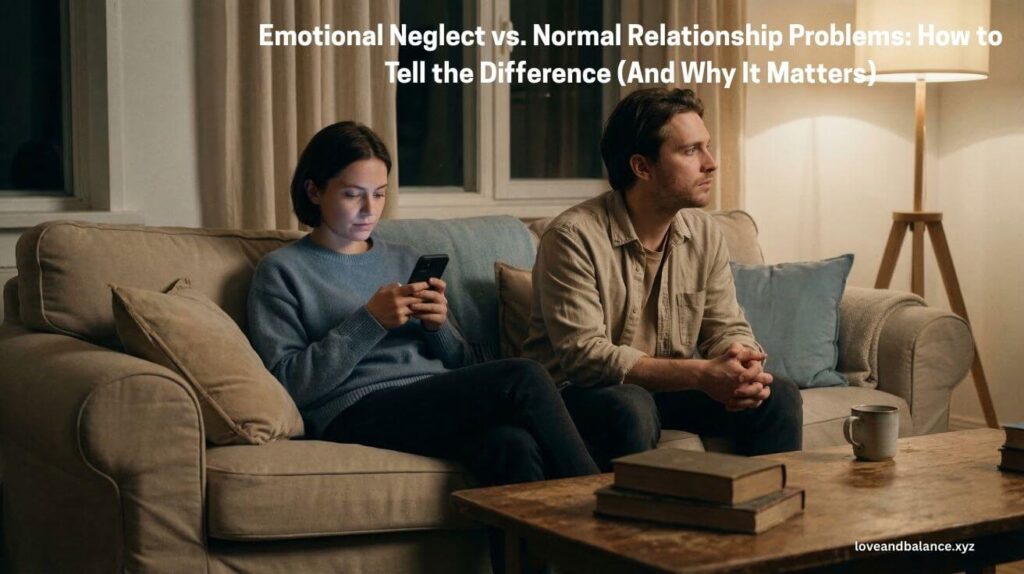
Emotional Neglect vs. Normal Relationship Problems: How to Tell the Difference (And Why It Matters)
By Love and Balance
There’s a moment many people describe the same way — sitting next to the person they love, and feeling completely alone.
Not after a fight. Not during a rough patch. Just… always.
If that sounds familiar, you might be experiencing something that gets mistaken for “relationship stress” all the time: emotional neglect. And the confusion between emotional neglect and normal relationship problems is costing people years of their lives — spent either tolerating something harmful, or leaving something that just needed honest work.
This post is going to help you tell the difference. Not with a checklist you could find anywhere, but with real psychology, real patterns, and real questions you can sit with.
What Even Is Emotional Neglect in a Relationship?
Before we compare, we need to get clear on what emotional neglect actually is — because most people get it wrong.
Emotional neglect is not about what your partner does to you. It’s about what they consistently fail to do. It’s the absence of emotional presence, responsiveness, and attunement. It’s your partner being physically there but emotionally unavailable — not once, not during a hard week, but as a pattern.
Think of it this way: a house can feel freezing not because someone broke the heater, but because no one ever thought to turn it on.
Journalist and author Malcolm Gladwell once said on a podcast: “It’s not conflict that drives people away — it’s neglect.” That statement, while simple, aligns with decades of relationship research. Conflict, ironically, requires two people to show up. Neglect means one person has quietly left the room — emotionally speaking.
A 2024 study published in Psychiatry Investigation found that emotional neglect is positively correlated with neuroticism and depression, while being negatively correlated with psychological resilience — meaning people who experience neglect become more emotionally fragile over time, not stronger. This is what makes it so dangerous when it goes unrecognised.
Normal Relationship Problems: What They Actually Look Like
Every relationship has problems. Every single one. And if you’re reading this and thinking your relationship is uniquely broken — it probably isn’t.
Normal relationship problems include:
Recurring arguments about money, chores, or family — These are friction points, not signs of contempt or indifference.
Communication gaps — Sometimes partners talk past each other, especially during stress. This is common and fixable.
Temporary emotional distance — Work pressure, grief, health issues, or burnout can cause a partner to withdraw temporarily.
Differing love languages — One person shows love through acts of service; the other needs words of affirmation. The mismatch creates confusion, not cruelty.
Conflict avoidance — Some people shut down during arguments because they were raised in volatile homes. That’s a coping mechanism, not a character flaw.
Periods of reduced intimacy — This ebbs and flows in long-term relationships and is well-documented.
What all of these have in common: they are responsive to effort. When you bring them up, your partner engages — even if imperfectly. They acknowledge the problem exists. They feel bad. They try. The relationship moves, even if slowly.
The Core Difference: Active Engagement vs. Emotional Absence
Here is the most important distinction, and it’s worth reading twice:
Normal relationship problems involve two people who are both present but struggling. Emotional neglect involves one person who has emotionally checked out — and often doesn’t realise it.
Conflict — even painful, ugly conflict — is a form of engagement. It means both people still care enough to react. Emotional neglect is the opposite. It’s indifference. It’s your partner not noticing you’re upset. It’s expressing pain and being met with a shrug, or worse, silence.
Dr. Jonice Webb, a licensed psychologist who coined the term “Childhood Emotional Neglect” (CEN), writes that people who grew up with emotionally unavailable parents often become partners who replicate that pattern — not out of malice, but because they were never taught to recognize or respond to emotional cues. This pattern becomes the invisible architecture of their adult relationships.
This is crucial because it means emotional neglect in a relationship is often unintentional — but that doesn’t make it harmless.
Side-by-Side: Emotional Neglect vs. Normal Problems
Situation | Normal Relationship Problem | Emotional Neglect |
You share something upsetting | Partner listens, even if imperfectly | Partner dismisses, changes the subject, or goes silent |
You feel distant | Partner notices and initiates reconnection | Partner doesn’t notice — or doesn’t care |
You argue | Both people engage, even if messily | One person shuts down consistently and permanently |
You need support during a hard time | Partner shows up in their own way | Partner is physically present but emotionally absent |
You raise a concern | Partner takes it seriously, even if defensive | Partner minimises, mocks, or ignores your feelings |
Pattern over time | Things shift and evolve | Emotional distance becomes the baseline |
Real Stories That Illustrate the Difference
Story 1 — The Partner Who Was “Just Busy”
Priya and her husband, Marcus, had been married for six years. He worked long hours in finance, and she often felt lonely. When she raised it, he’d apologise, plan a date night, and things would improve — for a while. Then the cycle repeated.
Was this emotional neglect? Not quite. Marcus was responsive. He heard her. He changed his behaviour, even temporarily. What Priya and Marcus had was a normal problem: mismatched expectations around quality time, made worse by work stress. With couples counselling, they identified that Priya needed daily emotional check-ins, not just weekend plans. That was a solvable problem.
Story 2 — The Partner Who “Didn’t Do Drama”
Leila had been with her boyfriend for four years. Whenever she cried — after a bad day at work, after a loss in the family, after a fight — he would leave the room or tell her she was “being too emotional.” He never asked what was wrong. He never sat with her in discomfort. She learned to cry in the bathroom.
When she brought up how lonely she felt, he told her she expected too much. He never raised his voice. He never cheated. He was just… absent. And she had spent four years convincing herself that was fine.
That was emotional neglect. The absence of cruelty doesn’t equal the presence of love.
The Long-Term Damage of Confusing the Two
Here’s where it gets serious.
When emotional neglect goes unrecognised — when it’s chalked up to “we’re going through a rough patch” or “he’s just not good at emotions” — the person being neglected begins to internalise the message. They start to believe the problem is them.
A 2024 study in Psychiatry Investigation found that emotional neglect significantly increases depression risk through a process called neuroticism — essentially, the neglected person becomes hypersensitive to emotional stress and loses resilience over time. Research published on PubMed Central (2023) also found that a person’s experience of emotional neglect directly impacts their partner’s relationship satisfaction, creating a cycle of disconnection that spreads through the relationship like a slow leak.
And perhaps most quietly devastating, a Frontiers in Psychology (2021) study found that emotional maltreatment in a relationship predicts a decrease in compassionate goals over time, meaning that the neglected partner gradually stops trying to show up for the other person. Not because they’re selfish — but because they’ve been starved of the reciprocity that makes compassion feel safe.
The relationship doesn’t explode. It fades.
Why Emotional Neglect Is So Easy to Miss
Unlike physical abuse or verbal cruelty, emotional neglect leaves no visible marks. It’s made of silence, not screaming. That’s precisely what makes it so difficult to name.
Several factors make it easy to miss:
Cultural and gender norms — In many cultures, emotional stoicism is praised as maturity. “He doesn’t make a big deal out of things” can be reframed as emotional unavailability.
Gaslighting (even unintentional) — When you bring up emotional needs, and your partner says “you’re too sensitive,” you start to doubt your own experience.
Intermittent connection — Occasional moments of warmth or affection can make you believe the neglect isn’t real, or that things are improving.
Childhood conditioning — If you grew up in an emotionally unavailable household, neglect may feel so normal that you don’t recognise it as a problem at all.
Signs You’re Experiencing Emotional Neglect (Not Just a Rough Patch)
These aren’t occasional feelings — they’re persistent, recurring patterns:
You feel lonely inside the relationship, not just when your partner is away
Your emotions are regularly minimised, dismissed, or ignored
You’ve stopped sharing things with your partner because “it’s not worth it”
You find yourself emotionally relying on friends, journaling, or strangers online for the connection you should have at home
When you’re upset, your partner doesn’t notice — or doesn’t ask
You walk on eggshells emotionally — not because of anger, but because of indifference
Intimacy feels performative or absent
You frequently wonder: “Would they even notice if I disappeared for a day?”
What To Do When You Recognise Emotional Neglect
Naming it is the first, hardest step. Once you’ve named it, here’s how to move forward:
1. Stop minimising your own experience. If you consistently feel emotionally alone in your relationship, that feeling is data. Don’t argue yourself out of it.
2. Have a direct, calm conversation. Use “I feel” language: “I feel invisible when I share something, and you don’t respond.” Avoid accusatory framing, which will trigger defensiveness.
3. Observe the response. This is where you learn everything. Does your partner get defensive and shut down? Or do they sit with discomfort, ask questions, and show a genuine desire to understand? That response tells you more than any conversation could.
4. Seek couples therapy. Emotional neglect — especially when it stems from childhood patterns — is genuinely difficult to shift without professional support. A good therapist helps both partners understand each other’s emotional architecture without assigning blame.
5. Know your limits. If you’ve raised the issue repeatedly and nothing changes, that’s important information. You deserve a relationship where your emotional reality is acknowledged — not just tolerated.
When Normal Problems Become Neglect
Here’s a nuance most articles miss: normal relationship problems can become emotional neglect if they’re left unaddressed long enough.
A couple who have a communication problem but never work on it — choosing avoidance, year after year — eventually creates an environment of emotional absence. The neglect wasn’t intentional at first. But the choice to keep avoiding is a choice, even when it’s unconscious.
Research backs this up: chronic unresolved conflict creates emotional withdrawal, which over time mirrors the patterns of neglect. The difference is in the willingness to engage. A partner dealing with a normal problem will show up when asked. A neglectful relationship pattern resists engagement — because the emotional disconnection has become the default.
Can a Relationship Recover From Emotional Neglect?
Yes — but only under specific conditions.
Recovery requires the neglectful partner to:
Acknowledge that the pattern exists (not explain it away)
Show genuine curiosity about the other person’s emotional world
Commit to sustained behavioural change — not just apologies
Engage in therapy, individually or as a couple
If both partners are willing and the neglect hasn’t been happening for years without any attempts to change, relationships can recover remarkably well. Emotional attunement is a learnable skill — it’s not a fixed personality trait.
The relationships that cannot recover are the ones where one partner refuses to acknowledge that the problem exists at all. Because you cannot heal what one person refuses to see.
Emotional Neglect vs. Normal Relationship Problems: How to Tell the Difference (And Why It Matters)
FAQs: Emotional Neglect vs. Normal Relationship Problems
Q1: Is emotional neglect the same as falling out of love?
Not necessarily. Emotional neglect can happen even when love is present — especially when a partner has an avoidant attachment style or grew up in an emotionally suppressed household. Falling out of love typically involves a loss of affection, attraction, and desire for the person’s well-being. Emotional neglect is more specifically about the inability or unwillingness to engage emotionally, which can be worked on.
Q2: Can emotional neglect be unintentional?
Absolutely — and this is one of the most important things to understand. Many emotionally neglectful partners are not malicious. They were raised in environments where emotional needs were dismissed or ignored, so they genuinely don’t recognise what emotional attunement looks like. That doesn’t excuse the impact, but it does change the conversation from blame to understanding.
Q3: How long does a “rough patch” last before it becomes a pattern?
There’s no fixed timeline, but the key question is: Is the problem moving? Normal rough patches are temporary, responsive to effort, and show some improvement when addressed. If you’ve raised the same emotional concern three or more times over six months with no meaningful change, you’re likely dealing with a pattern, not a phase.
Q4: Can emotional neglect cause depression?
Yes — research published in Psychiatry Investigation (2024) found a direct and significant correlation between emotional neglect and depression, mediated by neuroticism. People experiencing prolonged emotional neglect begin to internalise the message that their feelings don’t matter, which is a direct path to depressive symptoms.
Q5: What if my partner says I’m “too needy” when I bring up emotional needs?
This is one of the most common responses neglectful partners give — and it’s a red flag. Having emotional needs in a relationship is not neediness; it’s human. If your partner consistently reframes your needs as a personal failing rather than engaging with them, that’s part of the neglect itself.
Q6: Should I leave a relationship with emotional neglect?
That depends on whether your partner is willing to acknowledge and work on the pattern. If they deny it, dismiss it, or show no interest in changing, leaving may be the healthiest option. But if there’s genuine willingness and mutual effort — especially with professional support — many relationships do recover.
Q7: What’s the difference between an introvert partner and an emotionally neglectful one?
An introverted partner may need more alone time, be quieter, or not communicate feelings as verbally — but they still care about your emotional state and show it in their own way. They’ll check in after you’ve had a hard day. They’ll notice if you’re sad. Emotional neglect is not about personality style; it’s about a fundamental lack of responsiveness to your emotional reality.
A Final Word
The most disorienting thing about emotional neglect is that it can look like a perfectly functioning relationship from the outside — and even from the inside, on good days.
But love is not just the absence of conflict. It’s not just “we never fight” or “they’ve never cheated.” Love is being seen. It’s having your feelings met with curiosity instead of dismissal. It’s someone noticing when you’re carrying too much — and sitting with you in it.
Normal relationships struggle. They argue, they miscommunicate, they go through seasons where both people are exhausted and give less than they should. That’s not neglect. That’s being human together.
Emotional neglect is something different. It’s the quiet experience of being alone inside a relationship — and being told, over and over, that you shouldn’t feel that way.
You deserve more than the absence of harm. You deserve the presence of love.
If this resonated with you, share it with someone who might need it. And if you’re working through your relationship patterns, explore more on Love and Balance — where we talk about the emotional side of love that nobody teaches us.