
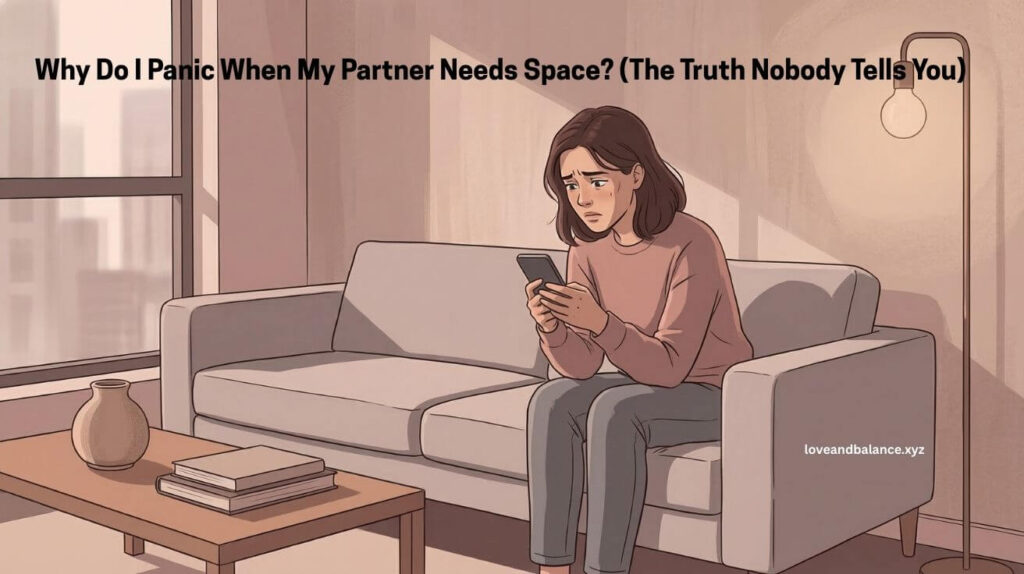
Why Do I Panic When My Partner Needs Space? (The Truth Nobody Tells You)
There’s a specific kind of dread that settles in your chest the moment your partner says, “I just need a little space.”
Your heart rate picks up. Your mind starts racing. You replay the last 48 hours, searching frantically for what you did wrong. You check your phone — twice, five times, twelve times. You compose a message, delete it, and compose it again. You imagine worst-case scenarios so vividly that they feel real.
And the most confusing part? You know, somewhere in the rational corner of your brain, that needing space is normal. People need breathing room. That’s healthy. You know this. And yet — the panic still comes.
If this sounds familiar, you’re not dramatic, you’re not “too much,” and you’re definitely not alone. What you’re experiencing has a name, a psychological explanation, and — most importantly — a path forward.
Let’s talk about it, honestly.
What’s Actually Happening in Your Brain
When your partner asks for space, your brain doesn’t process it as a neutral request for alone time. For many people, it registers as a threat.
Neuroscience research shows that social rejection and relational uncertainty activate the same neural pathways associated with physical pain. Your brain, wired for survival, treats the ambiguity of “I need space” as a danger signal — because in your nervous system’s language, emotional disconnection equals risk.
This isn’t a weakness. It’s biology.
But here’s the key: why your brain reacts this way is deeply personal — shaped by your childhood, your past relationships, and the attachment patterns you formed long before you ever met your current partner.
The Real Root: Attachment Theory Explains Everything
In the 1960s and 70s, British psychiatrist John Bowlby developed what we now call Attachment Theory — the idea that our earliest bonds with caregivers become the blueprint for how we relate to people we love throughout our entire lives.
His work, later expanded by psychologist Mary Ainsworth through her famous “Strange Situation” experiments, identified distinct attachment styles: secure, anxious, avoidant, and disorganised.
If you panic when your partner needs space, there’s a very high chance you have an anxious attachment style.
What Anxious Attachment Actually Feels Like
People with anxious attachment style grew up in environments where love felt inconsistent. Maybe your caregiver was warm and present sometimes, but emotionally unavailable or unpredictable at other times. Your developing brain learned a painful lesson: closeness can disappear without warning, so you must constantly monitor for signs of withdrawal.
Fast forward to adulthood. The moment your partner creates emotional or physical distance, that old alarm system fires. Your nervous system doesn’t know the difference between your partner needing a quiet evening alone and your childhood caregiver emotionally withdrawing for days. The response — panic, clinging, seeking reassurance — is the same.
Research published in the journal Attachment & Human Development confirms that anxiously attached individuals experience hyperactivation of negative emotions in stressful relational contexts. They don’t just feel a little worried — they feel flooded.
The Pursuer-Distancer Cycle: Are You Stuck in It?
There’s a painful dynamic that therapists see repeatedly in couples where one partner has anxious attachment, and the other leans avoidant. Psychologists call it the pursuer-distancer cycle, and it works like this:
Partner A (avoidant) feels overwhelmed or stressed and asks for space to regulate
Partner B (anxious) interprets the request as a rejection and panics
Partner B pursues harder — texting more, seeking reassurance, wanting to “fix” things immediately
Partner A feels more overwhelmed, pulls further away
Partner B panics more
Repeat
Neither partner is the villain in this story. The avoidant partner isn’t being cruel — they genuinely need distance to self-regulate. Research shows that a 2021 study on emotional flooding found that heightened physiological arousal actually impairs communication, empathy, and problem-solving. Your partner may be trying to protect the relationship by stepping back.
But your nervous system hears it as abandonment.
This cycle is exhausting for both people. And it can slowly erode even genuinely loving relationships if it goes unaddressed.
Real Story: What Panic in a Relationship Actually Looks Like
Let me share a composite story based on patterns I’ve observed and studied in the relationship psychology space — names and details are changed for privacy, but the experience is deeply real.
Priya, 29, had been with her boyfriend Rohan for two years. By most measures, the relationship was good — they communicated, they laughed, they had shared goals. But every time Rohan had a busy week at work and went quiet on messages, Priya would spiral.
“I’d send him three texts and he wouldn’t respond for four hours. I’d start imagining he was pulling away, that he didn’t love me anymore, that something had fundamentally shifted. I’d feel this hollow, sick feeling in my stomach. And when he’d finally text back — totally fine, just tired from work — I’d feel relieved for about an hour. Then I’d start worrying again.”
Priya’s response had nothing to do with Rohan. It had everything to do with the fact that her father had walked out of her life when she was seven years old — without explanation, without warning. Her nervous system had been on “high alert for abandonment” ever since.
This is what attachment wounds look like in adult relationships. They show up not as logical fears, but as visceral, gut-level panic that feels completely disproportionate to the situation — because your nervous system is responding to them, not now.
7 Signs Your Panic Is Rooted in Anxious Attachment
Not sure if this resonates with you? Here are the most telling signs:
You feel a rush of anxiety the moment your partner doesn’t text back quickly
You constantly look for “hidden meanings” in their words or tone
You need frequent reassurance that they still love you and aren’t leaving
When they need time alone, your first thought is “what did I do wrong?”
You feel a compulsive urge to resolve conflict immediately — you can’t sit with unresolved tension
Your mood is largely dependent on how engaged and available your partner seems
You sometimes feel “too much” for your partner, even when they haven’t said so
If you nodded at four or more of these, your panic likely isn’t about the current situation — it’s your old nervous system speaking.
Why “Just Calm Down” Doesn’t Work
Here’s something that almost no relationship advice column acknowledges: you cannot logic your way out of a panic response.
When the anxious attachment alarm fires, your brain shifts into a threat-detection mode. The prefrontal cortex — the rational, thoughtful, “everything is fine” part of your brain — goes partially offline. You’re operating from the amygdala: raw, emotional, fight-or-flight.
This is why your partner saying “you’re being irrational” makes things worse, and why telling yourself “stop panicking, it’s fine” feels impossible in the moment. The solution isn’t logic — it’s nervous system regulation first, rational thinking second.
What to Do When the Panic Hits: Practical Tools That Actually Help
1. Name It to Tame It
Neuropsychologist Dan Siegel coined the phrase “name it to tame it.” When you feel the panic rising, try saying aloud or writing down: “I’m feeling scared right now because my partner asked for space, and that triggers my fear of being abandoned.”
Simply labelling the emotion activates the prefrontal cortex and begins to calm the amygdala response. It sounds too simple. It genuinely works.
2. Regulate Before You Reach Out
Before you send that anxious “are we okay?” text, try this first: 4-7-8 breathing. Inhale for 4 counts, hold for 7, exhale for 8. Do this three times. This activates your parasympathetic nervous system — the “rest and digest” counterpart to fight-or-flight — and brings your arousal level down enough to think clearly.
3. Redirect the Energy (Not Suppress It)
The urge to reach out when anxious is energy looking for somewhere to go. Instead of suppressing it, redirect it. Call a friend. Go for a walk. Write in a journal. Do a workout. The goal is to discharge the nervous system activation in a healthy direction.
4. Challenge the Story, Not the Feeling
Once you’ve regulated (not before), gently examine the narrative your mind created. Ask yourself:
“What is the actual evidence that my partner is pulling away permanently?”
“Is it possible they just need rest, not distance from me?”
“Have I felt this panic before and been wrong about what it meant?”
You’re not invalidating your feelings — you’re fact-checking the story your anxiety wrote.
5. Create a “Space Agreement” With Your Partner
One of the most effective tools for couples navigating this dynamic is a proactive conversation outside of conflict. Therapists often recommend that couples agree, in calm moments, on what “I need space” actually means in your relationship.
For example: “When I say I need space, I mean I need 2 hours to decompress. I’ll check in with you after. It has nothing to do with how much I love you.”
This removes the terrifying ambiguity that fuels anxious panic. When there’s a clear, agreed-upon meaning, the threat response is less likely to activate.
What Science Says About Space in Healthy Relationships
Here’s something worth sitting with: research consistently shows that healthy couples need and take space from each other. Far from signalling relationship doom, a partner asking for solitude can actually strengthen the bond.
A 2021 study on emotional flooding found that intentional time-outs during conflict — when followed by re-engagement — actually improve relational outcomes. Space, when used as a tool for self-regulation rather than avoidance, is a sign of emotional maturity, not withdrawal.
Your partner needing space doesn’t mean they love you less. It often means they’re trying to show up better for you.
The Deeper Healing: Building a More Secure Self
Managing the panic in the moment is important. But the deeper work — the work that changes everything — is healing the attachment wound itself.
This isn’t a quick fix. But here’s what genuinely helps over time:
Individual therapy, especially attachment-focused or EMDR therapy, helps you process the original experiences that created the wound. You can’t think your way out of a felt-sense trauma — you need a therapeutic space to metabolise it.
Secure relationships of any kind — with friends, family, mentors — teach your nervous system that not everyone will leave. Consistent, safe connections slowly rewrite the internal working model that said, “people always go”.
Mindfulness practice builds what therapists call “the observing self” — the ability to watch your panic without becoming it. Regular mindfulness literally changes the brain’s structure over time, reducing amygdala reactivity.
Couples therapy can be enormously effective when both partners are willing. When your partner understands your attachment history, they can become a co-regulator — someone who helps calm your nervous system rather than inadvertently activating it.
A Note to Partners of Anxiously Attached People
If you’re reading this and you sometimes need space — and you’ve watched your partner unravel when you ask for it — please hear this: your needs are valid, too.
You are allowed to need solitude to regulate. That is not selfish; that is healthy self-awareness.
But how you communicate that need matters enormously. “I need space” without context is genuinely terrifying to an anxious partner. A small shift — “I’m feeling overwhelmed and need a couple of hours to decompress. This isn’t about us. I love you.” — can prevent a spiral before it starts.
You can’t heal your partner’s attachment wound. But you can choose words that don’t accidentally reopen it.
Why Do I Panic When My Partner Needs Space? (The Truth Nobody Tells You)
Frequently Asked Questions
Is it normal to panic when your partner needs space?
Yes — it’s extremely common, particularly for people with anxious attachment styles. Research shows that the brain processes relational uncertainty as a threat, activating the same neural pathways as physical pain. It doesn’t mean something is wrong with you; it means your nervous system learned to be hypervigilant in close relationships, likely from early life experiences.
Does needing space mean my partner is falling out of love?
Not at all. A 2021 study on emotional flooding shows that requesting space is often an attempt at healthy emotional self-regulation, not a sign of emotional withdrawal from the relationship. Partners with avoidant attachment styles in particular use space as a primary tool to manage overwhelm, and research confirms this is their way of protecting the relationship, not abandoning it.
What is the anxious-avoidant trap, and am I in it?
The anxious-avoidant trap (also called the pursuer-distancer cycle) is when one partner pursues closeness while the other seeks distance, each accidentally intensifying the other’s response. You’re likely in it if every request for space escalates into a conflict where you feel increasingly desperate and your partner increasingly withdrawn. Couples therapy is the most effective way to interrupt this pattern.
How do I stop myself from texting my partner obsessively when they need space?
The key is to regulate your nervous system before you act on the urge. Try 4-7-8 breathing, physical exercise, or calling a friend first. Once regulated, ask yourself: is there an actual emergency, or is my anxiety creating one? Most of the time, you’ll find you can wait — and that waiting builds the internal security you’re seeking from outside.
Can anxious attachment be healed?
Absolutely. Attachment styles are not permanent personality traits — they are adaptive patterns formed in response to early experiences, and they can shift significantly through therapy, healthy relationships, and intentional self-work. Many people move from anxious to “earned secure” attachment, which is just as stable as naturally secure attachment. It takes time, but it is entirely possible.
When should I seek professional help for relationship anxiety?
If your anxiety about your partner needing space is significantly affecting your daily functioning — disrupting your sleep, work, social life, or physical health — it’s worth speaking to a therapist. Attachment-focused therapy, Cognitive Behavioural Therapy (CBT), and EMDR are all evidence-based approaches shown to be effective for relationship anxiety and fear of abandonment.
You Are Not “Too Much” — You’re Just Healing
The panic you feel when your partner needs space isn’t a character flaw. It’s a wound that has been waiting for understanding.
The moment you stop treating your anxiety as an enemy and start seeing it as a nervous system trying to protect you — with outdated information — everything begins to shift. You stop fighting yourself. You start getting curious instead.
And in that curiosity, something quietly remarkable happens: you begin to build the one thing that no partner can truly give you, but that changes every relationship you’ll ever have.
You begin to build security within yourself.
Have you experienced panic when your partner needs space? Share your thoughts in the comments — your story might be exactly what someone else needs to read today.
If this resonated with you, explore more on Love and Balance: [Anxious vs Avoidant Attachment: Why You Keep Triggering Each Other] | [How to Fix Communication Problems in a Relationship: A Complete Guide]