
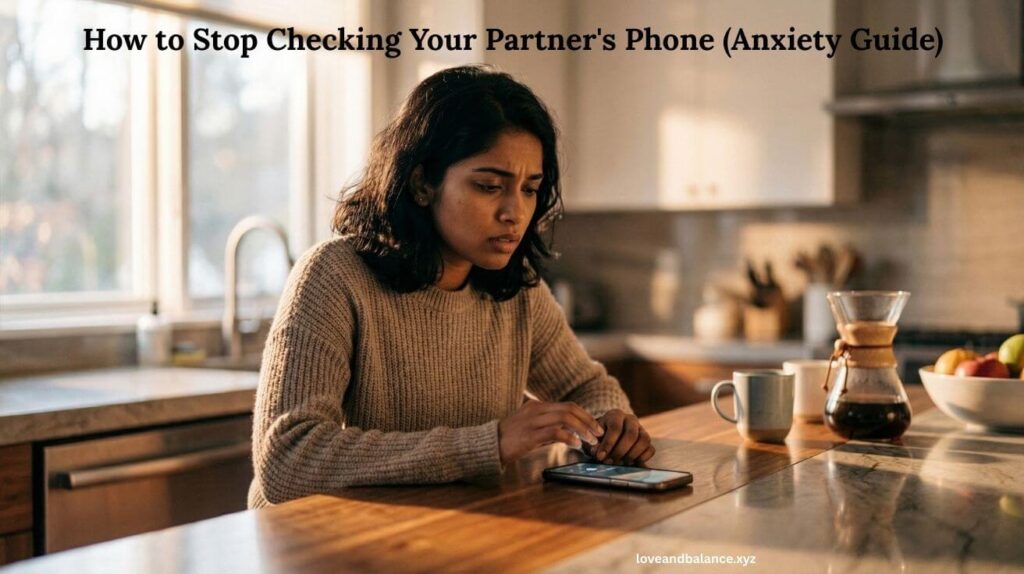
How to Stop Checking Your Partner’s Phone (Anxiety Guide)
There is a moment most people in relationships recognise — even if they never talk about it out loud. Your partner leaves their phone on the kitchen counter, face up, and walks into the next room. You stand there. Something tightens in your chest. Your eyes drift toward the screen. You tell yourself you won’t look. Then you do.
If that sounds familiar, you are not broken, and you are definitely not alone. But you are caught in one of the most anxiety-fueling loops in modern relationships — and it is quietly doing real damage.
This guide is not here to shame you. It is here to help you understand why it happens, what the research actually says about it, and how you can stop — not by willpower alone, but by working with your mind instead of fighting it.
Why You Check in the First Place
Let’s get honest before we get helpful.
Checking your partner’s phone is almost never really about the phone. It is about what you are afraid to find. And beneath that fear is something even deeper: a nervous system that genuinely believes it needs certainty to feel safe.
Dr. John Bowlby’s attachment theory, developed in the 1950s and expanded ever since, explains that humans are wired from birth to seek closeness and reassurance from their primary attachment figures. When that security feels threatened — even by a vague, unnamed feeling — our brains trigger a surveillance response. In 2023, researchers at the University of Granada confirmed this directly: people with anxious attachment styles engage in significantly more digital monitoring of their partners, including checking phones, tracking social media activity, and monitoring who comments on their posts. Critically, the same study found that this monitoring does not reduce anxiety — it actually amplifies jealousy and insecurity because the mind starts interpreting everything as potential evidence.
In other words, the behaviour that feels like it will calm you down is the very behaviour keeping you anxious.
The Real Numbers Behind Phone Snooping
You might wonder just how common this is. A large-scale consumer survey found that 51% of Americans have checked their partner’s phone without permission — looking at messages, emails, social media, and photos. Over 55% had gone through their partner’s email. These are not people who are inherently suspicious or controlling. Many people who love their partners deeply and are struggling with anxiety that has no healthy outlet.
A separate peer-reviewed study published in Psychological Reports examined 329 married participants and found that lack of trust was a significant predictor of relationship problems — and that phone snooping partially mediated the connection between emotional instability and the intention to break up. Translation: when people snoop, it doesn’t fix the insecurity. It feeds the very emotional instability that leads couples toward conflict and, eventually, separation.
This is not a small thing. This behaviour pattern has measurable consequences on whether relationships survive.
What Happens in Your Brain When You Check
Understanding the neurological side of this matters because it removes the moral weight from a behavioural pattern and puts it where it belongs: in the realm of mental health and habit formation.
When you feel the urge to check your partner’s phone, your amygdala — the brain’s threat-detection centre — has already fired. It picked up on some cue: maybe your partner laughed quietly at their screen, or they tilted it away slightly, or they mentioned someone’s name you don’t recognise. The amygdala doesn’t distinguish between a real lion and an imagined one. It just sounds the alarm.
You check the phone. Nothing is there — or maybe there is something ambiguous. Either way, what you get is a brief, shallow relief followed by a stronger wave of anxiety. This is the anxiety loop: trigger → compulsive behaviour → temporary relief → increased anxiety → repeat. A 2024 study published in Computers in Human Behaviour found that phone-checking frequency predicted greater depression, anxiety, and stress levels — not just for personal phone use, but in a relational context as well.
The behaviour becomes self-reinforcing. Each time you check and survive the moment, your brain logs it as: “Checking = safety.” Over time, the threshold lowers. You check more. The anxiety window shrinks. You check again.
“But What If My Instincts Are Right?”
This is the question that keeps most people stuck. And it deserves a real answer.
Yes — there are situations where infidelity is real, past betrayals are unresolved, and trust has genuinely been broken. In those cases, phone checking is not an irrational anxiety response; it is a symptom of an unhealed wound in the relationship. If your partner has cheated before and neither of you has genuinely worked through it with a counsellor or therapist, the phone checking is not the problem. The unaddressed rupture is.
But here is how you can tell the difference between valid concern and anxiety-driven surveillance:
Valid concern is specific: “He lied to me before and I found out through his phone.”
Anxiety-driven surveillance is diffuse: “What if something is going on? What if she’s not telling me everything? I just need to check, just once.”
Anxiety-driven checking tends to be habitual, secretive, and followed by guilt. It rarely produces the closure it promises because there is no amount of evidence that will satisfy a nervous system that has learned to see threat everywhere.
If you genuinely suspect ongoing infidelity, the answer is not another check of his WhatsApp. It is a direct, honest conversation — or a therapist’s office.
A Real Story: When Checking Becomes a Cage
Names have been changed.
Meera, a 31-year-old from Bangalore, had been with her partner for four years when she started checking his phone. It began after she noticed he was texting more than usual late at night. She went through his messages once — found nothing — and felt relieved. Two weeks later, she did it again. Then once a week. Then daily.
“I wasn’t finding anything,” she told a relationship counsellor. “But instead of feeling better, I was getting worse. I started interpreting normal things — a notification I didn’t recognise, a friend’s name I hadn’t heard before — as evidence. I was building a case for something that wasn’t happening.”
What Meera describes is clinically consistent with what researchers call anxious attachment-fueled hypervigilance. A 2026 study from the University of Southampton confirmed that people high in attachment anxiety are more likely to engage in phone-focused surveillance behaviours — and that these behaviours correlate with feeling more threatened, not less. Meera’s relationship did not end because her partner cheated. It ended because the checking created a distance neither of them could bridge.
Her story is not unique. It is a pattern repeating silently in millions of relationships right now.
How to Actually Stop: A Step-by-Step Anxiety Guide
1. Name What You Are Actually Feeling
Before you pick up that phone, pause and ask: What am I feeling right now? Not what you think — what you feel. Anxiety? Fear of abandonment? Loneliness? Boredom that your brain is converting into suspicion?
Labelling emotions — what psychologists call “affect labelling” — has been shown in multiple fMRI studies to reduce amygdala activation. Saying “I feel scared right now” out loud or in your journal interrupts the automatic escalation to compulsive behaviour. It moves you from your threat brain to your thinking brain.
2. Sit with the Urge for 10 Minutes
Cognitive Behavioural Therapy (CBT) uses a technique called exposure and response prevention to break compulsive checking cycles. The core idea: when you feel the urge, delay acting on it by 10 minutes. Just 10 minutes. Set a timer.
During those 10 minutes, do something physical — walk outside, wash dishes, do ten slow breaths. What you will find, if you practice this consistently, is that the urge peaks and then passes. Your nervous system physically cannot sustain maximum alertness indefinitely. The wave will break. And each time you survive it without checking, your brain receives a new data point: I can handle uncertainty. I am safe.
Over days and weeks, you increase the delay. 10 minutes becomes 20. 20 becomes an hour. The urge loses power because you have stopped feeding it.
3. Identify the Trigger Pattern
Keep a small journal — even a notes app works — and every time you feel the urge to check, write down:
What just happened (the trigger)
What story does your mind immediately create?
What you felt in your body
After a week, you will start to see patterns. Maybe the urge spikes when you are tired, or when your partner doesn’t respond quickly, or after you’ve scrolled Instagram and seen something that activated comparison. Triggers are almost never random. Once you see your pattern, you have power over it.
4. Have the Conversation You Are Avoiding
Most people check their phones because they cannot bring themselves to say something out loud. The check is a substitute for vulnerability.
What would happen if you said: “I’ve been feeling insecure lately and I don’t fully know why. Can we talk?”
Or: “Something has been making me anxious about us and I want to be honest about it instead of letting it build.”
These conversations are terrifying. They require you to be emotionally exposed without a guarantee of the response you want. But they are the only path to the actual reassurance your nervous system is seeking — because reassurance that comes from invading someone’s privacy cannot be trusted by your own brain. You found nothing, but maybe you missed something. The cycle continues.
Reassurance from an honest conversation with your partner, however imperfect, is something your nervous system can actually metabolise.
5. Rebuild the Internal Security You Are Outsourcing
Here is the hard truth that most relationship advice avoids: the security you are looking for in your partner’s phone lives inside you. This is not a spiritual platitude. It is a psychological fact.
Anxious attachment — the root of most compulsive checking behavior — develops early in life, usually from inconsistent caregiving. As an adult, you learned to seek external evidence to regulate internal fear. Your partner’s phone became a proxy for your own emotional regulation system.
Building internal security means investing in yourself:
Therapy, specifically CBT or attachment-focused therapy, has strong evidence for reducing anxious attachment patterns.
Self-worth practices: activities that build identity outside the relationship — hobbies, friendships, goals, work you care about.
Mindfulness: even 10 minutes a day of breath-focused meditation measurably reduces amygdala reactivity over time.
Physical care: sleep deprivation and poor nutrition dramatically worsen anxiety. Your body is not separate from this problem.
6. Create Agreements, Not Surveillance
If you and your partner are at a point where transparency would genuinely help rebuild trust — perhaps after a past betrayal — the healthy path is a mutual, conscious agreement rather than secret surveillance.
Some couples agree to open phone access as a temporary measure while trust is rebuilt after infidelity. The key difference from snooping: it is mutual, transparent, and time-limited. One partner checking the other’s phone in secret corrodes the relationship from the inside. Two partners who agree to rebuild openly — with a therapist’s guidance — can actually recover.
7. Consider Whether the Relationship Is the Source
This guide has focused on anxiety as the driver of phone checking. But it is worth naming plainly: sometimes, the relationship itself is the problem.
If your partner is consistently secretive, dismissive of your feelings, has a history of dishonesty, or makes you feel crazy for having normal concerns, your anxiety may be a reasonable response to an unsafe relationship rather than a disorder that needs fixing in you alone.
You deserve to ask that question honestly. A therapist can help you sort out which is which.
The Role of Therapy: What Actually Works
Research consistently supports two therapeutic approaches for this specific issue:
Cognitive Behavioral Therapy (CBT) targets the thought-behavior-emotion loop directly. A therapist helps you identify the distorted beliefs driving the behaviour (“If I don’t check, something terrible will happen”) and replace them with more accurate, flexible thoughts.
Emotionally Focused Therapy (EFT), developed by Dr. Sue Johnson, works at the attachment level — helping you and your partner understand each other’s emotional needs and build a more secure bond that makes surveillance unnecessary.
If you are in India and seeking therapy, platforms like iCall, Vandrevala Foundation, and YourDOST provide affordable, accessible mental health support. You do not need to manage this alone.
Building a Relationship That Doesn’t Need Surveillance
The goal is not just to stop a behavior. It is to build a relationship where the urge largely disappears because real security has replaced the anxiety that created it.
That looks like:
Regular emotional check-ins — not just logistical conversations, but genuine “how are we doing?” moments
Physical presence rituals — shared meals, walks, or even 10-minute no-phone periods after work that signal: you matter more than my screen
Named agreements about privacy and trust — having an explicit conversation about what privacy means to each of you, rather than leaving it to assumption
Celebrating growth — when you resist the urge to check, notice it. Tell your therapist. Write it down. Small wins compound.
A 2025 study from NIH confirmed that phone use around one’s partner was significantly predictive of greater depression and lower life satisfaction — but the inverse is equally true. Choosing presence over surveillance consistently changes the emotional climate of a relationship.
How to Stop Checking Your Partner’s Phone (Anxiety Guide)
Frequently Asked Questions (FAQs)
Q: Is checking my partner’s phone ever justified?
Only in specific, transparent circumstances — such as a mutual agreement after a proven breach of trust, or a practical emergency. Secret, habitual checking is never justified because it does not solve the underlying anxiety and actively damages trust.
Q: What if my partner gave me a reason to check in the past?
A past betrayal is a legitimate wound, but checking the phone is not how that wound heals. Unprocessed betrayal needs couples therapy, not private surveillance. Without working through the root issue together, the checking will continue even if the behavior that caused it has stopped.
Q: How long does it take to stop the habit?
With consistent use of CBT techniques, most people see a meaningful reduction in compulsive checking within 6–12 weeks. This timeline shortens significantly with professional support.
Q: My partner knows I check their phone. How do we talk about it?
Start by owning it, not defending it. Something like: “I know I’ve been checking your phone and I know it’s not okay. I’m working on it because I don’t want this to damage us.” That kind of honesty opens a door. Defensiveness closes it.
Q: Could my checking be a sign of OCD?
In some cases, yes. Relationship OCD (ROCD) involves intrusive, unwanted thoughts about a partner’s fidelity or the relationship’s validity, often accompanied by compulsive checking behaviours. If the checking feels impossible to control even when you logically know there is no threat, speaking with a mental health professional is important.
Q: Does couples therapy actually help with trust issues?
Yes — particularly Emotionally Focused Therapy (EFT), which has one of the strongest evidence bases of any couples intervention. Research shows 70–75% of couples move from distress to recovery through EFT.
Q: Should I tell my partner I’ve been checking their phone?
If you are serious about stopping and rebuilding trust, honesty is usually necessary. Keeping the secret adds another layer of deception to a relationship already strained by anxiety. Choose a calm moment, take responsibility, and frame it as something you are actively working to change.
A Final Word
The urge to check your partner’s phone is not a character flaw. It is a pain response — your nervous system doing what it was trained to do when it feels unsafe. The question is not whether you are a bad person for feeling it. The question is whether you are willing to do the deeper work that actually addresses the fear rather than just feeding it.
That work is hard. It asks you to sit with uncertainty, to speak vulnerably, to trust slowly, and to invest in yourself as much as you invest in watching someone else. But on the other side of that work is something the phone check can never give you: a relationship — and a self — that actually feels secure.
This article reflects research-backed guidance for educational purposes. If you are experiencing significant anxiety, relationship distress, or compulsive behaviours, please consult a licensed mental health professional.
About the Author: The Love and Balance editorial team combines relationship psychology research, lived experience, and evidence-based therapeutic frameworks to deliver content that genuinely helps readers build healthier emotional lives.