
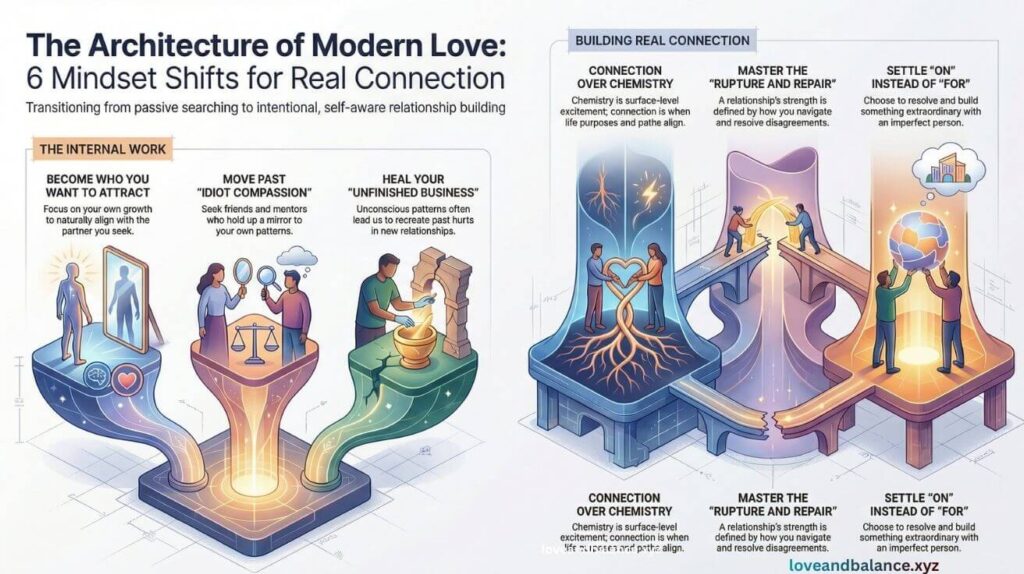
The Architecture of Modern Love: 6 Mindset Shifts for Real Connection
How to stop passively searching and start intentionally building the relationship you actually deserve
There’s a quiet exhaustion spreading through modern dating — and if you’ve felt it, you’re not imagining it.
You open the app. You swipe. You match. You chat for three days, maybe meet once, maybe not at all. Then the whole cycle restarts, and somehow, despite being “connected” to hundreds of people, you’ve never felt more alone in your search for love.
Here’s what nobody tells you: the problem isn’t your profile. It’s your approach.
According to a Forbes Health survey, 78% of dating app users report feeling burnt out — with Gen Z (79%) and Millennials (80%) leading the exhaustion chart. Meanwhile, Tinder lost over 594,000 users in 2024 alone. People aren’t giving up on love — they’re giving up on a passive way of finding it. And that shift? It’s the most important relationship move you’ll ever make.
Welcome to the architecture of modern love — where real connection isn’t found, it’s built — and it starts with how you think before you even go on a first date.
Why “Searching” Is Keeping You Single
Most people approach love like they’re shopping on Amazon. Browse. Filter. Add to cart. Return if unsatisfactory.
It feels efficient. But it’s not working.
Passive searching puts the focus entirely outside of you — on whether the other person is attractive enough, successful enough, or emotionally available enough. You become a judge, not a participant. And the deeper issue? You never actually examine what you yourself are bringing to the table.
New research published in January 2026 by The Times of India found that 68% of Indian singles paused in 2025 to evaluate their dating habits before moving forward — a major cultural signal that the era of mindless swiping is giving way to something more purposeful. Clear communication (40%), being respectful and reliable (35%), and consistent follow-through (24%) were the behaviours singles said they valued most going into 2026.
The world is waking up to something therapists and psychologists have known for years: the quality of your relationship begins with the quality of your inner architecture.
Let’s rebuild it — brick by brick.
Shift 1: From “Am I Their Type?” to “Are They Aligned with My Life?”
The first and most seductive trap in dating is the question: Will they like me?
You spend hours crafting the perfect bio, choosing the most flattering photo, thinking of a witty opening line — and the entire mental exercise is centred on their approval. This is passive searching in its purest form. You’re auditioning for someone else’s standards instead of defining your own.
Intentional dating flips this completely. Before you ask if someone will choose you, ask if you would choose them — not for surface chemistry, but for long-term alignment.
Consider the real story of Priya, a 28-year-old marketing professional from Mumbai who spent two years on dating apps before stepping back in 2023. “I realised I was so busy trying to seem perfect that I never once asked whether the guy actually matched what I wanted in life. I was performing, not connecting,” she shared. When she started dating intentionally — defining her values around emotional maturity, shared ambition, and a desire for family — she found her now-fiancé within seven months. Not because she got lucky, but because she knew exactly what she was looking for.
A 2025 study on romantic motivations confirms this: people who date with clear relational goals report significantly higher satisfaction and lower emotional distress than those who date ambiguously or out of loneliness.
Practical shift: Before every new connection, write down three non-negotiables and three dealbreakers. Not physical ones — values-based ones. Let that list guide your attention, not just your feelings.
Shift 2: From Performing to Revealing
There’s a reason so many first dates feel like job interviews. Both people are “on” — showing the best version of themselves while carefully concealing anything that might seem too much, too damaged, or too real.
This is an emotional performance, and it is the single biggest killer of genuine connection.
A landmark study by Amy Brunell at Ohio State University found that people who reported being more “true to themselves” also reported significantly more positive dating relationships. Authenticity led to more intimacy-building behaviour, fewer secrets, and greater relationship satisfaction for both men and women. In other words, the willingness to reveal — not just impress — is what creates the kind of connection that actually lasts.
Think about the last time someone was radically honest with you on a date. Maybe they admitted they were still healing from something. Maybe they confessed they didn’t have their life entirely figured out. Chances are, it made you more interested, not less — because it felt real.
Practical shift: On your next date or in your next conversation, share one thing that’s genuinely vulnerable — something you’re still working on, something you’re unsure about. Watch how it changes the energy in the room.
Shift 3: From Attachment Anxiety to Secure Self-Concept
Here’s where it gets psychological — and deeply important.
Attachment theory, developed by John Bowlby and later expanded by researchers like Mary Ainsworth, suggests that our earliest experiences with caregivers create internal “blueprints” for how safe we feel in close relationships. These blueprints follow us into adult dating — often without us realising it.
People with anxious attachment tend to date reactively. They over-invest early, read into every message, and spiral when someone pulls away. People with avoidant attachment, on the other hand, self-sabotage intimacy the moment things start to feel real. Both styles are forms of passive relationship behaviour — responding to old fears rather than choosing from a grounded place.
A 2025 peer-reviewed study found that developing self-awareness and emotional regulation significantly improved relationship satisfaction and psychological well-being. Another 2025 study tracking 121 couples across 21 days found that people higher in avoidance consistently reported lower relationship satisfaction — and so did their partners. The data is clear: unexamined attachment patterns cost you connection.
The mindset shift here is profound: you stop dating from a place of fear and start dating from a place of clarity. You don’t need every date to “work out” to feel okay. You can be disappointed without being devastated. You can like someone without losing yourself.
Practical shift: Look up your attachment style (there are free, validated quizzes online). Then ask yourself: In my last three connections, was I responding to this person — or to an old wound?
Shift 4: From Chemistry-First to Values-First
Chemistry is real. Chemistry is also wildly unreliable as a compass.
The problem with leading with chemistry is that it activates the same neurological reward system as addictive behaviour — dopamine, adrenaline, the intoxicating uncertainty of “will they text back?” You feel alive in a relationship that is, in fact, deeply unstable. And you feel bored in one that is calm and consistent — even if that calm relationship is genuinely healthy.
A 2024 eHarmony study found that 61% of singles felt more emotionally safe when dating with clear intent rather than chasing electric chemistry. Emotional safety, it turns out, is the soil in which real love grows.
The intentional dating movement — now being called a “revolution” rather than a trend by relationship experts and media alike — places shared values, communication styles, and life vision above butterflies and physical attraction as primary compatibility markers.
Real love stories built on this model look different. They start slower. They feel quieter. They grow bigger.
Practical shift: After a first meeting, ask yourself: Do I feel calm and respected with this person, or do I feel anxious and electrified? One is chemistry. One might be connected. Know the difference.
Shift 5: From Waiting to Be Chosen to Actively Choosing
This is the mindset shift that changes the entire power dynamic of your love life.
Most passive daters are in a permanent state of waiting — waiting to see if they’ll get a match, waiting for a reply, waiting to find out if this person “likes them back.” The locus of control sits entirely with the other person. And when it doesn’t work out, the conclusion is always the same: I wasn’t chosen. Something is wrong with me.
Psychology Today, citing research published in October 2025, highlights that having an internal locus of control — taking accountability for your own behaviour and growth — is one of the most powerful predictors of relationship health. People who recognised their own need for change and acted on it showed measurably healthier relationship patterns than those who continued blaming external factors.
Actively choosing means deciding what kind of partner you want to be — not just what kind of partner you want to find. It means showing up fully, communicating honestly, and ending connections that don’t align with your values — not waiting to be “let go.”
Practical shift: After every romantic encounter, spend five minutes journalling from a position of agency: What did I bring? What do I want to bring more of? What do I want less of — in myself, not just in them?
Shift 6: From Destination Thinking to Process Thinking
“I just want to find my person.”
It’s the most common sentence in modern dating — and it’s also the one that causes the most pain. Because it frames love as a destination you arrive at, rather than a practice you deepen over time.
Destination thinking turns every date into a pass/fail test. Every unanswered message becomes evidence of failure. Every breakup feels like a wrong turn. It makes dating exhausting, high-stakes, and emotionally draining.
Process thinking is radically different. It understands that every connection — even the ones that end — teaches you something about yourself. The person who didn’t text back helped you notice how quickly you spiral. The situationship that dragged on for eight months taught you that you don’t enforce boundaries under emotional pressure. These aren’t failures. They are data points in your self-architecture.
A QuackQuack survey of Indian Gen Z daters found that 39% believe mindful, slow-paced dating leads to better matches because it is “more researched and thought out, leaving less room for error in judgment”. The shift isn’t just emotional — it’s strategic.
When you treat love as a process of growing into the partner you want to be, something unexpected happens: you become someone who attracts the kind of love you actually want.
Practical shift: Reframe your dating mantra. Instead of “I’m looking for someone”, try “I’m becoming someone.” Watch how that single word change shifts your energy in every conversation.
The Bigger Picture: You Are the Architecture
Modern love isn’t falling apart — it’s evolving.
The fact that 78% of people are burned out on passive swiping doesn’t mean love is harder to find. It means the old infrastructure no longer works. People are hungry for something more real, more honest, more grounded. And they’re slowly realising that the renovation doesn’t start with their profile — it starts with their psychology.
Each of these six mindset shifts is a structural change. Together, they don’t just change how you date. They change who you are when you date — and that changes everything.
The architecture of modern love isn’t built by luck. It isn’t built by algorithms. It’s built by people who chose — consciously, deliberately, and with full self-awareness — to show up differently.
That person can be you. Starting today.
The Architecture of Modern Love: 6 Mindset Shifts for Real Connection
Frequently Asked Questions (FAQs)
Q1. What is intentional dating, and how is it different from regular dating?
Intentional dating means approaching relationships with a clear sense of your values, boundaries, and long-term vision — rather than passively swiping and hoping for the best. While traditional dating often starts with physical attraction or convenience, intentional dating prioritises emotional alignment, honest communication, and self-awareness from the very first interaction.
Q2. How do I know if I’m a passive dater?
Some clear signs include: always waiting for the other person to set the pace, not knowing what you actually want in a partner, repeatedly ending up in the same type of unfulfilling relationship, feeling anxious after most dates, or defining your romantic worth by whether or not someone chooses you back. If any of those feel familiar, this blog was written for you.
Q3. Can mindset shifts really change my relationship outcomes?
Yes — and the research backs this up. Studies consistently show that self-awareness, authenticity, and emotional regulation are directly linked to higher relationship satisfaction. Mindset shifts don’t guarantee a perfect partner, but they dramatically improve the quality of your connections and your emotional experience within them.
Q4. What if I try to be intentional and the other person isn’t?
This is actually the point. When you date intentionally, you can identify very early whether someone else shares your level of emotional maturity and clarity. Instead of spending months in a confusing grey zone, you’ll have the self-awareness to recognise a mismatch and the confidence to move on without it wrecking your sense of worth.
Q5. Is this approach relevant for people who are already in a relationship?
Absolutely. Intentionality doesn’t stop at the “getting together” stage. All six shifts — especially moving from performance to revelation, and from destination to process thinking — apply equally to long-term partners. In fact, research shows couples who consistently maintain emotional authenticity and internal accountability report significantly better long-term satisfaction.
Q6. How long does it take to shift from passive to intentional dating?
There’s no fixed timeline — this is personal work, not a 30-day challenge. But most people who commit to self-reflection (journalling, therapy, or simply slowing down their dating pace) begin to notice a difference in their choices and emotional reactions within a few weeks. The goal isn’t to change overnight; it’s to grow steadily into someone who relationships with rather than someone who searches for.
Q7. I’m an introvert and find dating exhausting. Is intentional dating even harder?
Actually, intentional dating tends to suit introverts better. It replaces the volume-based approach (more dates, more apps, more options) with a depth-based approach — fewer, more meaningful conversations and connections. For people who are drained by surface-level small talk, slowing down and dating with purpose can feel like a massive relief.
If this resonated with you, share it with someone who needs to hear it — and drop your thoughts in the comments. What mindset shift feels most relevant to your journey right now?