
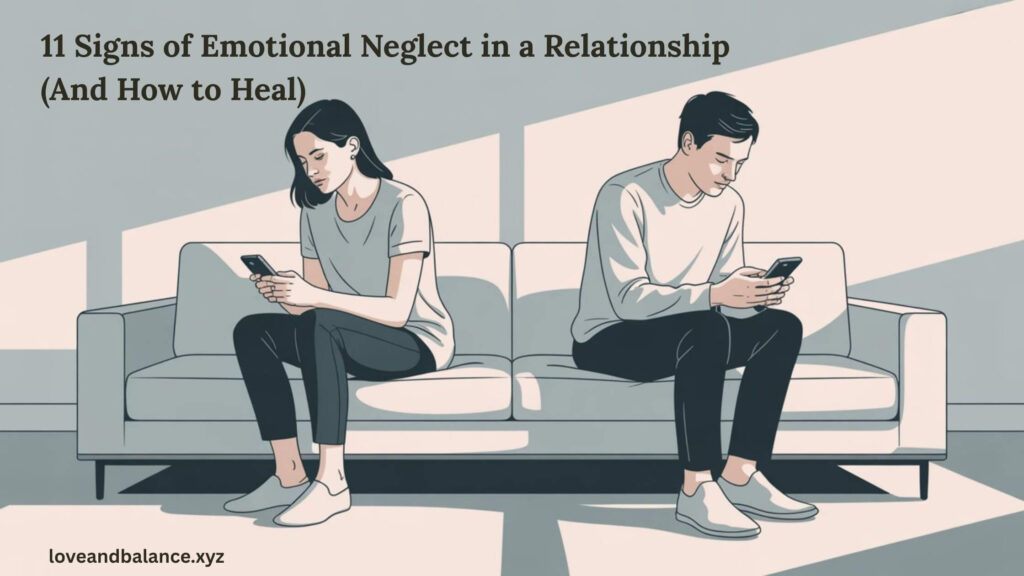
11 Signs of Emotional Neglect in a Relationship (And How to Heal)
Emotional neglect in relationships is the silent relationship killer that often goes unnoticed until it’s too late. Unlike dramatic fights or obvious betrayals, emotional neglect operates in the shadows—a slow erosion of connection that leaves partners feeling alone even when they’re together. Recent research from 2025 reveals that emotional neglect is linked to psychological consequences including self-blame, isolation, diminished self-esteem, and hopelessness about the relationship. If you’ve been feeling invisible in your own relationship, you’re not alone, and understanding these warning signs is the first step toward healing.
What Is Emotional Neglect in a Relationship?
Emotional neglect in a relationship occurs when one partner consistently fails to respond to the other’s emotional needs. It’s not about what happens—it’s about what doesn’t happen. It’s the absence of emotional awareness, validation, and responsiveness that creates a void where connection should exist.
A 2025 study published in academic journals found that emotional neglect is a pervasive and underrecognized dynamic that contributes significantly to communication breakdowns and psychological distress. The research emphasizes that this issue isn’t limited to any particular demographic—it affects couples across all socioeconomic backgrounds.
Think of Sarah and Michael’s story: After 12 years of marriage, Sarah realized she couldn’t remember the last time Michael asked her how she truly felt about anything. When she got a promotion at work, his response was a distracted “that’s nice” before returning to his phone. When her father was diagnosed with cancer, he offered practical solutions but never asked how she was coping emotionally. Sarah wasn’t being abused or mistreated in obvious ways—she was being emotionally ignored, and it hurt just as deeply.
11 Signs of Emotional Neglect in a Relationship
1. You Feel Lonely Even When You’re Together
One of the most telling signs of emotional neglect is experiencing profound loneliness despite being in a relationship. You can be sitting right next to your partner on the couch, yet feel completely alone. This isn’t occasional distance—it’s a persistent feeling that you’re emotionally isolated even in your partner’s presence.
Research shows that couples experiencing emotional neglect often describe feeling like they’re living parallel lives rather than sharing one. You might go through the motions of daily life together—sharing meals, sleeping in the same bed, managing household tasks—but the emotional intimacy that makes a relationship meaningful is absent.
2. Your Partner Doesn’t Notice When Something’s Wrong
In emotionally healthy relationships, partners are attuned to each other’s emotional states. They notice when something’s off, even when you haven’t said anything. But in emotionally neglectful relationships, you could be falling apart inside, and your partner wouldn’t notice—or wouldn’t respond if they did.
Jessica shared her experience: “I was going through severe anxiety about losing my job. For three weeks, I barely slept, was crying regularly, and couldn’t eat properly. My partner never once asked if I was okay. When I finally broke down and told him, he seemed surprised and said, ‘You should have said something.’ But the signs were everywhere—he just wasn’t paying attention.”
3. Your Feelings Are Consistently Dismissed or Minimized
When you try to express your emotions, does your partner respond with phrases like “you’re overreacting,” “it’s not a big deal,” or “you’re too sensitive”? This is emotional invalidation—a core component of emotional neglect. Your feelings are not recognized or accepted as valid, leaving you feeling unseen and unheard.
A 2025 study identified emotional invalidation as a pattern where partners are left feeling unimportant to their loved ones. Over time, this dismissal teaches you to suppress your emotions, creating even more distance in the relationship.
4. Conversations Remain Stubbornly Surface-Level
If your conversations rarely venture beyond logistics, schedules, and practical matters, emotional neglect may be at play. You talk about what to have for dinner, who’s picking up the kids, or what bills need paying—but never about hopes, fears, dreams, or feelings.
Research shows that emotionally neglectful partners often avoid topics that might lead to emotional conversations. This creates what therapists call “roommate syndrome,” where couples function as household managers rather than intimate partners.
5. You’re Not Each Other’s Go-To Person
In healthy relationships, your partner is typically the first person you want to share news with—good or bad. But when emotional neglect is present, you find yourself turning to friends, family members, or even acquaintances before your partner. You’ve learned, either consciously or unconsciously, that your partner won’t provide the emotional response you need.
Mark realized this pattern when he got promoted: “I called my sister first, then my best friend, then posted on social media. It was only the next day that I casually mentioned it to my wife. I didn’t even realize I’d done it until she pointed it out. The truth is, I knew she wouldn’t really celebrate with me—she’d just say ‘congratulations’ and move on.”
6. Emotional Unavailability Has Become the Norm
Your partner seems distant, preoccupied, or unresponsive to your emotional needs on a regular basis. They’re physically present but emotionally checked out. When you try to connect, you’re met with distraction, disinterest, or detachment.
Clinical observations show that emotional unavailability manifests as disengaged listening, suppression of emotional expression, and emotional detachment—all core aspects of emotional neglect. This unavailability isn’t occasional stress; it’s a consistent pattern that defines the relationship.
7. Physical Affection Has Disappeared
While not every couple is equally affectionate, a noticeable decline or absence of physical touch often accompanies emotional neglect. Hugs, kisses, hand-holding, and intimate moments become rare or nonexistent. Research confirms that emotional connection is the foundation of physical intimacy—without it, physical affection becomes mechanical or disappears entirely.
This isn’t just about sex (though that often diminishes too). It’s about the small touches throughout the day that signal “I see you, I love you, you matter to me.” When emotional neglect sets in, these touches fade away.
8. Your Partner Uses Withdrawal as Punishment
Some partners employ emotional withdrawal as a form of control or punishment. When they’re upset, they shut down completely, giving you the silent treatment instead of communicating. This creates an emotionally unsafe environment where you’re walking on eggshells, afraid to upset them and trigger another period of cold detachment.
Research from 2025 identified verbal withdrawal as a key ineffective communication pattern in marriages affected by emotional neglect. This pattern undermines emotional safety and communicative trust, making it nearly impossible to resolve conflicts constructively.
9. Your Needs Are Consistently Deprioritized
If your partner consistently puts others’ needs—work obligations, friends, extended family, hobbies—above yours, that’s a sign of emotional neglect. While healthy relationships involve balancing multiple priorities, emotional neglect occurs when your needs are always at the bottom of the list.
Recent studies found that couples reporting demand/withdraw patterns (where one partner makes requests and the other withdraws) or mutual avoidance patterns experienced greater negative emotions, lower positive emotions, and even slower physical wound healing. The body keeps score of emotional neglect.
10. You’ve Lost Touch with Your Own Emotions
A particularly insidious effect of prolonged emotional neglect is that you begin to lose touch with your own feelings. When your inner world is consistently ignored, you start doubting whether your emotions are valid or important. You might struggle to identify what you’re feeling or believe you’re “too needy” or “too emotional”.
Psychology research shows this pattern is especially common when both partners experienced childhood emotional neglect. They may not realize emotional connection is missing because it’s something they never experienced—making them more vulnerable to seeking that connection elsewhere.
11. Attempts to Address Issues Lead Nowhere
Perhaps the most frustrating sign is when you try to address the emotional distance, but your concerns are denied, dismissed, or met with defensiveness. Your partner might say there’s no problem, that you’re imagining things, or that you’re asking for too much. These conversations go in circles, leaving you feeling helpless and more alone than before.
A key distinction in relationship research is this: if your spouse acknowledges the distance when you bring it up and shows willingness to work on reconnecting, there’s hope. But if the pattern has been consistent over months or years, your spouse denies there’s a problem, and bringing it up makes things worse—you’re dealing with genuine emotional neglect.
The Real Impact of Emotional Neglect
Psychological Consequences
Emotional neglect doesn’t just hurt feelings—it causes measurable psychological damage. Research consistently shows links between emotional neglect and depression, anxiety disorders, loss of self-esteem, and decreased overall well-being.
When your feelings consistently go unacknowledged, you start believing they don’t matter. This erosion of self-worth can lead to loss of identity, as you become disconnected from your own preferences, desires, and sense of self.
Physical Health Effects
The impact extends beyond mental health. Studies show that couples with more negative communication patterns (including emotional neglect) experienced higher baseline inflammatory markers, slower wound healing, and greater stress responses. Your body literally responds to emotional neglect with increased inflammation and decreased immune function.
Common physical symptoms include headaches, stomach problems, insomnia, and other stress-related conditions. The mind-body connection means that emotional pain manifests as physical pain.
Relationship Consequences
Left unaddressed, emotional neglect becomes a self-perpetuating cycle. It creates communication breakdowns, undermines emotional safety, and destroys communicative trust. Many couples eventually find themselves in what becomes a loveless marriage—still together but without the warmth and connection that makes marriage meaningful.
Perhaps most concerning, research shows that emotional neglect in a primary relationship can make emotional affairs more likely. When people are starved for emotional connection, they become vulnerable to seeking it elsewhere.
How to Address Emotional Neglect
Recognize the Pattern
The first step is acknowledging that what you’re experiencing is real and valid. Emotional neglect can be invisible to everyone, including sometimes the couple themselves. Give yourself permission to name the problem.
Open Communication Without Blame
If you’re ready to address the issue, approach your partner with vulnerability rather than accusation. Try saying something like: “I’ve been feeling disconnected from you lately, and I want to work on rebuilding our emotional connection. Can we talk about this?”
Research emphasizes that open communication is key—talk about your feelings, fears, and needs without blame. For example, if you struggle with emotional detachment, you might say, “I’m finding it hard to open up, but I want to try with you”.
Consider Professional Help
Couples therapy can help partners navigate emotional neglect together, teaching them how to support each other’s healing. A 2025 study underscores the importance of identifying emotional neglect in therapeutic settings and developing interventions that focus on emotional literacy, attunement, and trust-building.
Individual therapy can also be valuable, especially if childhood emotional neglect is affecting your adult relationships. Many adults who experienced emotional neglect as children struggle with emotional detachment, people-pleasing tendencies, fear of vulnerability, and attachment issues in their adult relationships.
Build Emotional Skills Together
If both partners are willing, work on developing emotional literacy—the ability to identify, express, and respond to emotions effectively. This might involve:
Setting aside regular time for meaningful conversations
Practicing active listening without judgment
Learning to validate each other’s feelings even when you don’t fully understand them
Expressing appreciation and affection consistently
Checking in with each other emotionally, not just logistically
Know When to Leave
Sometimes, despite your best efforts, the relationship cannot be repaired. If your partner refuses to acknowledge the problem, shows no willingness to change, or the emotional neglect has caused too much damage, it may be time to consider ending the relationship. Your emotional needs are valid, and you deserve a partner who sees you, hears you, and values your inner world.
FAQs About Emotional Neglect in Relationships
Q: Is emotional neglect the same as emotional abuse?
A: While both are harmful, they’re different. Emotional abuse involves active behaviors intended to control, manipulate, or harm (such as name-calling, threats, or deliberate humiliation). Emotional neglect is characterized by what’s absent—the lack of emotional responsiveness, validation, and connection. However, both can cause significant psychological damage and warrant serious attention.
Q: Can a relationship recover from emotional neglect?
A: Yes, if both partners are willing to work on the issue. Recovery requires acknowledgment of the problem, commitment to change, development of emotional skills, and often professional guidance through couples therapy. Research shows that couples can rebuild emotional connection through improved communication, emotional literacy, and consistent effort at attunement.
Q: How do I know if I’m being emotionally neglectful toward my partner?
A: Ask yourself: Do I regularly check in on how my partner is feeling? Do I notice and respond when something seems wrong? Do I validate their emotions even when I don’t fully understand them? Am I emotionally available and engaged during conversations? Do I prioritize our emotional connection? If you’re answering “no” to these questions, you may be unintentionally neglecting your partner’s emotional needs.
Q: Why do people emotionally neglect their partners?
A: Often, emotional neglect stems from childhood emotional neglect—people who didn’t receive emotional attunement as children may not know how to provide it as adults. Other causes include unaddressed mental health issues, stress, relationship patterns learned from parents, fear of vulnerability, lack of emotional skills, and sometimes simply not recognizing the importance of emotional connection.
Q: What’s the difference between needing space and emotional neglect?
A: Needing space is temporary, communicated clearly, and doesn’t involve dismissing your partner’s feelings. It’s situation-specific and followed by reconnection. Emotional neglect is a consistent pattern over months or years where emotional needs are routinely dismissed, attempts to connect are rebuffed, and the disconnection seems to be the baseline rather than an exception.
Q: Can emotional neglect cause depression?
A: Yes. Research shows clear links between emotional neglect and mental health issues including depression and anxiety disorders. When your emotions are consistently invalidated and you feel chronically alone in your relationship, it can lead to decreased self-esteem, loss of identity, and clinical depression.
Q: Should I give my partner an ultimatum about the emotional neglect?
A: Rather than an ultimatum, start with clear, honest communication about your needs and how the emotional neglect is affecting you. If your partner acknowledges the issue and shows genuine willingness to work on it, give the process time with appropriate support (like couples therapy). However, if they deny the problem, refuse to engage, or nothing changes despite your efforts, you may need to make difficult decisions about whether the relationship can meet your needs.
Q: How long does it take to heal from emotional neglect in a relationship?
A: The timeline varies significantly depending on how long the neglect has occurred, the willingness of both partners to address it, whether professional help is involved, and individual factors. Some couples notice improvements within a few months of focused effort, while deeper healing may take a year or more. Individual therapy can help you process the impact even if the relationship doesn’t continue.
11 Signs of Emotional Neglect in a Relationship (And How to Heal)
Final Thoughts
Emotional neglect in relationships is more common than many people realize, but it doesn’t have to be permanent. Whether you’re experiencing these signs yourself or recognizing patterns you’ve created, awareness is the first step toward change. Your emotional needs aren’t excessive—they’re fundamental to human connection. You deserve a relationship where you feel seen, heard, valued, and emotionally connected. If your current relationship can’t provide that despite sincere efforts to repair it, know that choosing yourself isn’t selfish—it’s necessary.
Remember, healing is possible, whether that means healing together with your partner or healing yourself as you move forward to healthier relationships. The most important thing is to stop accepting emotional neglect as normal and start building the emotionally fulfilling life you deserve.